
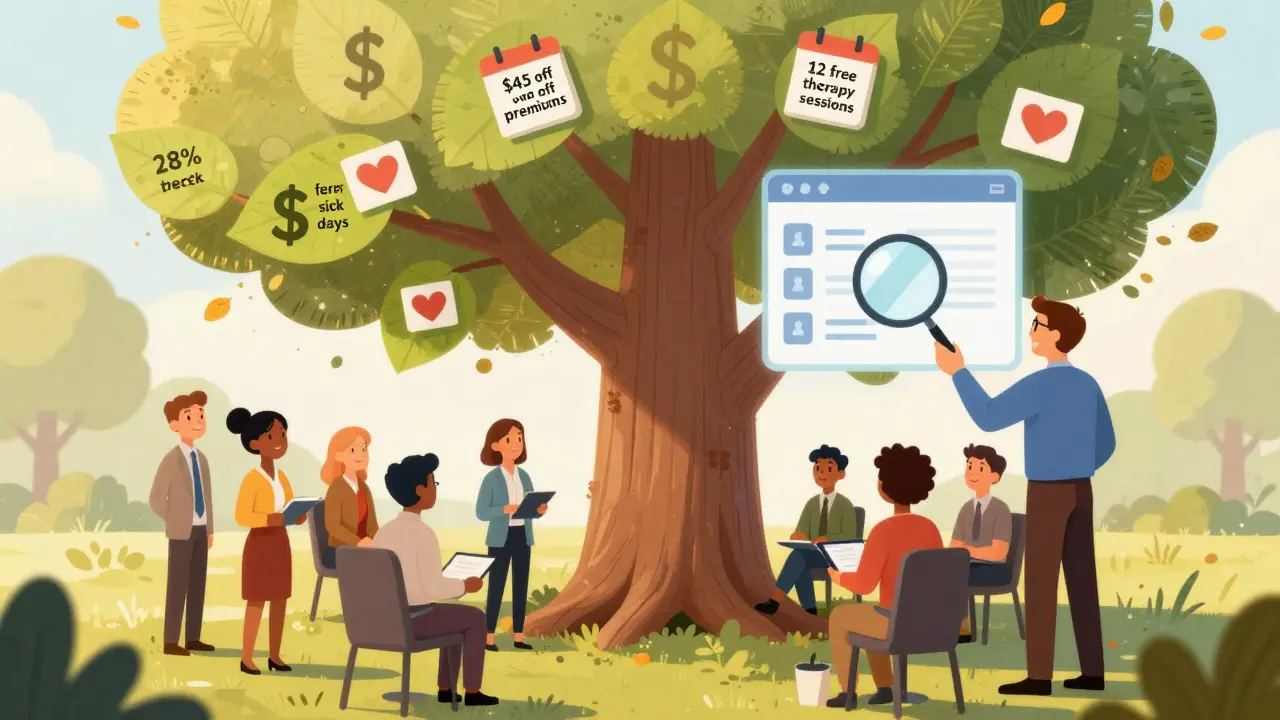
Most companies think they’re doing enough for employee wellness by offering gym discounts or annual flu shots. But if your staff doesn’t understand why these programs matter - or how they directly affect their paychecks, stress levels, or workdays - participation drops fast. In fact, 68% of disengaged employees say they simply don’t get how wellness activities connect to real benefits. That’s not a program failure. It’s an education failure.
Why Generic Messages Fail
Sending out a generic email that says "Join our wellness program!" is like handing someone a key to a house they don’t know exists. They won’t use it. Companies that rely on vague slogans like "Be healthier!" or "Feel better at work!" see engagement rates below 19%. That’s not because employees are lazy. It’s because those messages don’t answer the question they’re really asking: What’s in it for me? The data is clear. When employers use personalized benefit statements - showing employees exactly how much they could save on premiums, reduce sick days, or avoid presenteeism - participation jumps to 68%. One company on Reddit reported a 105% increase in sign-ups after switching from bland newsletters to individualized reports showing projected savings based on their health data. People don’t respond to buzzwords. They respond to numbers that hit home.What Employees Actually Care About
Forget the myth that employees care mostly about physical health. According to PwC’s 2024 Employee Financial Wellness Survey, 68% of workers rank financial stress as their top concern - higher than sleep, diet, or exercise. That’s why the latest wellness programs now include financial coaching, debt management tools, and retirement planning as core components. The WELCOA 7 Dimensions model, updated in January 2025, now requires 20% more content on financial wellbeing for good reason: when employees feel secure about money, they’re 34% more likely to engage in other wellness activities. Mental health is another big one. Nearly half of employees don’t understand what mental health benefits even cover. After the CDC updated its Work@Health Program in March 2024 to include clearer mental health messaging, participation in counseling services rose by 47% in participating companies. Employees aren’t ignoring these benefits - they’re confused by them. A simple explanation like "You get 12 free therapy sessions per year with no copay" works better than a brochure titled "Mindfulness Matters."The Business Case They Need to Hear
Employees don’t care about ROI for the company. But they do care about how wellness affects their lives. Here’s how to translate corporate benefits into personal value:- Lower premiums: Employees in programs with strong education saw 22% lower healthcare claims on average, according to Strive Well-Being’s 2023 reports. That means smaller monthly deductions.
- More paid time off: Educated employees take 28% fewer sick days. That’s extra vacation days you didn’t have to ask for.
- Less burnout: Companies using multi-channel education (email, manager talks, intranet) saw 27% higher engagement. That means fewer meetings where everyone’s drained and distracted.
- Higher retention: Employers with strong wellness education had 11% lower turnover. That means your coworkers stay longer - and you don’t have to train new people every year.
Don’t just say "Wellness saves money." Say: "If you join the walking challenge and complete 80% of your steps this quarter, your health insurance premium could drop by $45 a month next year. Here’s how we calculated that for you."

How to Do It Right: The 5-Step Plan
You don’t need a big budget. You need a clear plan.- Survey first: Ask employees what they want. Use anonymous tools to find out if they care more about mental health, financial help, or fitness. Don’t guess. The CDC’s Work@Health Program says needs assessments are the first step - and most companies skip it.
- Explain the "why" in plain language: Replace corporate jargon with real-life examples. Instead of "reduce presenteeism," say "When you’re less stressed, you’ll actually enjoy your workday and get more done without burning out."
- Use multiple channels: One email won’t cut it. Combine manager huddles, short videos on the intranet, printed benefit cards, and personalized dashboards. Personify Health found 53% higher engagement when using four channels versus one.
- Show, don’t just tell: Use real data from your own workforce. "Last year, employees who joined our stress management program reduced their sick days by 30%. You could too."
- Update regularly: Wellness isn’t a one-time launch. The EEOC reported 2,147 complaints in 2023 - many because benefits changed without clear communication. Keep employees in the loop.
What Goes Wrong - And How to Avoid It
The biggest mistake? Overpromising. A Trustpilot review from July 2024 called out a vendor that claimed employees would save $1,200 a year - but the actual savings were $217. That’s not just misleading. It destroys trust. Be honest. Say: "Based on data from similar companies, most participants save between $150 and $400 annually on healthcare costs. Your results may vary."Another problem: small businesses. Only 38% of companies with fewer than 50 employees offer structured wellness education, according to the Bureau of Labor Statistics. Why? They think it’s too expensive. But you don’t need a $50,000 platform. Basic education modules start at $495 per employee per year. That’s less than $42 a month. Compare that to the cost of replacing one employee - which can be 50-200% of their salary.
And compliance? Don’t ignore it. The EEOC has strict rules about incentives. If you offer a discount for joining, it can’t exceed 30% of your health plan cost. And you can’t ask for genetic info or medical records without consent. Get certified. Use CCWS-trained staff. The cost of a single EEOC penalty? Up to $119,556 per employee.
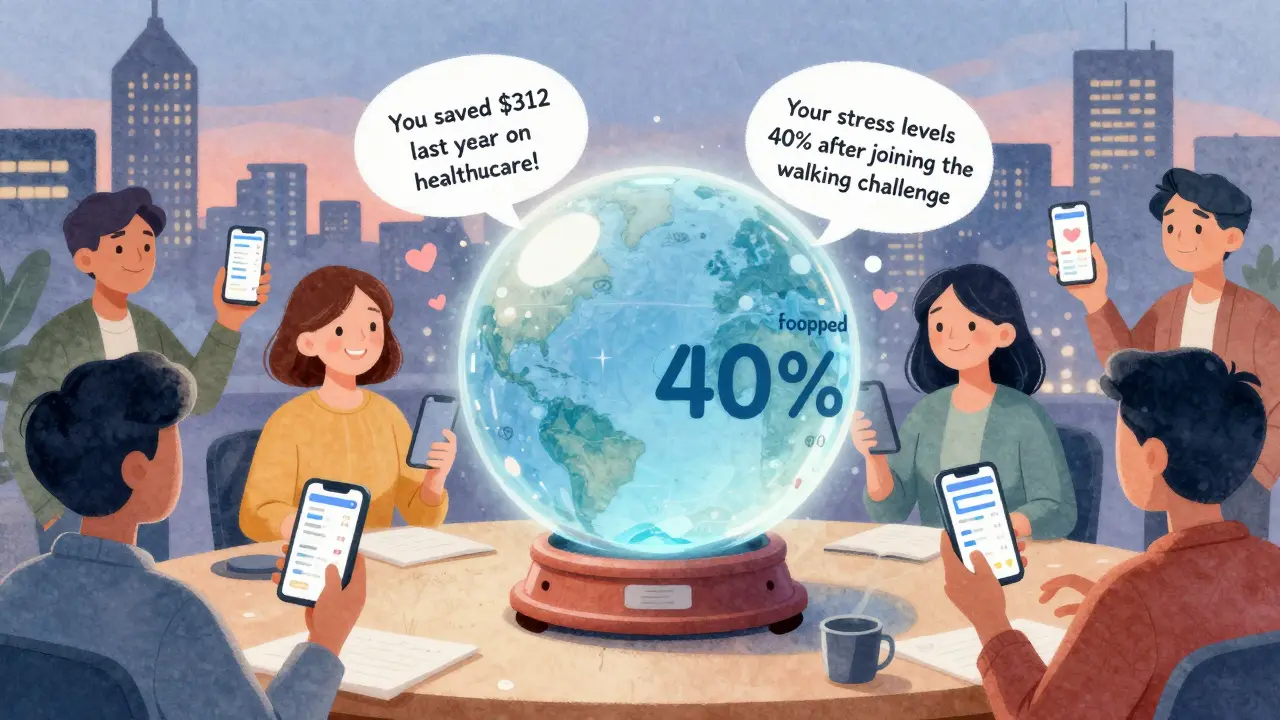
What’s Next? Personalization Is the Future
By 2026, Forrester predicts 45% of large employers will use AI to generate personalized wellness benefit statements - showing each employee exactly what they stand to gain. That’s not science fiction. It’s already happening. One company in Brisbane started using simple AI tools to analyze survey data and auto-generate tailored messages. Participation jumped 33% in six months.The future of workplace wellness isn’t about more programs. It’s about clearer, smarter communication. The companies that win won’t be the ones with the fanciest yoga mats or the biggest fruit baskets. They’ll be the ones who took the time to explain, in plain terms, why these benefits matter - to each person, on a personal level.
Why do most wellness programs fail to engage employees?
Most programs fail because they rely on generic messaging like "Be healthier!" without explaining how participation affects employees’ daily lives. Employees need to see a direct link between the program and benefits they care about - lower premiums, fewer sick days, less stress, or better financial security. Without that connection, engagement stays below 19%.
What’s the biggest mistake companies make when educating employees about wellness?
The biggest mistake is overpromising results. Claiming employees will save $1,200 a year when the real savings are closer to $200 breaks trust. Instead, use real data from similar companies and say, "Most participants save between $150-$400 annually." Transparency builds credibility, not hype.
Do small businesses need a big budget to run a successful wellness education program?
No. Basic wellness education modules start at $495 per employee per year - less than $42 a month. You don’t need expensive platforms. Focus on clear communication: surveys, manager talks, simple emails, and personalized benefit summaries. Many small businesses skip this because they think it’s too costly, but the cost of losing one employee can be 10 times more.
What should wellness education include besides physical health?
Modern wellness education covers seven key areas: physical, emotional, social, financial, community, purposeful, and professional wellbeing. Financial stress is the #1 concern for employees - so include debt help, budgeting tools, and retirement planning. Mental health support is also critical, with 47% of employees misunderstanding what’s covered. Don’t just offer therapy - explain how to use it.
How can I measure if my wellness education is working?
Track participation rates, healthcare claim reductions, sick day usage, and employee feedback. Companies using strong education saw 22% lower healthcare claims, 28% fewer sick days, and 27% higher engagement. Also, survey employees: ask if they understand how the program benefits them. If 68% say no, it’s time to improve your messaging.
Is there legal risk in offering wellness programs?
Yes. The EEOC received 2,147 wellness-related complaints in 2023 - up 37% from the year before. Risks include asking for medical info without consent, offering incentives over 30% of health plan costs, or making participation feel mandatory. To avoid penalties (up to $119,556 per employee), use certified wellness specialists and follow EEOC guidelines. Always get legal review before launching.
What’s the ROI of workplace wellness education?
Harvard Business Review found an average ROI of $3.27 for every $1 spent on wellness programs - but only when education is strong. That return comes from lower healthcare costs, reduced absenteeism, higher productivity, and less turnover. The key is not the program itself, but whether employees understand it. Programs with poor communication often show no ROI at all.
How often should I update my wellness education materials?
At least once a year - but ideally every quarter. Benefits change. Regulations change. Employees’ concerns change. The CDC updated its Work@Health Program in March 2024 to add mental health communication. WELCOA updated its 7 Dimensions model in January 2025 to focus more on financial stress. If your materials haven’t changed in two years, they’re already outdated.


Gran Badshah
December 29, 2025 AT 12:27Bro, I work at a startup in Bangalore and we just rolled out a simple monthly finance chat with HR. No fancy app, just a 10-min Zoom where they show how much you’d save if you skip the coffee runs and use the mental health hotline. Participation went from 12% to 61%. People don’t want buzzwords. They want to know how it saves them cash or stops them from crying in the bathroom.
Also, stop calling it ‘wellness.’ Call it ‘not going broke while working.’
Ellen-Cathryn Nash
December 30, 2025 AT 20:19Oh my god. I’m so tired of companies pretending they care. They hand out yoga mats like they’re giving out free hugs and think that’s ‘wellness.’ Meanwhile, my coworker is maxing out her credit card to pay for insulin. This post? Finally someone gets it. Stop the performative crap. Give us actual numbers. Show us the math. Don’t tell us to ‘breathe deeper’ when our rent is 70% of our paycheck.
And if you’re not including financial literacy? You’re not helping. You’re gaslighting.
Samantha Hobbs
January 1, 2026 AT 09:50Y’all are overcomplicating this. I work in HR at a 40-person company. We stopped sending emails. Started putting little sticky notes on the coffee machine: ‘You got 12 free therapy sessions. No one will know you used them. Just click here.’
Within two weeks, 18 people signed up. No survey. No webinar. Just a sticky note and zero judgment. Sometimes the simplest thing works best.
Also, the ‘wellness’ word is dead. Say ‘mental health’ or ‘paycheck protection.’ Not ‘wellness.’
Nicole Beasley
January 2, 2026 AT 18:38OMG YES 😭 I work at a company that sent out a 12-page PDF called ‘Your Path to Holistic Vitality’ with zero numbers. I cried. Then I made a meme: ‘When your wellness program is more confusing than your ex’s text messages.’ Got 200 likes internally.
Then we switched to: ‘Join the walking challenge → $45 off your premium next year. Here’s your personal estimate.’ Boom. 80% participation.
Stop being corporate. Be human. 💬
sonam gupta
January 3, 2026 AT 01:39Julius Hader
January 4, 2026 AT 16:49I’ve seen this play out three times. Companies spend $50k on a wellness platform. Then they don’t train managers. Then employees think it’s optional. Then they blame the staff for ‘not caring.’
The real issue? Leadership doesn’t get it. If your CEO doesn’t talk about using their therapy sessions, why would you?
Start at the top. Walk the talk. No app can fix that.
Vu L
January 5, 2026 AT 09:4168% of employees don’t get it? Newsflash: maybe it’s because the program is garbage. I’ve been in three companies where wellness was just a cover for cutting health benefits. They replace a $200/month plan with a $150 plan and call the $50 difference ‘wellness savings.’
Don’t fool people. If you’re cutting costs and calling it wellness, you’re not educating. You’re scamming.
James Hilton
January 5, 2026 AT 15:29Let me get this straight. You spent 2,000 words telling companies to stop being boring.
And you didn’t say ‘just talk to people like humans.’
That’s the whole thing. That’s it. No AI. No dashboards. No surveys. Just a manager saying: ‘Hey, I used my free therapy last week. It helped. You should too.’
That’s all it takes.
Stop overengineering. Just be real.
Mimi Bos
January 6, 2026 AT 03:52so i just read this and i think its amazing but i think you missed something... like... what if people just dont want to talk about their money or mental health at work? like... maybe they just wanna do their job and go home? i know i do. maybe the real problem is we're forcing too much personal stuff into the workplace? just a thought 😅
Payton Daily
January 7, 2026 AT 01:15Let me break this down for you like you’re five. People don’t care about your ‘wellness programs’ because they’re not broken. They’re just tired. They’re overworked. They’re underpaid. You can’t fix systemic exploitation with a $42/month budgeting app.
Want real engagement? Give them a raise. Give them a four-day week. Give them union rights.
Stop trying to make them love your wellness program while you’re extracting 80-hour weeks from them. That’s not education. That’s gaslighting with a PowerPoint.
And if you think AI-generated personalized messages are the future? You’re not future-proof. You’re just late to the dystopia party.
Kelsey Youmans
January 7, 2026 AT 11:59While the intent of this initiative is commendable, one must not overlook the ethical and psychological implications of leveraging personal health data for incentive-based programs. The conflation of financial outcomes with behavioral compliance may inadvertently foster a culture of surveillance, wherein employees feel coerced into disclosing intimate health information under the guise of benevolence.
Furthermore, the EEOC’s regulatory framework must be strictly adhered to, as even minor deviations may precipitate class-action litigation. A more prudent approach would be to prioritize voluntary, opt-in educational frameworks devoid of quantifiable performance metrics tied to compensation.
Wellness, at its core, must be rooted in autonomy-not algorithmic nudging.
Sydney Lee
January 9, 2026 AT 11:53Let’s be brutally honest: this isn’t about education. It’s about cost-shifting. Companies are using ‘wellness education’ as a Trojan horse to offload healthcare costs onto employees. They’re not trying to help you-they’re trying to make you *pay less* while they pay *even less*. The real ROI? They save $3.27 for every $1 you spend on your own time, mental energy, and privacy.
And let’s not pretend this is about ‘personalization.’ AI-generated messages are just data mining dressed up as empathy. You’re not being helped-you’re being monetized.
If you want wellness, demand better wages. Demand better hours. Demand dignity. Not a $45 discount on your premium while your boss takes a $2M bonus.
This isn’t a solution. It’s a smirk.