
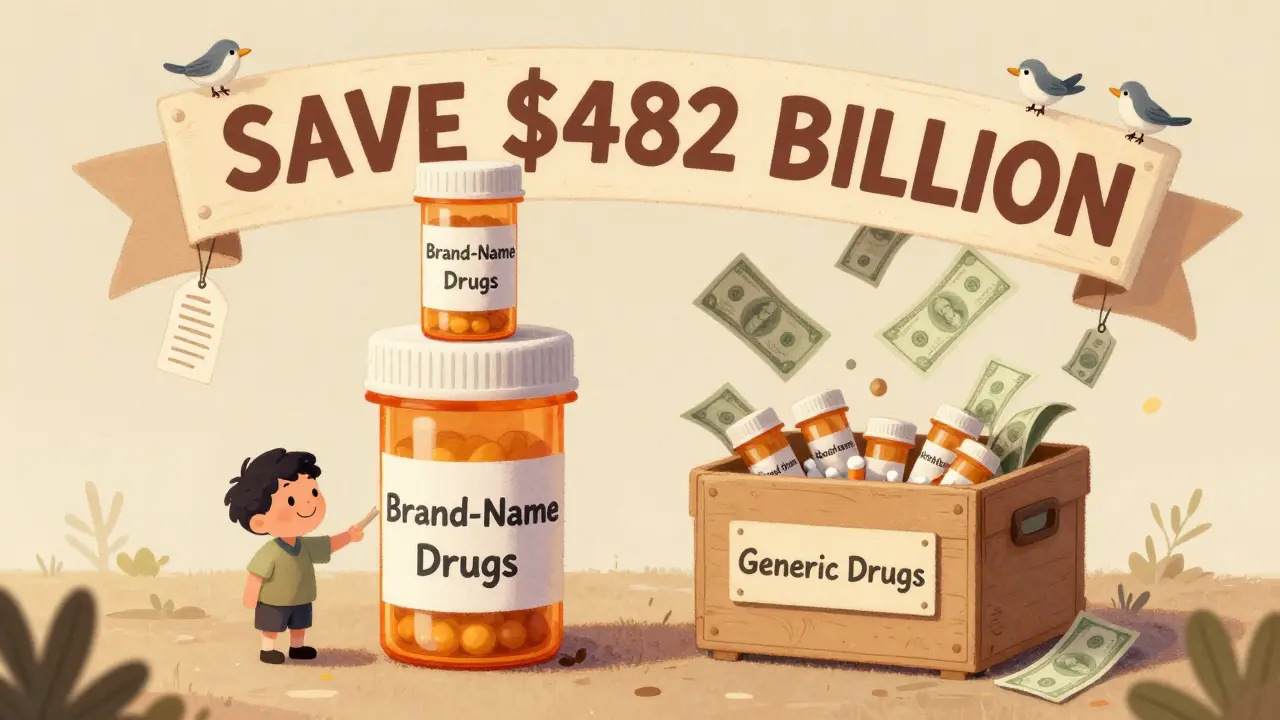
Every year, Americans spend over $700 billion on prescription drugs. But here’s the surprising part: 90% of all prescriptions filled are for generic medications - and they account for just 12% of that total spending. That means generics are the single biggest reason drug costs haven’t exploded even further. In 2024 alone, generic and biosimilar drugs saved the U.S. healthcare system $482 billion. That’s more than the entire annual budget of the Department of Education. And it’s not a fluke - it’s a pattern that’s been growing for a decade.
How Generics Save So Much Money
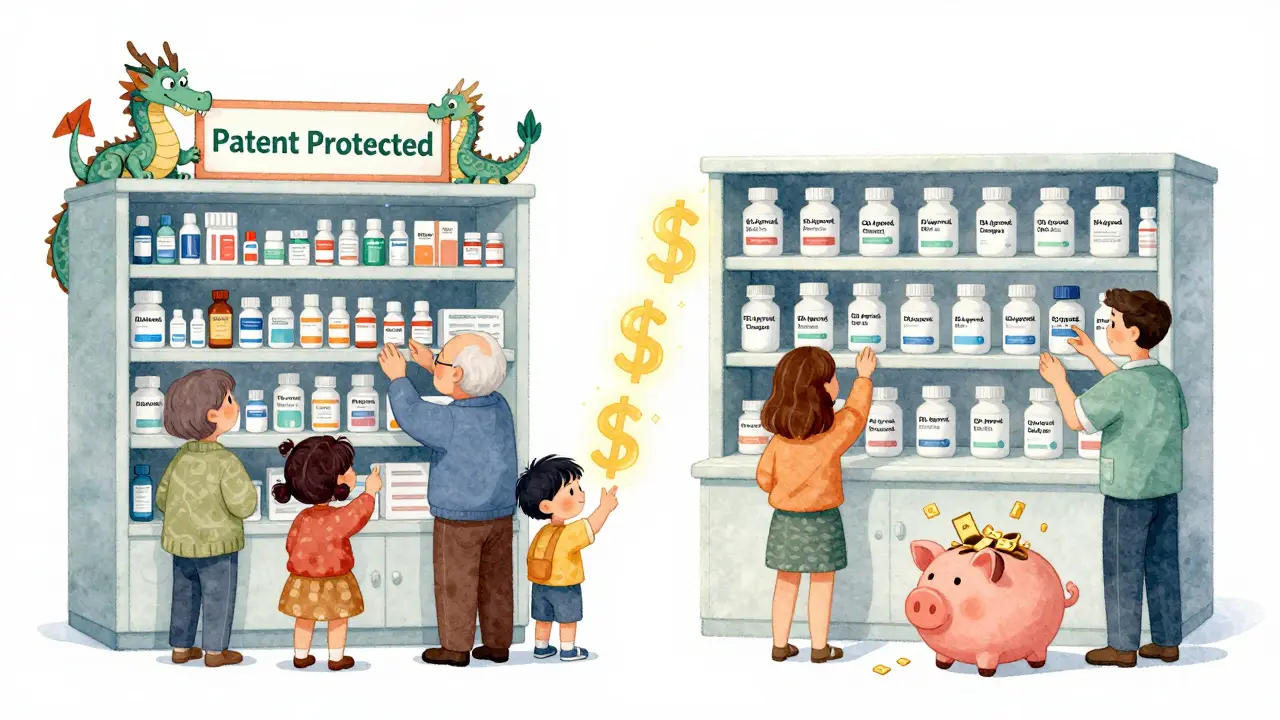
Brand-name drugs might look the same on the bottle, but their price tags tell a different story. In 2024, brand-name medications made up only 10% of prescriptions, yet they consumed 88% of total drug spending. That’s because brand-name companies hold patents that let them charge whatever they want - often $300, $500, or even $1,000 per month for a single medication. Once that patent expires, generics enter the market. These are chemically identical versions, approved by the FDA, but they cost 80-90% less.
Take Humira, the top-selling biologic drug for arthritis and autoimmune diseases. When it first launched, it cost over $70,000 a year. After biosimilars hit the market in 2023, the price dropped. By 2024, private-label strategies pushed biosimilar adoption from just 3% to 28%. That single shift saved health plans billions. The same thing is happening with Stelara, a $6 billion-a-year biologic. Seven biosimilars are now approved, priced more than 80% lower. Once fully adopted in 2026, they’re expected to save $4.8 billion annually.
It’s not just biologics. A common asthma inhaler like albuterol costs $150 without insurance. The generic version? $15. One Reddit user reported switching to generic albuterol saved them $300 a month. For millions of Americans living paycheck to paycheck, that’s the difference between taking their medicine and skipping doses.
The Hidden Cost of Delaying Generics
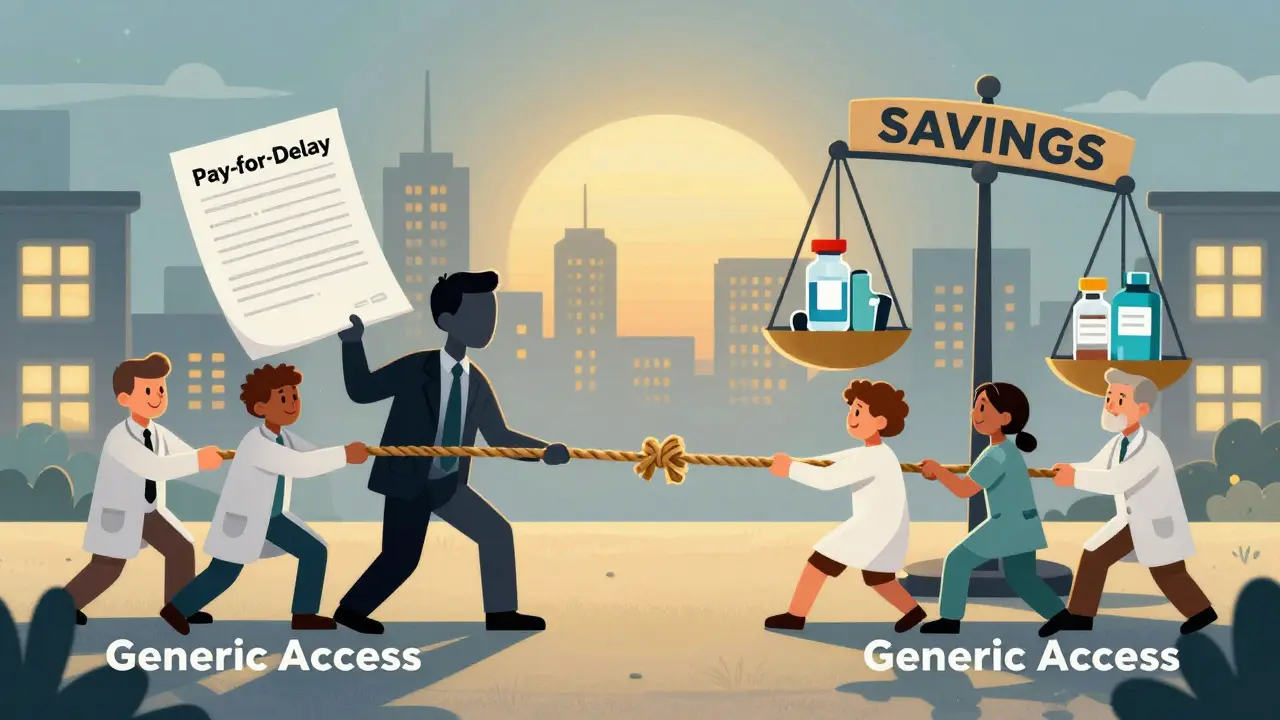
But here’s the dark side: brand-name drugmakers don’t always let generics in. They use something called “pay for delay” agreements. In simple terms, they pay generic companies to stay off the market. In 2024, these settlements totaled over $1.2 billion per year. That’s not just unethical - it’s illegal under antitrust law. Yet it still happens. These deals keep prices high, delay savings, and hurt patients.
Blue Cross Blue Shield found that these agreements are especially common for blockbuster drugs. One study showed that for every $1 billion in sales a brand-name drug makes, the company spends an average of $200 million to delay generics. That’s not innovation. That’s market manipulation.
And it’s not just small drugs. The biggest threat is coming from biologics - complex, injectable drugs used for cancer, diabetes, and autoimmune diseases. These are expensive to develop, and manufacturers extend their monopolies with clever patent stacking. The problem? 90% of biologics set to lose patent protection in the next 10 years have no biosimilar in development. That means $234 billion in potential savings could vanish before it even starts.
Why Medicare and Medicaid Are Key
Medicare Part D, the prescription drug program for seniors, is where these savings show up most clearly. In 2024, less than 1% of Medicare beneficiaries who hit the catastrophic coverage phase - the point where out-of-pocket costs skyrocket - used only generic drugs. That tells us one thing: high-cost brand-name drugs are the main reason seniors go broke on prescriptions.
The Inflation Reduction Act changed that. Starting in 2025, insulin costs are capped at $35 per month for Medicare beneficiaries. Eli Lilly, one of the biggest insulin makers, dropped its price from $275 to $25 per vial for non-branded versions. That’s not charity - it’s pressure. Public outrage, media coverage, and political action forced change. And it worked.
Now, the same strategy is being expanded. The White House has negotiated Most-Favored-Nation pricing with drugmakers like Eli Lilly and Novo Nordisk. Ozempic, which once cost $1,000 a month, is now $350. Wegovy dropped from $1,350 to $350. These aren’t generics - but they’re proof that price negotiation works. And if this model expands to all drugs, not just Medicare, the savings could hit $1 trillion over the next decade.
The Bigger Picture: What’s at Stake
Prescription drugs account for 10.3% of total U.S. healthcare spending. Without generics, that number would be closer to 18%. The generic industry supports 350,000 jobs across 46 states. It’s not just a cost-saver - it’s an economic engine. But there’s a gap. The FDA issued 1,247 Form 483 observations in 2024 - warning letters for manufacturing quality issues. That’s a red flag. If we want to keep saving billions, we need to fix the supply chain, not just the pricing.
Health plans are starting to act. PwC recommends three steps to boost biosimilar use: streamline prior authorization, pay fair prices for biosimilars, and support patient switching. Right now, many insurers still pay the same amount for a biosimilar as they do for the brand - even though the biosimilar costs half as much. That’s like paying full price for a knockoff designer bag. It doesn’t make sense.
The future of healthcare spending depends on two things: more generics and smarter policies. If we keep letting brand-name companies delay competition, we’ll keep paying more. But if we expand Medicare-style price negotiations, remove pay-for-delay loopholes, and invest in biosimilar development, we could cut total prescription drug spending by 15-18% by 2030. That’s over $100 billion in annual savings.
What Patients Can Do
You don’t need to be a policy expert to save money. Ask your pharmacist: “Is there a generic version?” If your doctor says no, ask why. Sometimes it’s a myth - like thinking generic thyroid meds aren’t as good. They are. The FDA requires them to be within 3% of the brand’s effectiveness. That’s tighter than the tolerance for two batches of the same brand.
Check GoodRx or SingleCare. They show cash prices for generics, often under $10. Even if you have insurance, the cash price is sometimes cheaper. And if you’re on Medicare, make sure you’re enrolled in a plan that covers your meds. The Part D doughnut hole is gone - but only if you use generics.
Patients who switch to generics report fewer skipped doses, lower medical bills, and less stress. One study found that patients on generics were 20% more likely to stick to their treatment plan. That’s not just saving money - it’s saving lives.
The Bottom Line
Generic drugs aren’t a side note in healthcare. They’re the backbone of affordability. They’ve saved half a trillion dollars in one year. They’re the reason millions of Americans can still afford their prescriptions. But the system is fragile. Patent abuse, lack of biosimilar development, and weak enforcement are eating away at the savings.
If you want lower drug costs, support policies that speed up generic approval, ban pay-for-delay deals, and expand price negotiation. And when you get a prescription, always ask: Is there a generic? Because the answer might just save you hundreds - or thousands - a year.
Are generic drugs really as effective as brand-name drugs?
Yes. The FDA requires generic drugs to have the same active ingredients, strength, dosage form, and route of administration as the brand-name version. They must also meet the same strict manufacturing standards. Bioequivalence studies show generics perform within 3% of the brand in the body - which is tighter than the variation between two batches of the same brand. Millions of Americans use generics every day with no difference in outcomes.
Why do some pharmacies refuse to switch me to a generic?
Sometimes, it’s because the prescribing doctor wrote “Dispense as Written” (DAW) on the prescription, which legally blocks substitution. Other times, it’s because the pharmacy’s contract with the insurer pays the same amount for the brand and the generic - so they have no incentive to switch. Always ask your pharmacist why. If it’s not a legal restriction, you can ask your doctor to change the prescription to allow substitution.
Do biosimilars work the same as biologics?
Biosimilars are not exact copies - biologics are too complex for that. But they’re highly similar. The FDA requires biosimilars to show no clinically meaningful difference in safety, purity, or potency compared to the original biologic. Over 460 million patient days of therapy have been delivered using biosimilars since 2015, with no evidence of reduced effectiveness. Many patients switch without noticing any change.
How do pay-for-delay deals hurt patients?
Pay-for-delay deals keep expensive brand-name drugs on the market longer by paying generic manufacturers to delay launching cheaper versions. This artificially inflates prices for years. One study found that a single pay-for-delay deal can cost consumers over $1 billion in extra spending. Patients pay more out of pocket, insurers pay more, and Medicare spends more - all because companies prioritize profits over access.
Can I save money by switching to a generic even if I have insurance?
Absolutely. Insurance doesn’t always cover generics at a lower cost. Some plans have high copays for generics if they’re not on the preferred list. Cash prices through apps like GoodRx are often lower than your insurance copay. For example, a generic statin might cost $40 with insurance but only $8 cash. Always compare. And if your plan doesn’t cover a generic you need, ask your doctor to change the prescription to one that does.
Matt Alexander
March 2, 2026 AT 05:51Generics are the unsung heroes of American healthcare. I used to think brand-name drugs were better until my doctor switched me to a generic statin. Same pill, same results, but I saved $120 a month. That’s a car payment gone. Millions don’t even know this is an option. Pharmacies don’t push it. Doctors don’t always mention it. But if you ask? You’ll save serious cash. No magic, just math.
Stephen Vassilev
March 2, 2026 AT 22:08It is not merely a question of cost; it is a systemic corruption of the pharmaceutical industry, which, through patent trolling, pay-for-delay agreements, and regulatory capture, has engineered a monopoly that is both legally sanctioned and morally indefensible. The FDA, despite its mandate, is compromised by revolving-door appointments, and the very agencies meant to protect consumers are now enablers of corporate extortion. This is not capitalism; this is feudalism with a pill bottle.
John Cyrus
March 3, 2026 AT 04:23People who think generics are just as good are fooling themselves. I had a cousin who took a generic for blood pressure and ended up in the hospital. The FDA doesn’t test them like real drugs. It’s all about saving a buck not saving lives. And don’t even get me started on biosimilars. They’re not even the same thing. You’re playing Russian roulette with your health if you switch
John Smith
March 3, 2026 AT 09:22Generics? More like genius drugs. Brand-name companies are out here charging rent on molecules they didn’t even invent. I’ve seen people cry because they had to choose between insulin and groceries. Then you switch to the generic? Boom. No more tears. Just breathing. Easy. Simple. Beautiful. The system’s rigged but the solution? It’s right there on the label. Ask for it. Demand it. Make them sweat. They’re not gods. They’re accountants in suits.
Sharon Lammas
March 4, 2026 AT 16:13I’ve been on a generic thyroid med for over a decade. I never noticed a difference. Not in energy, not in mood, not in lab results. But I noticed the price drop - from $80 to $7. That’s not just savings. That’s dignity. It’s quiet. It’s not flashy. But for people who live with chronic illness, it’s everything. The system doesn’t celebrate these wins. But they’re real. And they matter more than headlines.
marjorie arsenault
March 6, 2026 AT 16:01It’s so simple, really. Ask your pharmacist. Ask your doctor. If they say no, ask why again. And if they still say no, ask for a second opinion. You’re not being difficult. You’re being responsible. And if you’re on Medicare, check your plan’s formulary - you might be paying more than you need to. Small steps, big savings. You’ve got this.
Shivam Pawa
March 7, 2026 AT 17:09India produces over 50% of global generic supply. Quality control is strict. FDA inspections happen there too. Many U.S. generics are made in India. The fear is manufactured. The savings are real. Let’s stop confusing cost with quality. We can have both.
Ethan Zeeb
March 8, 2026 AT 18:22Pay-for-delay is a crime. Period. These companies are buying silence. And the government lets it happen because lobbyists write the laws. If you think this is about innovation, you’re delusional. It’s about control. The FDA approves generics in weeks. The courts? They drag their feet for years. This isn’t healthcare. It’s a shell game. And we’re the suckers.
Darren Torpey
March 9, 2026 AT 05:05Imagine if your Netflix subscription dropped from $20 to $2 because someone else started offering the same shows. That’s generics. The content’s identical. The delivery’s better. The price? A joke. But instead of celebrating, we’re told to fear the knockoff. That’s not logic. That’s fearmongering. Time to stop being scared of cheap and start being smart about it.