
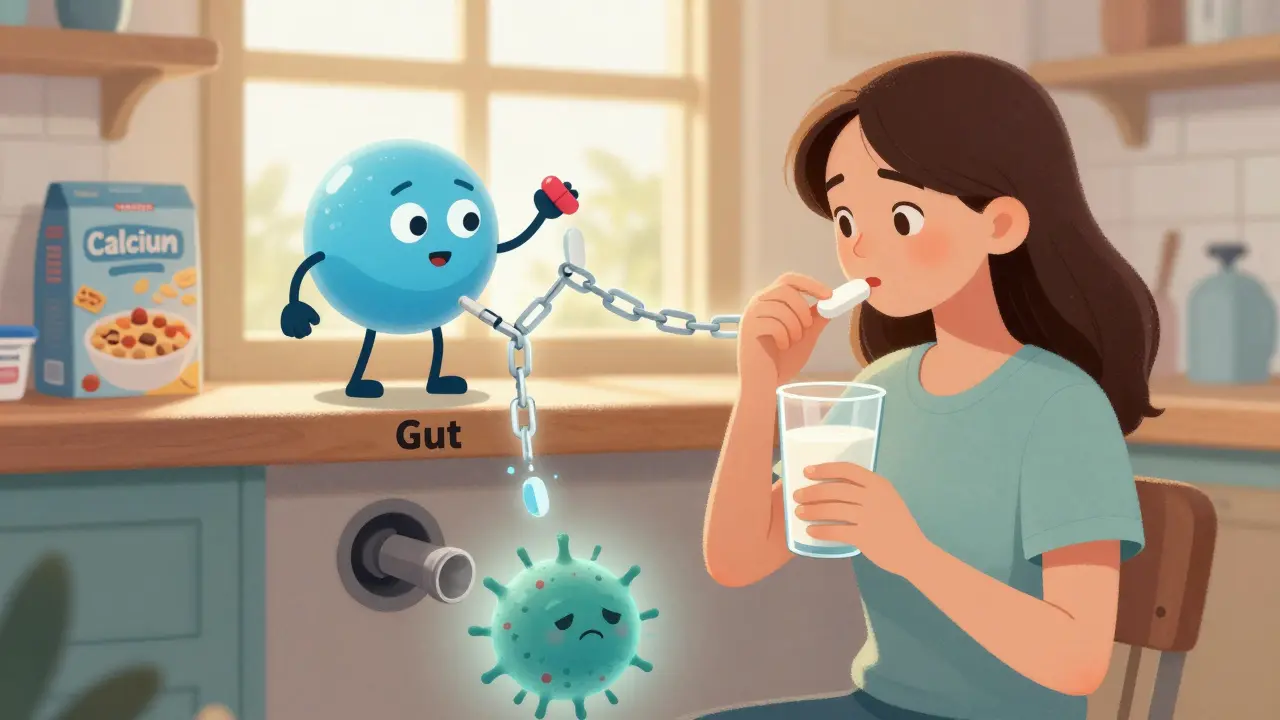
Ever taken your antibiotic with a glass of milk or a bowl of yogurt, only to wonder why your infection won’t go away? You’re not alone. For decades, doctors and pharmacists have known that dairy can seriously mess with how well your antibiotic works - but most people still don’t realize it. The problem isn’t about allergies or stomach upset. It’s chemistry. And it can mean the difference between getting better in a few days or ending up back in the doctor’s office with a worse infection.
Why Dairy Stops Antibiotics from Working
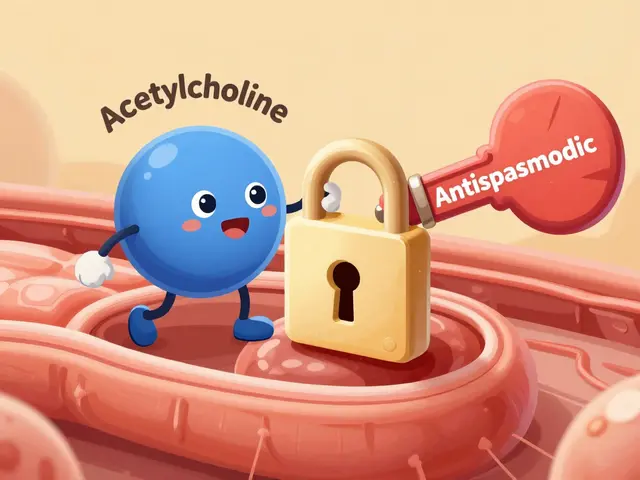
The issue isn’t that dairy is bad for you. It’s that the calcium in milk, cheese, yogurt, and even fortified plant-based milks binds tightly to certain antibiotics. This creates a kind of chemical glue - an insoluble complex - that your body can’t absorb. Instead of entering your bloodstream to fight infection, the antibiotic just passes through your gut, useless. This was first clearly documented in the 1970s with tetracycline antibiotics. Since then, research has confirmed it again and again. A 2022 study in the Journal of Rawal Academy of Sciences found that milk cut the peak blood levels of ciprofloxacin by 70%. Yogurt? It dropped them by 92%. That’s not a small drop - that’s a treatment failure waiting to happen.Which Antibiotics Are Most Affected?
Not all antibiotics are affected the same way. Some are barely impacted. Others? They’re completely shut down by dairy. The big two classes that get hit hardest are:- Tetracyclines - including tetracycline, doxycycline, and minocycline. These were the first to be studied, and calcium binds to them like Velcro. Older versions like tetracycline can lose up to 90% of their absorption with dairy. Doxycycline is a bit less sensitive, but still needs space.
- Fluoroquinolones - like ciprofloxacin, levofloxacin, and moxifloxacin. These are commonly prescribed for urinary tract infections, sinus infections, and pneumonia. Dairy slashes their absorption by 50% to 90%, depending on the product.
How Long Should You Wait?
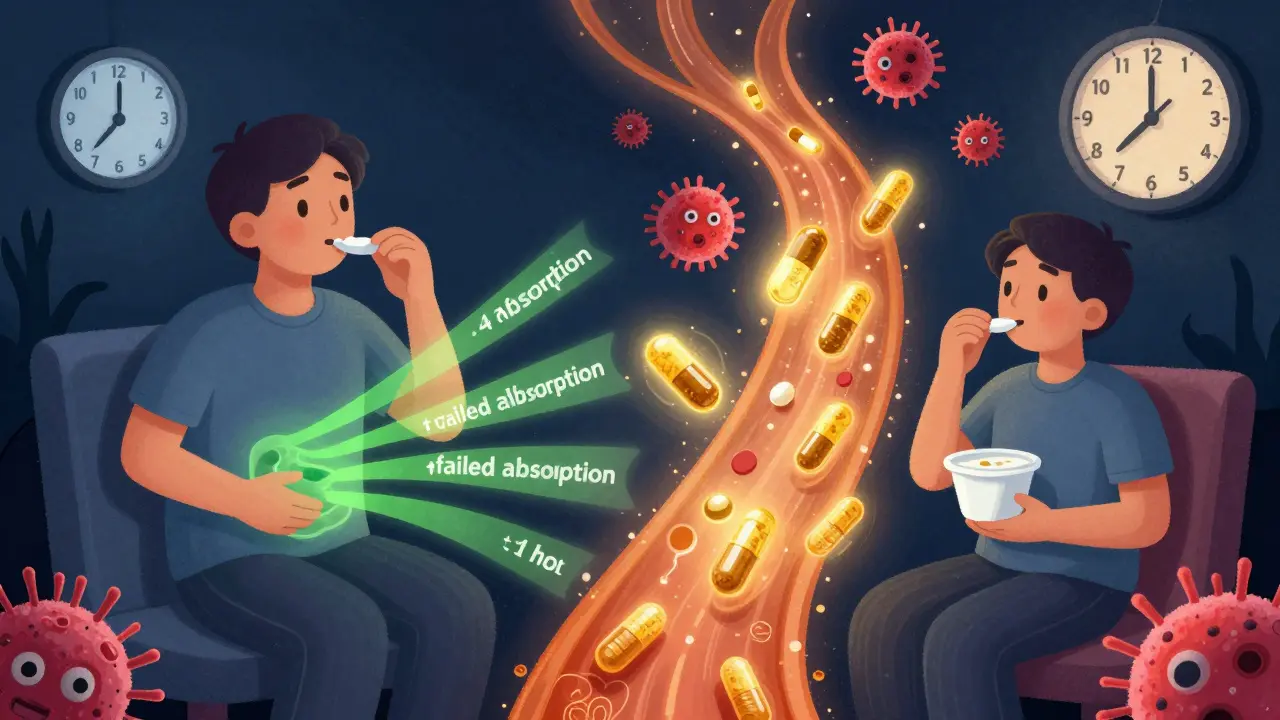
Timing isn’t just advice - it’s science. And the numbers matter. For tetracyclines, the standard rule is: take the pill at least 1 hour before or 2 hours after eating anything dairy. Some sources, like the European Association of Hospital Pharmacists, recommend a full 3-hour gap to be safe. For fluoroquinolones, you need to be even more careful. The American Pharmacists Association says: take ciprofloxacin 2 hours before or 4 to 6 hours after dairy. Why the longer wait? Because these drugs are absorbed higher up in the small intestine, and dairy can linger in your stomach longer than you think. Here’s what that looks like in real life:- You take your doxycycline at 8 a.m. - don’t have cereal with milk until after 10 a.m.
- You take your ciprofloxacin at 8 p.m. - skip your yogurt parfait until after 2 a.m. the next day (or better yet, have it at breakfast instead).
What Happens If You Ignore the Timing?
You might not feel sick right away. But here’s what’s happening under the hood:- Your antibiotic levels in the blood are too low to kill all the bacteria.
- The surviving bacteria multiply - and some become resistant.
- Your infection doesn’t clear. You feel worse. You go back to the doctor.
- They prescribe another antibiotic. Maybe a stronger one. Maybe an IV.
- And now you’ve helped fuel the global crisis of antibiotic resistance.
Why Do So Many People Get It Wrong?
Here’s the ugly truth: most doctors don’t mention it. A 2022 survey by the American Society of Health-System Pharmacists found that 43% of patients received no instructions about dairy when prescribed affected antibiotics. Pharmacists are better - but even they can’t always catch it if the patient doesn’t mention their morning yogurt routine. It’s also easy to forget. If you take your pill once a day, you might think, “I had milk with breakfast, and I take my pill at night - that’s fine.” But your gut doesn’t work that way. Antibiotics and calcium can still meet in your intestines hours later. Elderly patients are especially at risk. Many take calcium supplements for bone health - and they often take antibiotics for infections. That’s a double whammy. The WHO estimates that timing errors like this contribute to 5-10% of community-based antibiotic resistance cases.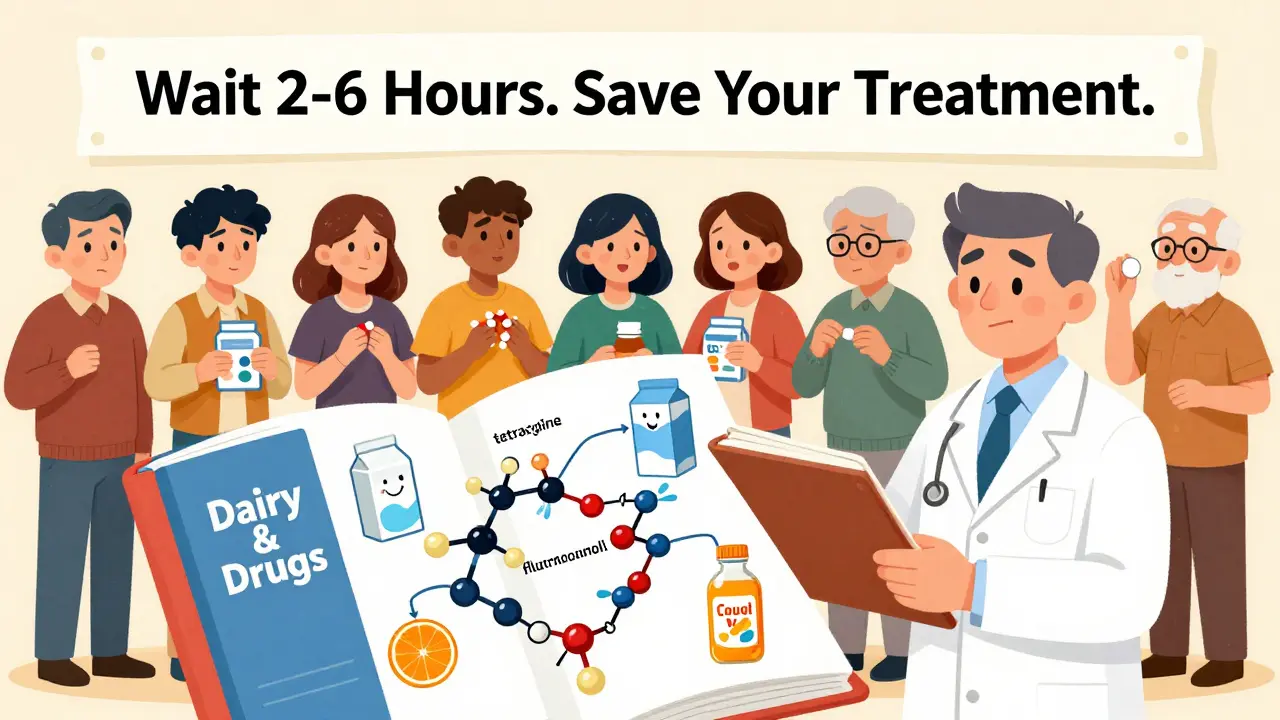
What Can You Do?
It’s simple, but it takes discipline:- Check your prescription. If it’s doxycycline, ciprofloxacin, or another tetracycline/fluoroquinolone, assume dairy interferes unless told otherwise.
- Read the label. Since January 2023, the FDA requires clearer timing instructions on these drugs. Look for phrases like “take on an empty stomach” or “avoid dairy for 2-6 hours.”
- Plan your meals. If you take antibiotics twice a day, schedule them around meals. Morning dose? Have dairy at lunch or dinner. Night dose? Skip the bedtime snack with calcium.
- Ask your pharmacist. They’re trained for this. Bring your list of meds and your typical meals. They’ll tell you exactly what to avoid and when.
- Use apps. Tools like Medisafe and MyMeds now flag dairy interactions. If you input your antibiotic, they’ll send you a reminder: “No dairy for 4 hours.”
What’s Next?
Pharmaceutical companies are trying to fix this. Newer versions of ciprofloxacin (like Cipro XR) are designed to be less affected by calcium - but they cost over $200 a bottle, while the generic version is under $16. Not exactly a solution for most people. Researchers are also working on calcium-resistant tetracycline derivatives. But those are still in clinical trials. Don’t expect them before late 2026. For now, the only proven fix is timing. The chemistry hasn’t changed. The rules haven’t changed. And the risks? They’re still very real.Can I take dairy with amoxicillin or azithromycin?
Yes. Antibiotics like amoxicillin (a penicillin) and azithromycin (a macrolide) are not affected by dairy. You can take them with or without food, including milk, yogurt, or cheese. The interaction only applies to tetracyclines and fluoroquinolones.
What if I accidentally took my antibiotic with milk?
Don’t panic. One mistake won’t ruin your treatment - but it does lower your drug levels. Skip the next dairy meal, and continue taking your antibiotic as prescribed. If you’re on a short course (like 5-7 days), it’s still likely to work. But if you’re on a longer course (like for Lyme disease or chronic infection), talk to your doctor. You may need to extend the treatment or switch antibiotics.
Does it matter if I use low-fat or nonfat dairy?
No. The problem isn’t fat - it’s calcium. Low-fat milk, nonfat yogurt, and cottage cheese all have the same amount of calcium as full-fat versions. The type of dairy doesn’t change the risk. Only the timing does.
Can I take calcium supplements with my antibiotic?
No. Calcium supplements - whether tablets, chewables, or liquids - will interfere just like dairy. Wait at least 2 hours after taking a tetracycline or 4-6 hours after a fluoroquinolone before taking a calcium supplement. If you take calcium daily, ask your doctor if you can shift the timing to when you’re not on antibiotics.
Is this a problem outside the U.S.?
Yes. This is a global issue. The FDA, European Medicines Agency, WHO, and health systems in Australia, Canada, and the UK all warn about dairy-antibiotic interactions. The science is the same everywhere. Where it differs is in patient education - some countries have better labeling and pharmacist counseling than others.


Alex Ogle
February 10, 2026 AT 07:13So I’ve been taking doxycycline for my acne for like six months now, and I swear I’ve had zero issues. I mean, I always take it with a big glass of water and then immediately eat breakfast - cereal with milk, scrambled eggs, the whole deal. I just assumed the ‘take on empty stomach’ thing was a generic warning. But now I’m wondering if I’ve been slowly breeding superbugs in my gut without even realizing it. The stats in this post are wild - 92% drop with yogurt? That’s not a side effect, that’s a sabotage. I’m gonna start timing it right from now on. No more morning yogurt with my pill. Honestly, this is the kind of thing that should be on every prescription bottle in giant neon letters.
Brandon Osborne
February 11, 2026 AT 21:17YOU’RE ALL BEING SO CARELESS. I’ve seen this happen in the ER - people come in with recurrent UTIs because they ‘just had a little yogurt’ and now they’ve got a multidrug-resistant strain of E. coli in their bladder. It’s not rocket science. Calcium binds to antibiotics like glue. If you’re too lazy to wait two hours, you’re not just risking your own health - you’re contributing to a global public health disaster. Stop being selfish. This isn’t about convenience - it’s about survival. And if you’re still drinking almond milk with your cipro because ‘it’s plant-based,’ you’re literally playing Russian roulette with your microbiome.
Marie Fontaine
February 12, 2026 AT 14:14OMG I JUST REALIZED I’VE BEEN DOING THIS WRONG 😱 I take my cipro at night and always have Greek yogurt before bed… like, every single night. That’s why my UTIs kept coming back!! I’m so relieved I found this post - I’m gonna switch to morning pills and save my yogurt for lunch. Also, can we make a meme about this? ‘Me: I’m healthy. My antibiotics: 😭’ 🤣 Seriously though, thank you for explaining this so clearly!!
Ken Cooper
February 13, 2026 AT 09:13ok so i just got prescribed doxy for some lyme bs and i was like ‘cool ill just take it with my coffee’ - turns out my oat milk has calcium added?? i had no idea. i thought only dairy dairy was bad. now i’m paranoid about every fortified thing. like, is my orange juice gonna mess me up? what about my protein powder? this is wild. i think i’m gonna start keeping a log. also why isn’t this on the label in bold? why do i have to google this? pharmacy techs should be trained to yell this at you when you pick up the script.
MANI V
February 14, 2026 AT 12:55How can you be so irresponsible? This isn’t just about antibiotics - it’s about discipline. The fact that people think ‘a splash of milk’ is harmless shows how detached modern society is from basic science. You think your body is a magic box? Calcium doesn’t care if you’re ‘busy’ or ‘forgot.’ It binds. Period. And now you’re not just failing your treatment - you’re contributing to antibiotic resistance. This is a moral failure. People in developing countries are dying because of this kind of ignorance. Wake up.
Random Guy
February 15, 2026 AT 06:49so let me get this straight… i can’t have my morning latte with my doxycycline? like, at all? what am i supposed to do, sip water and stare at my cereal for 2 hours? this is the dumbest thing i’ve ever read. next they’ll tell me i can’t breathe while taking pills. 😭
Ryan Vargas
February 16, 2026 AT 04:48There’s a deeper philosophical layer here, one that transcends mere pharmacokinetics. The calcium-antibiotic interaction is not simply a biochemical phenomenon - it is a metaphor for modern humanity’s disconnection from natural rhythms. We have replaced ritual with convenience, science with assumption, and discipline with distraction. The body, in its ancient wisdom, demands timing, spacing, and reverence - yet we treat it like a vending machine. We shove in our pills and expect results, ignoring the silent, mineral-laden interference of our industrialized diets. The real tragedy is not that dairy reduces absorption - it’s that we’ve forgotten how to listen. When we no longer respect the quiet laws of physiology, we don’t just fail to heal - we lose touch with the very essence of biological harmony.
Tasha Lake
February 16, 2026 AT 15:48From a clinical pharmacology standpoint, the calcium-mediated chelation of tetracyclines and fluoroquinolones is a well-documented Cmax and AUC reduction phenomenon. The divalent cation binding in the GI lumen prevents transcellular absorption via passive diffusion, particularly in the duodenum. What’s underreported is the pharmacodynamic consequence - subtherapeutic concentrations promote mutant selection windows, accelerating horizontal gene transfer of resistance determinants like qnr and efflux pumps. This isn’t anecdotal - it’s a documented contributor to the global AMR crisis. We need standardized, AI-driven medication reconciliation tools that auto-flag dietary interactions at the e-prescribing stage. Until then, patient education remains fragmented and ineffective.