
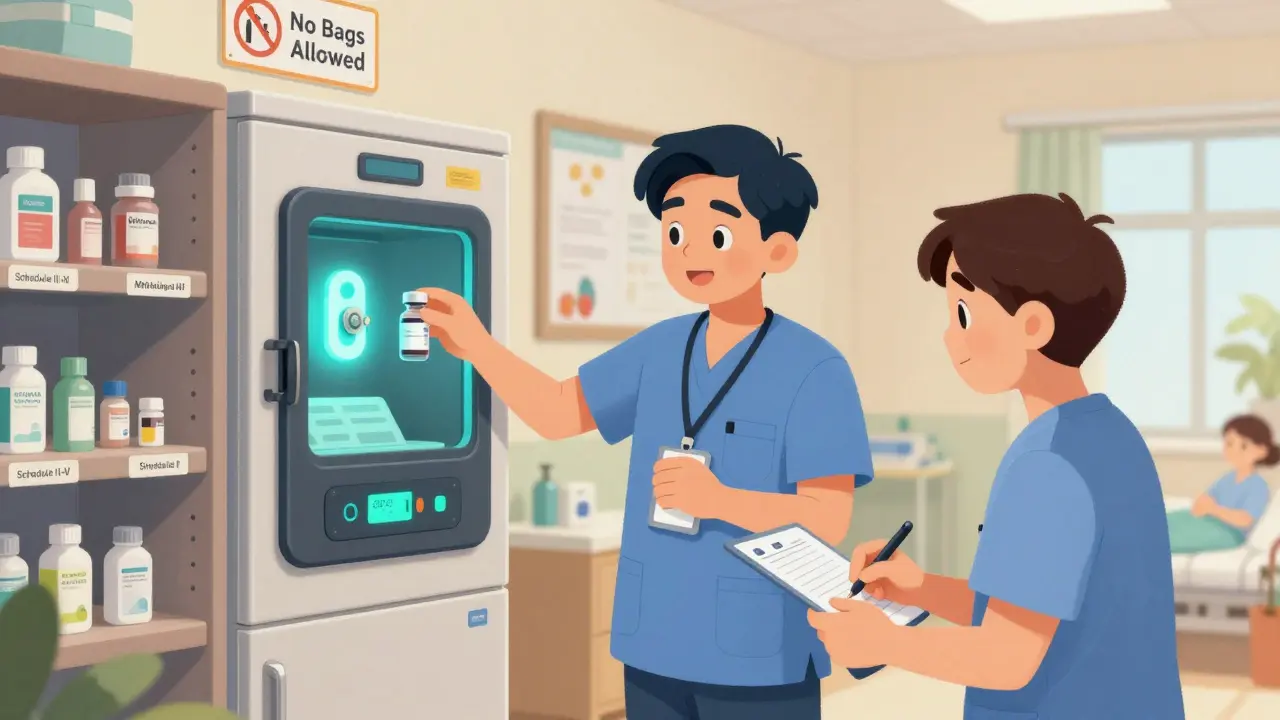
Storing controlled substances properly isn't just about following rules-it's about saving lives. Every year, tens of thousands of prescription opioids, sedatives, and stimulants go missing from hospitals, clinics, and pharmacies. Many end up in the wrong hands, leading to addiction, overdose, or even patient harm. The problem isn't just theft by outsiders. More often, it's insiders-staff with access-who take doses meant for patients. That's why controlled substance storage must go beyond a simple locked cabinet. It needs layers of security, clear procedures, and constant vigilance.
What Counts as a Controlled Substance?
Controlled substances are drugs regulated under the U.S. Controlled Substances Act (CSA) because they have a high potential for abuse. These include Schedule II drugs like oxycodone, fentanyl, and Adderall; Schedule III drugs like hydrocodone with acetaminophen; and lower-schedule drugs like benzodiazepines and certain cough syrups. Even though Schedule IV and V drugs are considered lower risk, they still get diverted. The key is: if it's on the DEA’s list, it needs secure handling. There’s no such thing as a "safe" controlled drug when it comes to access. If it’s stored carelessly, it will be taken.
Physical Storage: Locks Aren’t Enough
Many facilities still use basic metal cabinets with padlocks. That’s a red flag. According to DEA audits from 2021-2022, facilities relying on manual locks had diversion rates 4.2 times higher than those using electronic systems. A locked cabinet without access logs is like leaving a safe with the combination written on the door. The standard now is a double-lock system: a physical lock plus an electronic audit trail.
The best practice? Use an Automated Dispensing Cabinet (ADC). These are smart lockers that require two-factor authentication-like a badge and fingerprint-to open. Each time someone takes a drug, the system logs who took it, when, and how much. Studies show ADCs reduce diversion incidents by up to 73%. But they’re not magic. If you install one but let staff bypass it with manual overrides, you’ve created a loophole. The DEA found that 68% of large-scale diversion cases happened during manual transfers-like moving meds from a central vault to a floor stock without digital tracking.
For smaller clinics that can’t afford ADCs, dual control is your next best option. That means two authorized staff members must be present for every access. One unlocks the cabinet. The other watches, counts, and signs off. No exceptions. No "I’ll just grab one quickly." That’s how most thefts start.
Who Gets Access-and Why?
Limiting access isn’t about being suspicious. It’s about reducing opportunity. The ASHP Guidelines recommend limiting access to one or two people per shift. More people with keys means more chances for error or abuse. In one case reviewed by the NIH, a pharmacy tech who had unrestricted access to the vault stole over 300 fentanyl vials over 18 months. No one was watching. No one was checking logs.
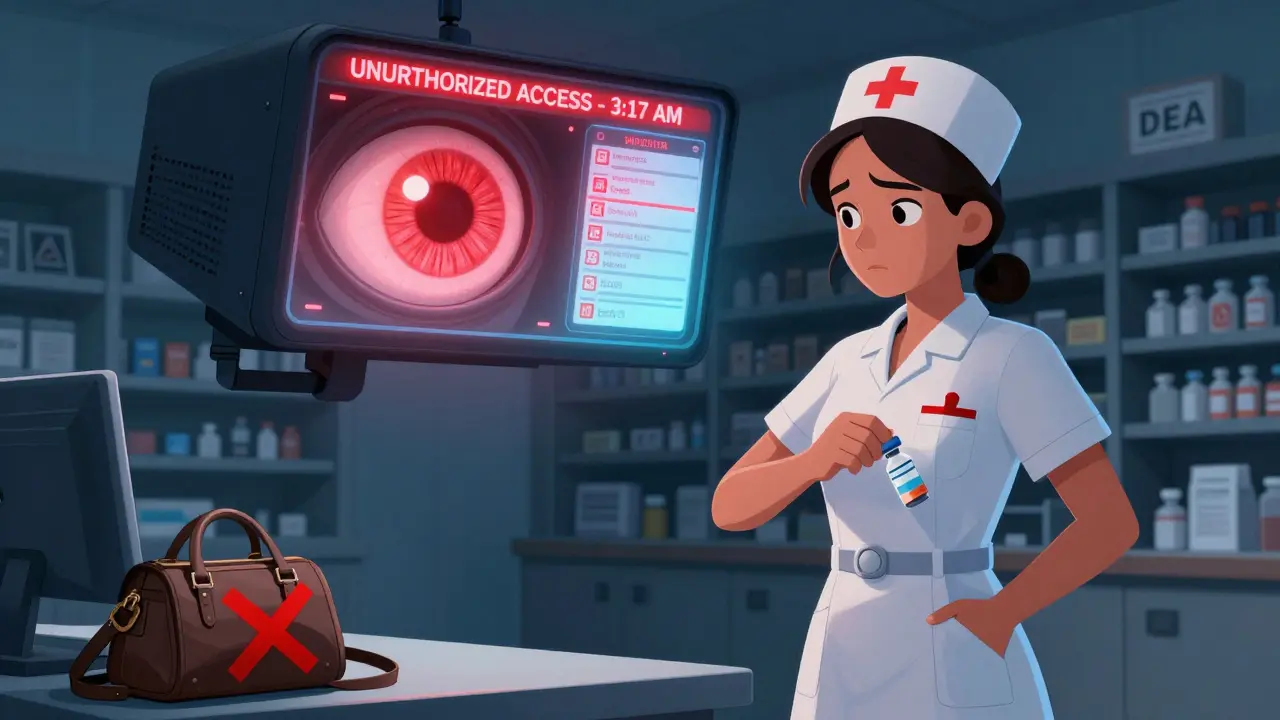
Also, ban personal bags and purses from medication areas. A 2013 NIH study found that 31% of diversion cases involved staff using bags to conceal drugs. That’s not paranoia-it’s data. Even a coat pocket can be a risk. Designate secure lockers outside the pharmacy zone for personal items. Make it part of the onboarding process: "No bags, no exceptions. Period."
Tracking Every Dose, Every Time
Manual logs are outdated. A handwritten sheet that says "10 mg oxycodone taken by J. Smith" doesn’t hold up under audit. Electronic systems track exact quantities, timestamps, and user IDs. If someone takes 5 vials at 3 a.m. on a weekend, the system flags it. A human might miss it. A computer won’t.
By January 1, 2025, the DEA will require all facilities handling over 10kg of Schedule II substances to use real-time inventory tracking. That means every pill, vial, or patch must be scanned in and out. No more "estimated counts." No more "we’ll update it tomorrow." If you’re not there yet, you’re already noncompliant.
Even if you’re not subject to the federal rule, adopt it anyway. Why? Because diversion doesn’t care about deadlines. It thrives in gaps. The more digital trails you leave, the harder it is to hide.
What Happens When Drugs Are Used or Discarded?
Diversion doesn’t stop at the cabinet. It happens during administration, waste, and disposal. A common trick? A nurse takes a vial, injects saline into the patient’s IV, then flushes the real drug down the sink. The patient gets no pain relief. The drug is gone. The chart shows "administered."
That’s why waste procedures must be tight. Every unused dose must be witnessed and documented. Two people must verify the disposal-ideally, one who prepared it and one who didn’t. Use a sharps container or DEA-approved drug disposal unit. Never just throw pills in the trash. Never flush them unless the DEA specifically allows it (and even then, document it).
And never, ever let a single person handle both the ordering and the disposal of controlled substances. That’s a classic conflict of interest. Split responsibilities. Make sure no one has too much control.
Training and Culture Matter More Than You Think
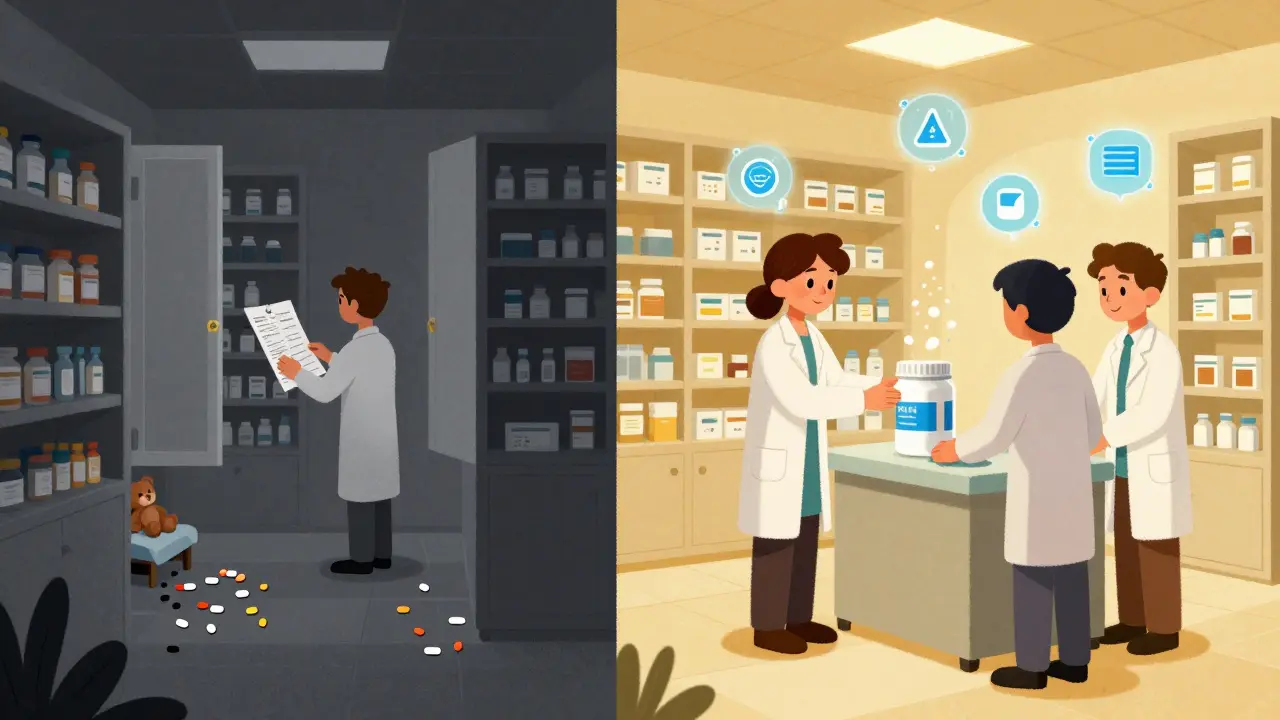
Technology helps. But people decide whether it works. A 2022 survey of 1,247 healthcare facilities found that 63% of staff pushed back when new storage rules were introduced. They called it "bureaucracy." But after six months of consistent enforcement, 89% said they felt safer and more aware.
Training isn’t a one-time event. It needs to be ongoing. Every new hire gets a 30-minute session. Every quarter, do a 15-minute huddle. Review real cases. Show them how diversion looks: a missing vial, a mismatched count, a late-night access log. Make it personal. Say: "This isn’t about rules. It’s about the patient in Bed 7 who needs pain relief tomorrow. If we don’t stop this, they won’t get it."
What Happens If You Get Caught?
DEA inspections are no joke. In 2022, 98% of inspections included a full review of storage areas. Penalties? Up to $187,500 per violation. But the real cost isn’t the fine. It’s the reputation. A single diversion case can trigger a federal investigation, loss of licensure, lawsuits, and mandatory patient notifications.
Colorado health officials reported that when a diverted drug caused an infection in a patient, the facility paid $287,000 in medical testing, legal fees, and public relations damage. That’s not a statistic-it’s a real hospital that had to shut down its pharmacy for six weeks.
And the DEA is watching closer than ever. Inspection frequency rose 37% between 2019 and 2022. If your storage logs are incomplete, your cabinets are unlocked, or your staff are bypassing systems-you’re asking for trouble.
What’s Next? The Future of Storage
The next wave is AI. Pilot programs at Johns Hopkins and Mayo Clinic are using machine learning to spot patterns in drug usage. If a nurse consistently takes morphine right before shift change, the system flags it. If a cabinet shows a spike in usage on weekends, it alerts the pharmacist. These systems cut false alarms by 63% and catch 92% of incidents within 48 hours.
By 2026, the market for diversion prevention tech will hit $1.2 billion. The tools are here. The regulations are tightening. The question isn’t whether you should upgrade-it’s whether you can afford not to.
What’s the difference between a locked cabinet and an automated dispensing cabinet (ADC)?
A locked cabinet just keeps drugs out of sight-it doesn’t track who opens it or when. An ADC requires two-factor authentication (like a badge and fingerprint), logs every access, and records exactly how much was taken. It also prevents over-dispensing and alerts staff if something looks unusual. ADCs reduce diversion by up to 73%, while manual cabinets are linked to 87% of all identified risk points in storage.
Can small clinics afford secure storage systems?
Yes. If you can’t afford an ADC (which costs $45,000-$75,000), use dual control: require two authorized staff to be present for every access to controlled substances. This method is low-cost and highly effective. Pair it with daily audits, no personal bags in the pharmacy area, and electronic logs-even if they’re simple spreadsheets. The goal isn’t fancy tech-it’s accountability.
Why do staff resist stricter storage rules?
Many feel the new rules slow them down or imply they’re untrustworthy. But resistance fades with clear communication. Explain that these rules protect patients-not just the facility. Share real stories: a patient who didn’t get their pain meds because a nurse stole them. Show them the data: 89% fewer incidents when access is limited. Turn compliance into a shared mission.
Is it legal to flush controlled substances down the toilet?
Only if the DEA explicitly lists that drug on its flush list (like fentanyl patches). For most drugs, flushing is illegal and dangerous to the environment. Always use a DEA-approved disposal unit or take-back program. Document every disposal with two witnesses-even if it’s just a small amount.
What should I do if I suspect a colleague is diverting drugs?
Report it immediately. Most facilities have anonymous reporting lines. Don’t confront the person. Don’t investigate yourself. Your job is to protect patients-not manage drama. If you wait, you risk someone getting hurt. The DEA requires reporting of suspected diversion within one business day. Delaying could make you legally liable.



Arshdeep Singh
February 20, 2026 AT 13:34Let me break this down like I’m explaining it to a third-year med student who still thinks ‘locked cabinet’ is a security protocol. You think a padlock stops anyone? Bro, I’ve seen nurses use paperclips to open those things. The real problem isn’t the lock-it’s the culture that lets staff treat controlled substances like a buffet. You don’t need AI to catch a thief. You need a culture where people report weird behavior because they care about patients, not because HR forced them to. And yeah, dual control works. But only if you actually enforce it. No exceptions. Not even for ‘Dr. Johnson-he’s been here 30 years.’
Liam Crean
February 22, 2026 AT 11:08I work in a small rural clinic and we use dual control. It’s not glamorous, but it works. Two people, always. No exceptions. We started with resistance-people thought it was micromanaging. But after three months, we noticed fewer discrepancies, and staff started noticing when someone was off their game. One nurse was coming in 20 minutes late every shift. Turned out she was using the med cart as a personal ATM. We caught her because someone asked, ‘Why’s the count always low on Tuesdays?’ Simple. Human observation beats tech every time.
Tommy Chapman
February 23, 2026 AT 13:08This whole post is just woke bureaucracy dressed up as safety. You want to stop diversion? Fire the people who steal. Don’t turn your pharmacy into Fort Knox with sensors and two-factor auth. That’s not security, that’s paranoia. And who the hell flushes fentanyl? If you’re that stupid, you shouldn’t be near a syringe. The real issue is lazy management. Stop spending $70k on ADCs and start firing people who can’t be trusted. Problem solved. No tech needed. Just accountability.
Freddy King
February 23, 2026 AT 20:44From a systems engineering standpoint, the ADC adoption curve is linear until you hit the 500-bed threshold. Below that, the cost-to-benefit ratio drops below 1.2x ROI, making dual control the pragmatic solution. But here’s the kicker-the real vulnerability isn’t the cabinet, it’s the workflow friction. Manual overrides create shadow inventory paths. And let’s not forget the human factor: cognitive load leads to procedural drift. If your staff are doing 17 tasks between med passes, they’re gonna bypass the system. Tech doesn’t fix culture. Culture fixes tech. Also, the 73% diversion reduction stat? That’s from a 2019 JAMA study. Post-pandemic, that number’s closer to 58% due to staffing shortages. Context matters.
Laura B
February 24, 2026 AT 08:51I’ve seen this firsthand. A patient died because their pain meds were stolen by a tech who had unrestricted access. We didn’t have ADCs. We had a cabinet and a handwritten log. That log? It was updated every two weeks. The patient’s chart said ‘administered.’ They never got it. We changed everything after that. Dual control. No bags. Electronic logs. Training every quarter. It’s not about trust-it’s about design. If the system lets someone slip through, we failed. And yeah, it’s annoying at first. But now? Everyone feels safer. Even the grumpy ones.
Hariom Sharma
February 25, 2026 AT 04:11Bro, this is beautiful. We need more of this in India. We have hospitals where nurses keep oxycodone in their pockets. No logs. No locks. Just ‘I’ll give it later.’ But I tell you-when you start showing them real stories, like a kid who overdosed because a nurse stole his meds? That hits hard. We started with dual control in our ICU. First week, 3 people quit. Second week, 5 more asked for training. Now? We have a WhatsApp group where staff post daily counts. It’s weird. It’s awkward. But it works. No one wants to be the one who broke the chain.
Nina Catherine
February 27, 2026 AT 01:48so i just read this whole thing and i’m like… wow. i work in a small clinic and we don’t even have a locked cabinet, just a drawer. but i’m gonna talk to my boss tomorrow about dual control and no bags. i never thought about how a coat pocket could be a risk. also, i had no idea flushing was illegal for most stuff. i’m gonna print this out and put it on the fridge. thanks for writing this. seriously. 😊
Courtney Hain
February 28, 2026 AT 12:49Okay, but have you considered that this entire system is a psyop by Big Pharma and the DEA to justify surveillance? Every ADC logs your movements, your habits, your access patterns. That data doesn’t stay in your hospital-it gets fed into federal databases, then sold to insurance companies who use it to flag ‘high-risk’ patients. And what about the 2021 whistleblower report that showed 60% of diversion cases were actually set up by hospital administrators to justify cutting staff? They let a few doses go missing, then blame the nurses, then fire them and install ‘security tech’ to replace human oversight. The real diversion? The truth. They don’t want you knowing that the system is designed to make you feel guilty so you’ll accept more control. Wake up. The cabinet isn’t protecting patients. It’s protecting the system from itself.
Robert Shiu
March 2, 2026 AT 06:26I love how this post didn’t just list rules-it told stories. That part about the patient in Bed 7? That’s the one that stuck with me. I work nights. I’ve seen the exhaustion. I’ve been tempted to grab a quick dose when I’m running on fumes. But then I remember: someone’s kid is waiting for pain relief tomorrow. This isn’t about locks or logs. It’s about remembering why we’re here. I started a ‘why we care’ board in our pharmacy. Staff post notes: ‘My mom had chemo.’ ‘My brother OD’d.’ ‘I almost lost my job over this.’ It’s not perfect. But it’s human. And that’s what changes behavior.