
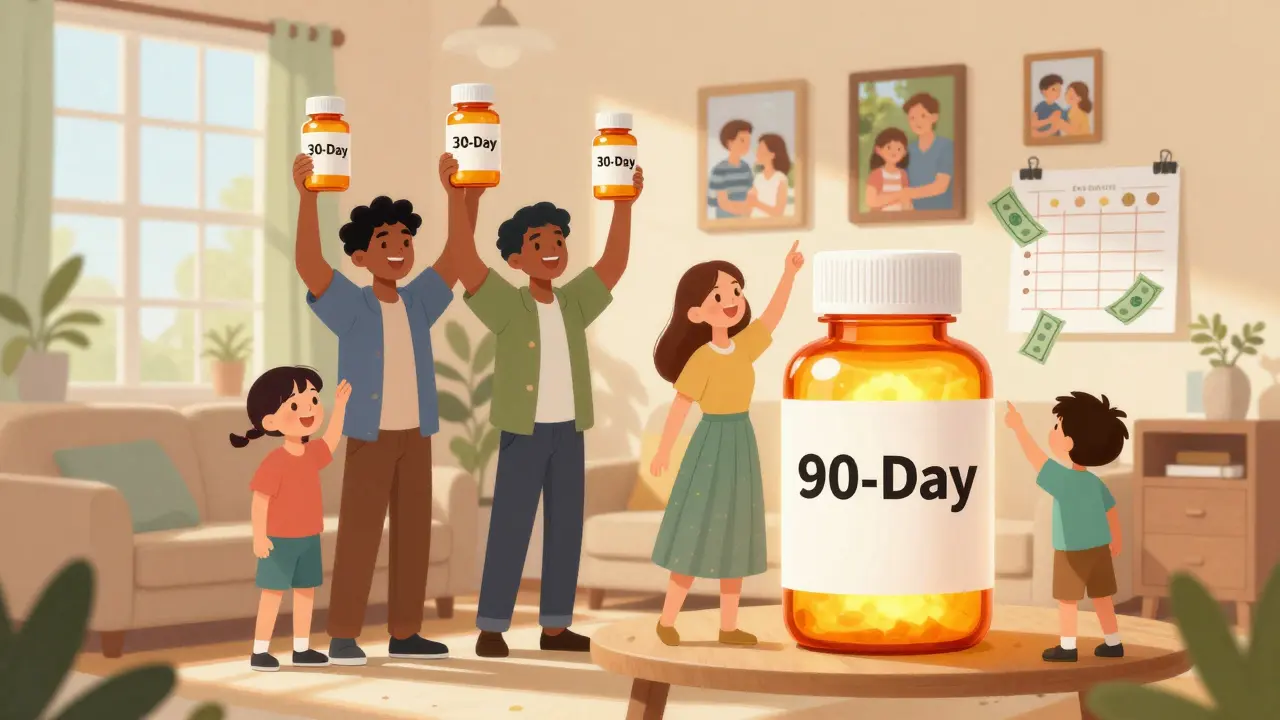
Getting a 90-day supply of your medication isn’t just about buying more pills at once-it’s one of the simplest ways to cut your monthly drug costs without changing your treatment. If you’re taking medication for a long-term condition like high blood pressure, diabetes, or cholesterol, you could be paying the same copay for three months’ worth of pills as you do for just one month. That’s not a trick. It’s standard practice-and most people don’t even know they can ask for it.
Why 90-Day Fills Save Money
Most insurance plans charge a flat copay for each prescription fill, no matter how many pills are in the bottle. So if your copay is $5 for a 30-day supply, you’re paying $15 a month for the same medication. But if you get a 90-day fill, you still pay $5-just once. That means you get three months of medication for the price of one. Over a year, that’s $39.20 saved on just one drug. Multiply that across three or four medications, and you’re looking at hundreds in annual savings.Mail-order pharmacies often offer the best deals, but many retail pharmacies like CVS and Walgreens now give you the same 90-day option right at the counter. The key is that your insurance plan treats the 90-day supply as one fill, not three. You’re not getting a discount on the drug itself-you’re getting a discount on the number of times you pay the copay.
Who Qualifies for a 90-Day Prescription
Not every medication qualifies. These programs are designed for maintenance medications-drugs you take daily for chronic conditions. Common examples include:- High blood pressure pills (like lisinopril or amlodipine)
- Cholesterol meds (like atorvastatin or simvastatin)
- Diabetes medications (like metformin or glimepiride)
- Thyroid meds (like levothyroxine)
- Antidepressants (like sertraline or escitalopram)
You also need to have taken the medication for at least one cycle already. Insurance companies want to make sure you’re tolerating it well before approving a longer supply. If you just started a new drug, you’ll likely need to stick with 30-day fills for now.
How to Get a 90-Day Prescription
Getting a 90-day supply is easier than most people think. Here’s how to do it in three steps:- Check your prescription label. Look at how many refills are left. If you have at least two or three refills remaining, your pharmacist can often fill a 90-day supply even if the original prescription was written for 30 days. Just ask.
- Ask your doctor. If you don’t have enough refills, call your doctor’s office. Say: “I’d like to switch to a 90-day prescription for my [medication name] to save on copays and reduce pharmacy visits.” Most doctors will approve it right away if it’s a maintenance drug.
- Choose your pharmacy. You can get 90-day fills at your local pharmacy or through mail-order services. Mail-order options like CVS Caremark or Postal Prescription Services deliver directly to your door-often with free shipping-and sometimes at even lower prices.
Pro tip: Don’t assume your pharmacy will bring it up. Most pharmacists won’t mention it unless you ask. Be direct. Say: “Can I get a 90-day supply of this with my insurance?”
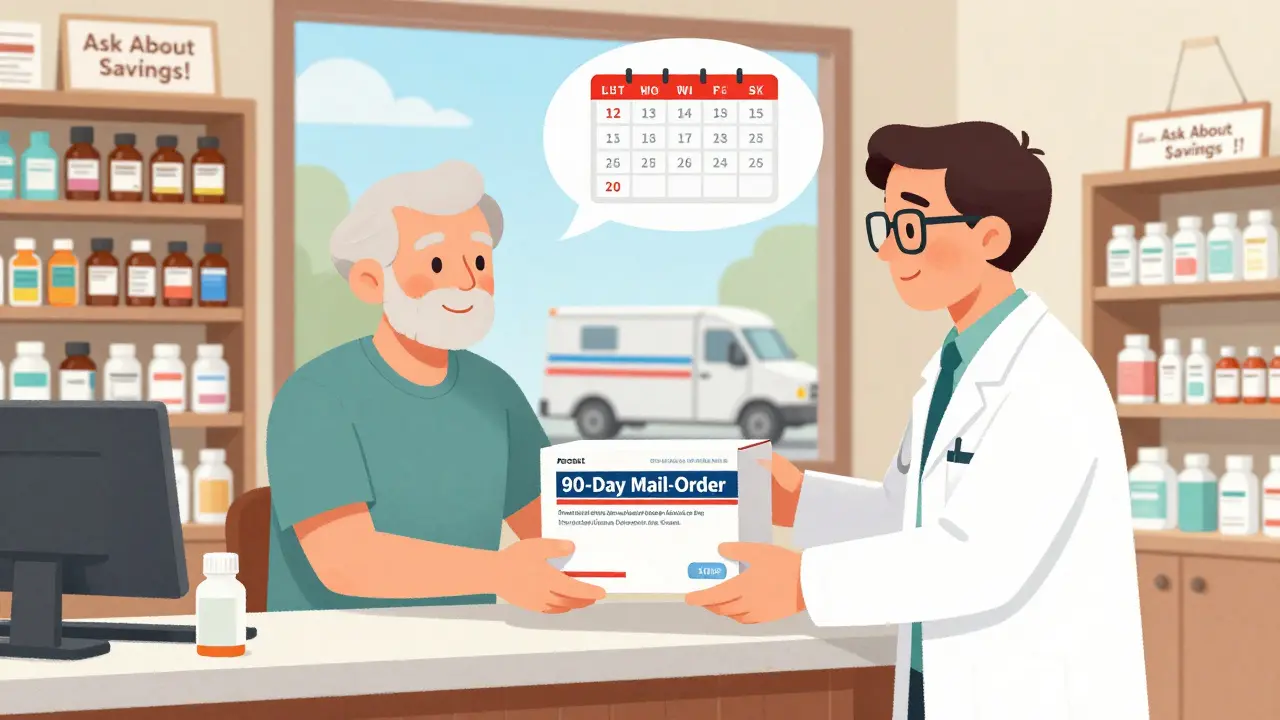
Mail-Order vs. Retail: Which Is Better?
There are two main ways to get a 90-day supply: through your local pharmacy or through mail-order.Mail-order pharmacies (like those run by CVS Caremark, UnitedHealthcare, or Humana) are designed for long-term medications. They typically only fill 90-day supplies and ship them every three months. You’ll get your meds delivered to your home, and you won’t need to leave the house. Some plans even offer free shipping and automatic refills. The downside? You have to plan ahead-ordering too late could mean running out.
Retail pharmacies (like Walgreens, Rite Aid, or local independents) now offer 90-day fills in-store too. This is great if you prefer to pick up your meds yourself or need to talk to a pharmacist in person. Some people find it easier to manage refills this way, especially if they already visit the pharmacy for other things like flu shots or over-the-counter meds.
Cost-wise, mail-order often wins. But retail can be just as cheap-and way more convenient if you’re already nearby. Always compare prices using tools like GoodRx before deciding.
What to Watch Out For
Not every plan allows 90-day fills for every drug. Some insurance companies require prior authorization, especially for newer or more expensive medications. Others may only offer 90-day options through their preferred mail-order service.Here’s how to avoid surprises:
- Call your insurance company before asking your doctor. Ask: “Does my plan cover 90-day fills for [medication name]?”
- Ask if there’s a preferred mail-order pharmacy-and whether you’re required to use it.
- Confirm your copay amount for a 90-day supply. Sometimes it’s lower than the 30-day copay.
If your plan says no, ask if you can switch to a different plan during open enrollment. Many Medicare Part D and Medicaid plans now make 90-day fills standard.

Extra Benefits Beyond Savings
Saving money is the big win-but there are other perks:- Fewer trips to the pharmacy. Instead of going every month, you’re going every three months. That’s eight fewer visits a year.
- Better adherence. Studies show people who get 90-day supplies are more likely to keep taking their meds. Missing doses is less likely when you’re not running out every 30 days.
- Less stress. No more last-minute calls to the doctor when you’re out of pills. You’ve got a buffer.
One patient told me they used to forget refills during busy work weeks. After switching to 90-day fills, they didn’t miss a single dose in over a year.
What If Your Pharmacy Says No?
Sometimes, especially at smaller local pharmacies, staff might say they can’t fill a 90-day supply. That’s usually not true. It’s often because:- They’re not trained on how to process it
- They’re worried about losing dispensing fees
- They’re assuming you need a new prescription
If they say no, ask to speak to the pharmacist on duty. Say: “My insurance allows 90-day fills for this medication. Can you check if my prescription has enough refills?” If they still say no, ask if they can transfer your prescription to CVS, Walgreens, or a mail-order service. Most pharmacies will do it.
And if your doctor’s office says they can’t write a 90-day script? Ask them to send a new prescription for 90 days with three refills. That’s the standard way to do it.
Bottom Line: It’s Simple, It’s Legal, It’s Worth It
You don’t need a special form, a doctor’s note, or a complicated process. If you’re on long-term medication, you’re eligible. All you need to do is ask.Start with your next refill. Call your pharmacy and say: “Can I get a 90-day supply of my [medication name]?” If they say yes, you’re saving money right away. If they say no, call your doctor. In most cases, you’ll get a yes within 24 hours.
This isn’t a loophole. It’s a benefit built into your insurance plan. Millions of Americans use it. You should too.
Can I get a 90-day prescription for any medication?
No. Only maintenance medications for chronic conditions qualify-like blood pressure, cholesterol, diabetes, or thyroid meds. Acute medications like antibiotics or pain relievers don’t qualify. Your insurance plan will have a list of covered drugs, but if you’re unsure, just ask your pharmacist or insurer.
Do I need a new prescription for a 90-day supply?
Not always. If your original prescription has refills left, your pharmacist can often fill a 90-day supply without a new script. But if you’ve used up all your refills, your doctor will need to write a new prescription for 90 days with up to three refills. Most doctors are happy to do this.
Is mail-order safer than picking up at the pharmacy?
Yes. Mail-order pharmacies are licensed, regulated, and inspected just like retail pharmacies. Many are run by your insurance company’s pharmacy benefit manager (PBM), like CVS Caremark or Express Scripts. They use temperature-controlled shipping and bar-code scanning to ensure accuracy. If you’re concerned about delays, most offer tracking and automatic refill reminders.
What if I miss a dose with a 90-day supply?
If you miss a few doses, you’re still covered. Since you’re getting three months’ worth at once, you have a built-in buffer. You won’t run out as quickly as with a 30-day supply. But if you’re consistently missing doses, talk to your doctor. You might need help managing your routine or switching to a different medication.
Can I switch back to 30-day fills later?
Absolutely. You’re not locked in. If you decide you prefer picking up your meds monthly, or if your insurance changes, you can switch back anytime. Just ask your pharmacy or doctor to change the prescription size. There’s no penalty.
How much can I really save with a 90-day fill?
It depends on your copay. If your 30-day copay is $5, you save $10 per month ($39.20 per year) for one drug. If you take three maintenance meds, that’s over $100 saved annually. For expensive drugs like insulin or specialty medications, savings can be hundreds or even thousands of dollars per year. Always check your plan’s formulary or use GoodRx to compare prices.



lorraine england
January 24, 2026 AT 02:51Just switched my blood pressure med to 90-day mail-order last month. Saved me $42 already. No more rushing to the pharmacy before weekends. Life’s too short for monthly pharmacy runs.
Also, my pharmacist didn’t even mention it. Had to ask. Seriously, why don’t they tell people this?
Shelby Marcel
January 25, 2026 AT 16:59wait so i can just ask for 90 days even if my rx says 30? no new doc visit? i thought i had to get a whole new script. this changes everything.
Michael Camilleri
January 27, 2026 AT 06:10People act like this is some secret hack but it’s literally how insurance is designed. You’re not gaming the system-you’re using the benefit they built in. The real scam is pharmacies and doctors not telling you this until you beg.
And don’t even get me started on how many people pay full price because they’re too lazy to ask. You’re not saving money because you’re cheap-you’re saving because you’re informed. There’s a difference.
Stop acting like you discovered gravity. This isn’t a life hack. It’s basic financial literacy.
And if you think mail-order is risky, you’ve never had insulin delivered to your door in a temperature-controlled box. That’s safer than your local pharmacy’s back room.
Patrick Gornik
January 29, 2026 AT 04:01Let’s deconstruct the institutional inertia here. The PBM ecosystem is optimized for volume, not adherence. 30-day fills generate more transactions, which means more dispensing fees, more administrative overhead, more opportunity for margin extraction.
90-day fills disrupt that model. That’s why pharmacies resist. Not because they care about your health-because they care about their P&L.
And let’s be real: if you’re on metformin or lisinopril, you’re not a patient. You’re a revenue stream with a pulse.
Asking for 90 days is an act of economic self-defense. You’re not asking for charity-you’re reclaiming your agency from a broken system.
Stop thinking in terms of copays. Think in terms of extraction vectors. Your pharmacy is a tax collector disguised as a healthcare provider.
John McGuirk
January 30, 2026 AT 21:03you think this is about saving money? nah. this is how they track you. mail-order = data collection. every time you get a shipment, they log it. when you stop refilling? they flag you. then your insurance hikes your rates or drops you. this isn’t a benefit. it’s surveillance.
and don’t get me started on how they auto-fill without consent. i know a guy who got 6 months of antidepressants he didn’t ask for. his wife found them in the mailbox. he didn’t even know he was on them anymore.
they want you addicted to the system. not the meds. the convenience.
you think you’re saving? you’re being groomed.
Himanshu Singh
February 1, 2026 AT 18:14Bro this is life changing 😊
I was paying $80/month for my diabetes med. Switched to 90-day through mail-order. Now it’s $25 every 3 months. I cried when I saw the bill.
Also, no more missing doses. I forgot my pills like 5 times a month before. Now I just open the box every 3 months and boom-done.
Thanks for this. I’m telling my whole family.
❤️
siva lingam
February 2, 2026 AT 19:10so you just ask and they give it to you? wow. i thought you needed a phd in insurance law and a signed affidavit from your cat.
Marlon Mentolaroc
February 2, 2026 AT 20:42Okay but let’s be real-this only works if you’re not on Medicaid or one of those crappy Medicare Advantage plans. I tried this last year and got denied because my plan ‘didn’t cover maintenance meds in 90-day unless through their exclusive PBM.’
So I had to pay $120 out of pocket to switch to CVS Caremark. Then they sent me the wrong med. Took 3 weeks to fix.
So yeah. Save money? Maybe. Save stress? Not even close.
blackbelt security
February 3, 2026 AT 10:51Do it. Just do it. No excuses. If you’re on chronic meds, this is the bare minimum you owe yourself.
You wouldn’t skip brushing your teeth. Don’t skip saving $100+ a year on pills.
It’s not hard. Ask. Then ask again. Then call your doctor. Then call again.
Your future self will high-five you.
Sharon Biggins
February 4, 2026 AT 06:25i tried this last year and the pharmacy said no so i gave up... but now i’m gonna go back and ask again. you’re right, they never bring it up. i feel dumb for not knowing this sooner.
thank you for writing this. i’m printing it out to take to my next appt.
Tommy Sandri
February 4, 2026 AT 21:42In many European systems, 90-day dispensing is standard practice for chronic conditions. The U.S. lags behind not due to medical necessity, but due to structural incentives favoring transaction volume over patient convenience. This post correctly identifies a systemic inefficiency. It is not a loophole-it is a correction.
One might argue that such practices reduce pharmaceutical waste and improve adherence metrics, both of which are measurable public health outcomes.
Consider this: if 30% of Americans on maintenance therapy adopted 90-day fills, annual healthcare costs could decline by an estimated $12 billion. This is not anecdotal. It is actuarial.
Jenna Allison
February 6, 2026 AT 19:14Just a quick tip: if your insurance says ‘only mail-order’ for 90-day, call them back and ask for the formulary code for your drug. Sometimes they’ll say it’s not covered-but if you ask for the specific code, they’ll often admit it’s covered at retail too. I did this with my thyroid med and saved $50/month.
Also, GoodRx coupons sometimes beat mail-order prices. Always check.
Darren Links
February 6, 2026 AT 20:44Look, I get it. You think this is some kind of American innovation. But in the UK, they’ve been doing this since the 80s. We call it ‘repeat dispensing.’
And guess what? Our system doesn’t require you to beg. It’s automatic.
So while you’re patting yourselves on the back for ‘figuring out’ 90-day fills, the rest of the developed world is already on to the next problem.
This isn’t progress. It’s remedial.
Jamie Hooper
February 8, 2026 AT 18:57so i just asked my pharmacist for a 90 day and she looked at me like i asked for a unicorn
then she said ‘oh you mean like the mail order one?’
and i said ‘no i mean right here’
and she said ‘ohhhhhh’
and then she did it
took 5 mins
now i have 3 months of pills and i didn’t even have to leave the parking lot
holy shit
why does no one tell you this