For millions of Medicare beneficiaries, paying for prescription drugs used to feel like a maze with hidden traps. One year, you’d hit a gap in coverage where your meds suddenly cost way more. The next year, you’d get hit with a late enrollment penalty just because you didn’t sign up on time. But in 2025, that’s all changed. The Medicare Part D drug coverage program has been completely rewritten to make costs predictable and manageable.
What Medicare Part D Actually Covers Now
Medicare Part D is prescription drug coverage you get through private insurance companies approved by Medicare. It’s not automatic-you have to enroll. But if you’re on Medicare and take any regular medications, skipping Part D could cost you more in the long run.
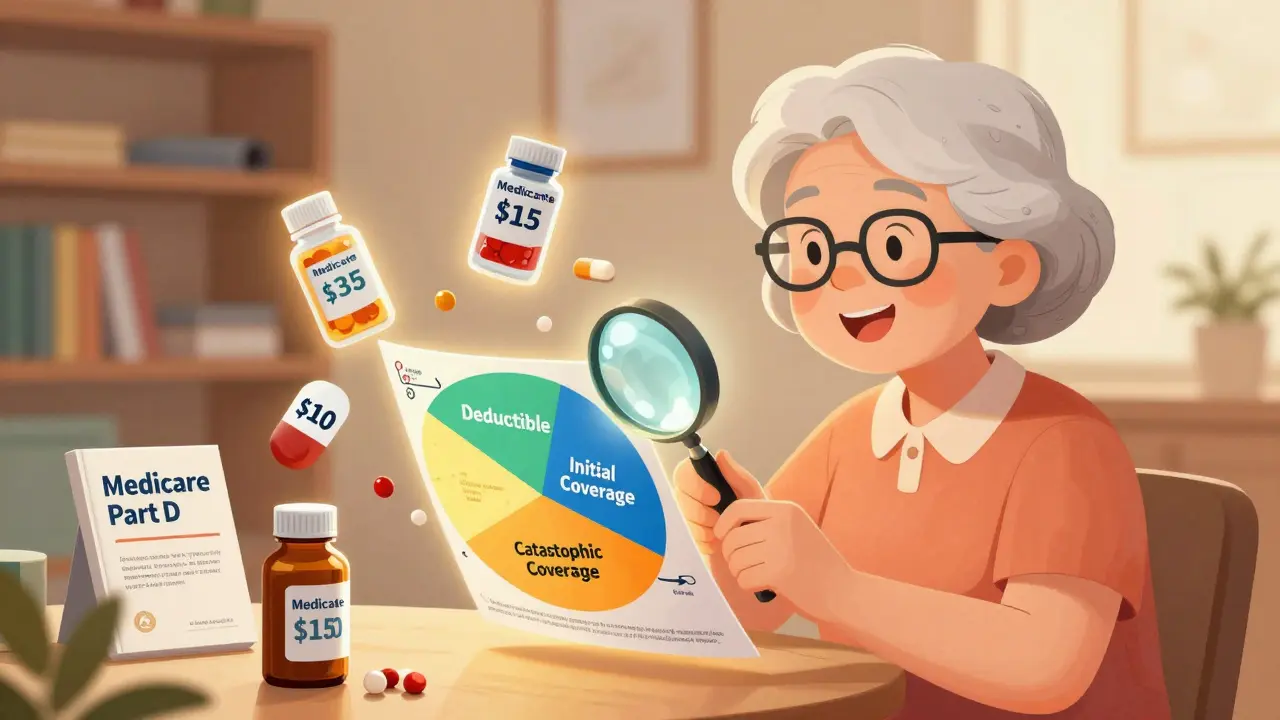
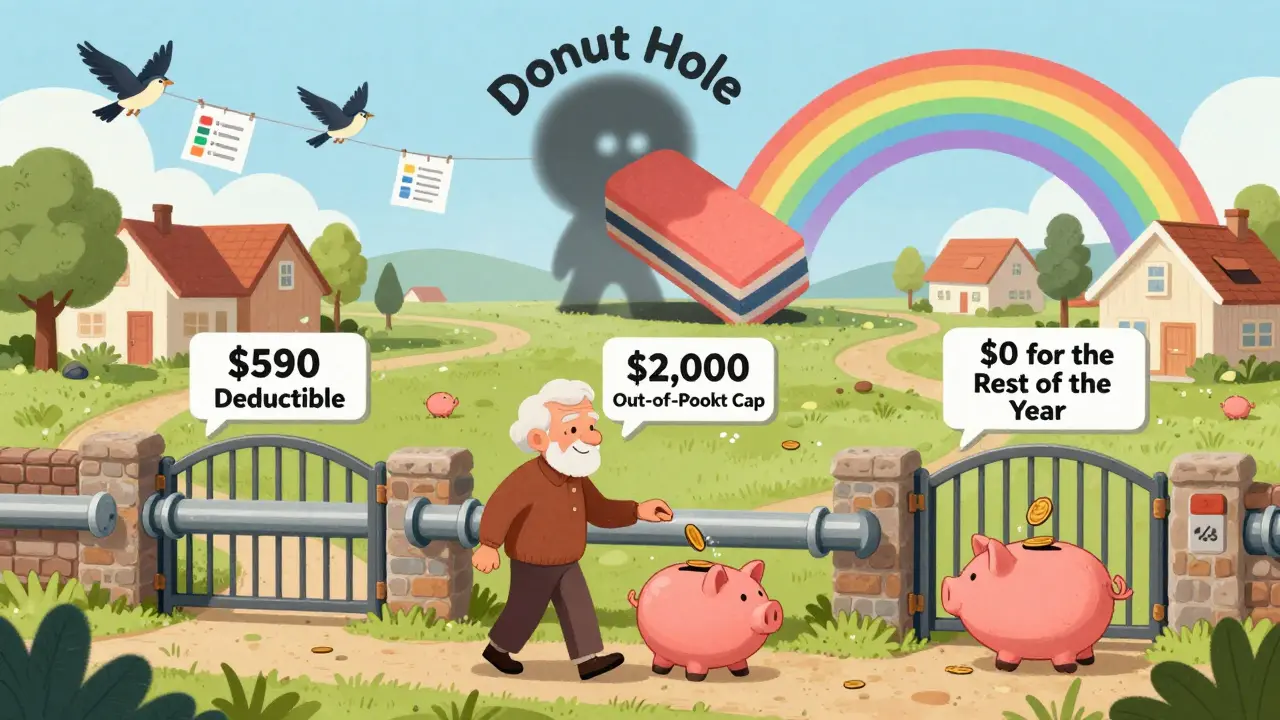
Starting in 2025, Part D covers both brand-name and generic drugs, including insulin, inhalers, vaccines, and specialty medications. The big change? There’s no more "donut hole." That confusing phase where your costs suddenly jumped up? Gone. Instead, there’s a simple three-phase system:
- Deductible phase: You pay 100% of drug costs until you hit $590 (up from $505 in 2024).
- Initial coverage phase: After the deductible, you pay 25% of the cost. Your plan pays 65%, and drug manufacturers chip in 10% through the new Discount Program.
- Catastrophic coverage phase: Once you’ve spent $2,000 out of your own pocket on covered drugs, you pay nothing for the rest of the year.
This $2,000 cap includes everything you pay: copays, coinsurance, even what you pay through Extra Help programs. It’s the first time in Part D’s history that there’s a hard limit on how much you’ll spend on meds in a single year.
How Much You’ll Actually Pay
Many people think the $2,000 cap means they’ll never pay more than that. But that’s not the whole story. That cap is only for what you pay toward your drugs. Your monthly premium is extra.
In 2025, the average monthly premium for a stand-alone Part D plan is $45. For Medicare Advantage plans that include drug coverage, it’s just $7. That’s a huge difference. But here’s the catch: lower premiums often mean higher costs when you actually fill your prescriptions. A $0 premium plan might have high copays for your specific meds.
Let’s say you take three drugs:
- Insulin: $35 per month (capped at $35 thanks to the Inflation Reduction Act)
- Generic blood pressure pill: $10 per month
- Brand-name cholesterol drug: $150 per month
That’s $195 a month in drug costs. In the initial coverage phase, you’d pay 25% of each: $8.75 for insulin, $2.50 for the blood pressure pill, and $37.50 for the cholesterol drug. Total: $48.75 a month. After you hit $2,000 total out-of-pocket spending across the year, you pay $0 for the rest.
But if you’re on a $0 premium plan with a high tier for your cholesterol drug, you might pay $60 a month for that one pill alone. That’s why comparing plans isn’t optional-it’s critical.
Formularies and Tiers: The Hidden Cost Factor
Every Part D plan has a list of covered drugs called a formulary. And every drug on that list is placed in a tier, which determines how much you pay.
Most plans use a five-tier system:
- Preferred generics: Lowest cost-often $0 to $10 per prescription.
- Generics: Slightly higher, usually $10 to $20.
- Preferred brands: $30 to $60.
- Non-preferred brands: $70 to $150.
- Specialty drugs: $200+ per prescription.
If your cholesterol drug is a non-preferred brand, you’ll pay way more than if it’s on preferred. Some plans don’t cover certain drugs at all. That’s why you need to check your exact medications against each plan’s formulary before enrolling.
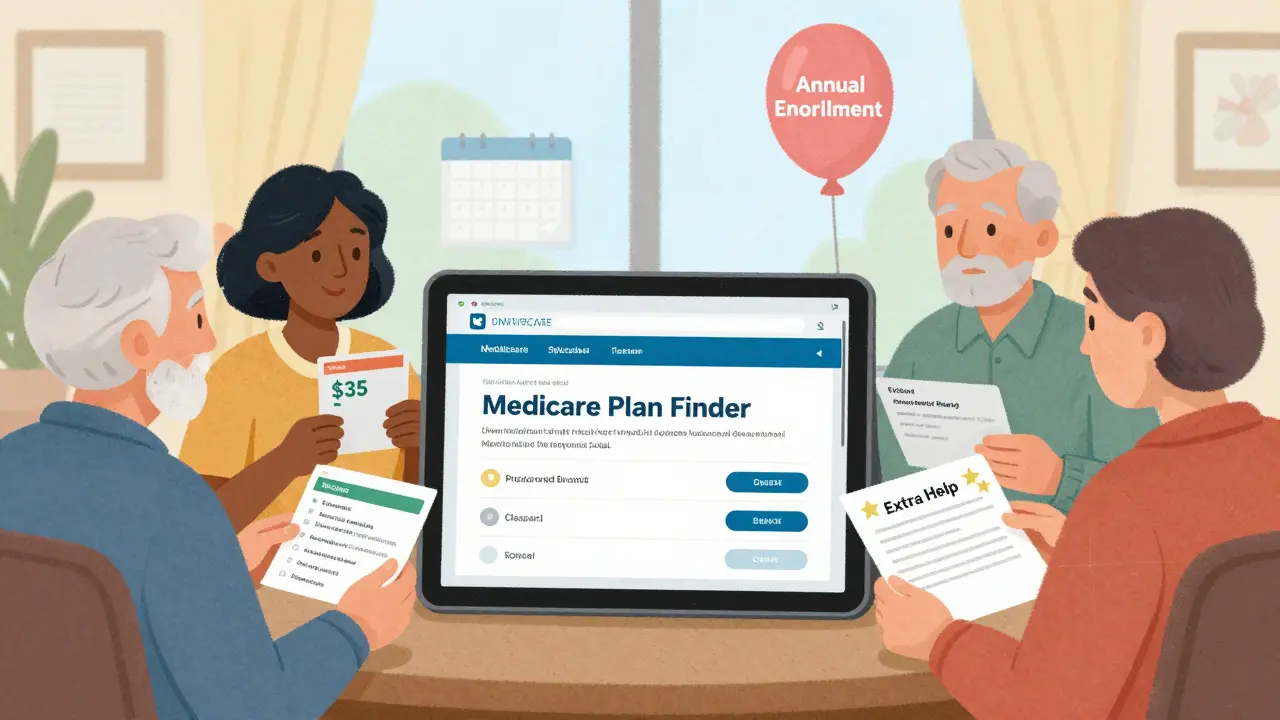
The Medicare Plan Finder tool lets you type in your drugs, dosages, and pharmacy preferences. It then shows you total estimated annual costs for each plan, including premiums, deductibles, and out-of-pocket spending. Don’t just pick the cheapest premium-pick the plan that saves you the most on your actual meds.
Who Qualifies for Extra Help?
If your income is low, you might qualify for Extra Help-a federal program that reduces your Part D costs even further.
For 2025, Extra Help covers:
- Monthly premiums (could be $0)
- Deductibles (no deductible)
- Copays (as low as $0 for generics, $10 for brands)
- Access to $0 premium plans
Over 90 stand-alone Part D plans in 2025 offer $0 premiums specifically for Extra Help recipients. If you’re on Medicaid, Supplemental Security Income (SSI), or have limited income and resources, you likely qualify. You can apply through Social Security or your state’s Medicaid office.
Why You Should Enroll Even If You Don’t Take Drugs Now
Here’s the part most people miss: if you don’t enroll when you’re first eligible and later decide to join, you’ll pay a late enrollment penalty.
The penalty is 1% of the national base beneficiary premium ($35.37 in 2024) for every month you go without creditable drug coverage. That means if you wait a year, your monthly premium jumps by $0.35. If you wait five years? That’s $1.77 extra per month-for life.
That penalty is added to your premium every month, forever. So even if you’re healthy now, signing up for a low-cost plan (even $5 a month) can save you hundreds later.
When and How to Change Plans
You can only change Part D plans during the Annual Enrollment Period: October 15 to December 7 each year. Your new plan starts January 1.
But there are exceptions:
- If you move to a new state or zip code.
- If you lose other drug coverage (like from an employer).
- If you qualify for Extra Help.
- If your plan leaves Medicare or changes its coverage.
Use the Medicare Plan Finder tool during open enrollment. Enter your medications, pharmacy, and zip code. Sort results by "lowest total cost"-not just premium. Look for plans that cover all your drugs on low tiers. If you take insulin, confirm it’s covered at the $35 cap.
What’s Still Confusing?
Despite the big improvements, confusion remains.
A 2024 survey by the Medicare Rights Center found that 68% of beneficiaries didn’t know about the $2,000 cap. Many thought it meant they’d pay no more than $2,000 total-including premiums. It doesn’t. Premiums are separate.
Another common mistake: assuming your current plan won’t change. Plans update their formularies every year. A drug you’re on today might move to a higher tier-or get dropped entirely. That’s why reviewing your plan every year isn’t optional. It’s your best defense against surprise bills.
Where to Get Help
You don’t have to figure this out alone.
- Medicare & You Handbook (Publication 10054-2025): Free guide with all the rules.
- 1-800-MEDICARE: Call 24/7. They handled 78 million calls in 2023.
- State Health Insurance Assistance Programs (SHIPs): Free, local counseling. In 2023, they helped over 5 million people.
- Medicare Plan Finder: Online tool at medicare.gov. Type in your drugs, get personalized cost comparisons.
Don’t wait until you’re hit with a $500 bill for your insulin. The system is simpler now-but you still need to act.
Is the $2,000 out-of-pocket cap for all drugs or just Part D-covered drugs?
The $2,000 cap only counts spending on drugs covered by your Medicare Part D plan. It includes what you pay out of pocket for copays, coinsurance, and deductible amounts. It does not include drugs not on your plan’s formulary, or medications bought outside of Part D (like over-the-counter drugs). Only covered Part D drugs count toward this limit.
Do I have to pay a premium even if I hit the $2,000 cap?
Yes. The $2,000 cap only covers what you pay for your medications. Your monthly premium is separate and still due every month, even after you’ve reached the catastrophic coverage phase. You’ll keep paying your premium until you drop your Part D plan.
Can I switch Part D plans anytime?
You can only switch during the Annual Enrollment Period (October 15-December 7), unless you qualify for a Special Enrollment Period. These include moving, losing other drug coverage, or qualifying for Extra Help. Outside those situations, you must wait until next year’s enrollment period.
What happens if my drug gets removed from the formulary?
Your plan must notify you in advance if a drug you take is being removed or moved to a higher tier. You can request a formulary exception, switch plans during the year if you qualify, or appeal the decision. Don’t stop taking your medication without talking to your doctor first.
Is insulin still capped at $35 per month in 2025?
Yes. The $35 monthly cap for insulin remains in place for 2025 and beyond. This applies to all Medicare Part D plans, regardless of tier or manufacturer. You pay no more than $35 per prescription for insulin, no matter how many you need.
Do all Part D plans cover the same drugs?
No. Each plan has its own formulary. While all plans must cover at least two drugs in each class (like blood pressure or diabetes meds), the specific brands and generics vary. Some plans may cover a drug you need, while others don’t. Always check your specific medications against each plan’s formulary before choosing.
How do I know if I’m getting the best plan?
Use the Medicare Plan Finder tool on medicare.gov. Enter your drugs, dosages, and preferred pharmacy. Select "Sort by lowest total cost" to see which plan saves you the most money over the year-not just the one with the lowest premium. Look for plans that put your medications on lower tiers and avoid those that require prior authorization for your drugs.