
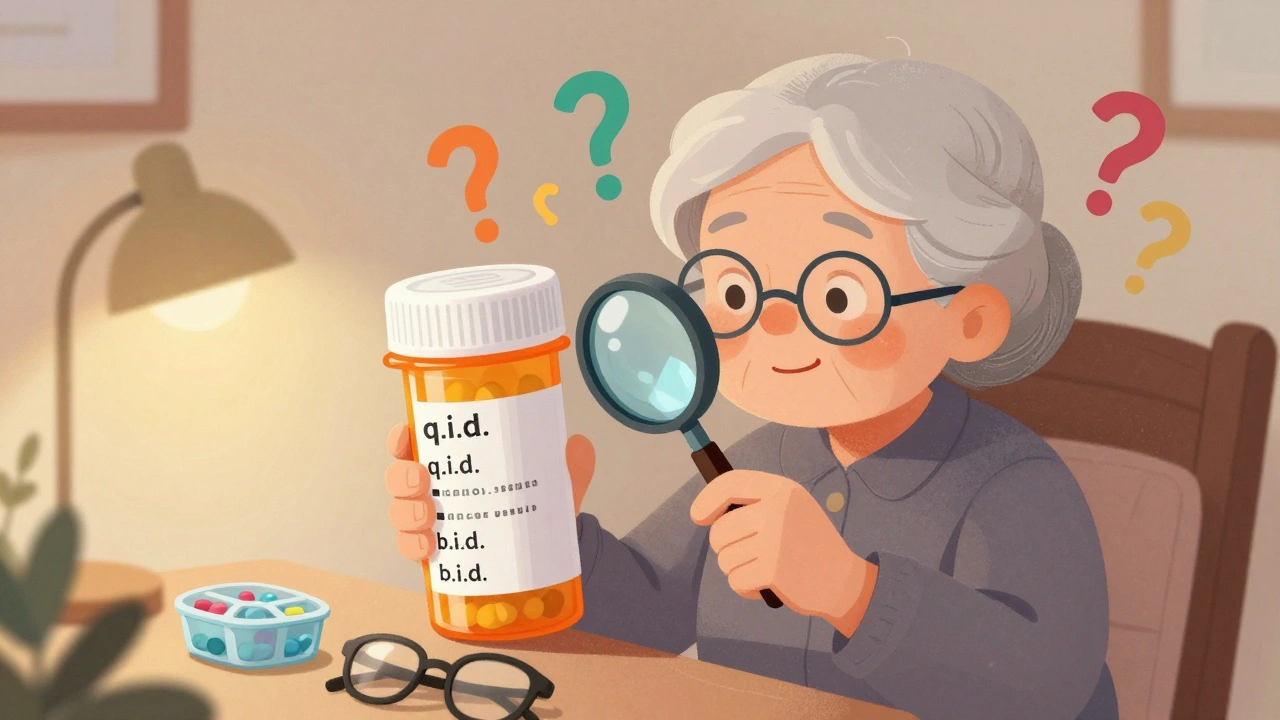
Every pill, injection, or inhaler you take comes with a label. But how many of you actually read it? Or worse - do you understand what it says? If you’ve ever stared at a prescription bottle wondering what ‘q.i.d.’ means, or if you’ve taken medicine at the wrong time because the instructions were too small to read, you’re not alone. In fact, 68% of patients in a 2022 survey said they struggled to understand their prescription labels. And for older adults, that number jumps to over half. This isn’t just about confusion - it’s about safety. Medication errors linked to unclear labels cause thousands of preventable hospital visits and even deaths every year.
What’s on a Prescription Drug Label?
Prescription labels in the U.S. follow strict rules set by the FDA. They’re built for healthcare professionals, not patients. That’s why they can feel like a dense, confusing document. The full label, called the Full Prescribing Information (FPI), has 17 sections. But you don’t need to read all of them. Here’s what actually matters to you:- Generic and Brand Names: The generic name (like metformin) is the active ingredient. The brand name (like Glucophage) is what the company sells it under. Always check both - mixing them up can lead to dangerous double-dosing.
- Dosage and Strength: This tells you how much of the drug is in each pill or dose. For example, 500 mg of metformin per tablet. Never assume two pills are the same just because they look alike.
- Route of Administration: How you take it. Is it by mouth? Injection? Skin patch? Sublingual (under the tongue)? This matters. Taking a sublingual tablet by swallowing it won’t work the same way.
- Indications: Why you’re taking it. Is it for high blood sugar? Depression? High cholesterol? This section is often buried, but knowing the reason helps you spot if you’ve been given the wrong medicine.
- Dosage Instructions: How much and how often. Look for phrases like ‘take one tablet by mouth twice daily’. Avoid abbreviations like q.d. or b.i.d. - they’re outdated and confusing. Ask your pharmacist to rewrite them in plain language.
- Contraindications: When NOT to take it. For example, if you have kidney disease, or you’re pregnant, or you’re on another drug that could interact dangerously.
- Warnings and Precautions: Red flags. This includes risks like liver damage, allergic reactions, or increased chance of falls in older adults.
- Expiration Date: Don’t ignore this. Medications lose potency over time. Some, like insulin or liquid antibiotics, can become harmful after expiration.
- Storage Instructions: Some drugs need refrigeration. Others must stay dry and out of sunlight. Storing them wrong can make them useless or unsafe.
On the bottle, you’ll also find the National Drug Code (NDC) - a unique 10-digit number that identifies the exact product, manufacturer, and package size. It’s useful if you need to report an error or check recalls.
What’s on an Over-the-Counter (OTC) Label?
OTC drugs - like pain relievers, cold meds, or antacids - have a simpler label called the Drug Facts box. It’s designed to be clear and readable. Here’s how to read it:- Active Ingredient: This is the medicine that works. For example, acetaminophen in Tylenol. Know this name - it’s the key to avoiding accidental overdoses. Many cold and flu pills also contain acetaminophen. Taking two products with it can cause liver damage.
- Purpose: What the ingredient does. Is it a pain reliever? Antihistamine? Decongestant? This helps you avoid taking multiple drugs with the same purpose.
- Uses: What symptoms it treats. Headache? Runny nose? Allergies? If your symptom isn’t listed, don’t take it.
- Warnings: This is critical. It tells you when to avoid the drug - like if you’re pregnant, have high blood pressure, or are taking other medications. It also warns about side effects and when to stop and call a doctor.
- Directions: How much to take and how often. Always follow this exactly. More isn’t better.
- Inactive Ingredients: Fillers, dyes, or flavorings. If you’re allergic to certain dyes or lactose, check this list.
OTC labels are better designed than prescription ones - but many people still skip reading them. A 2021 study found that 40% of adults took OTC painkillers more often than recommended, leading to serious liver or stomach damage.
Why Prescription Labels Are So Hard to Read
The system wasn’t built for patients. It was built for doctors and pharmacists. The FDA’s labeling rules focus on legal protection and clinical detail, not clarity. That’s why:- Text is tiny - often under 8-point font.
- Abbreviations like q.d. (once daily), b.i.d. (twice daily), or t.i.d. (three times daily) are still used, even though they’re banned in hospitals for safety reasons.
- There’s no clear indication of why you’re taking the medicine. You might get a pill for ‘hypertension’ - but what does that mean? ‘High blood pressure’ would be clearer.
- Language is medical. Terms like ‘adverse reactions’ or ‘hepatic impairment’ aren’t everyday words.
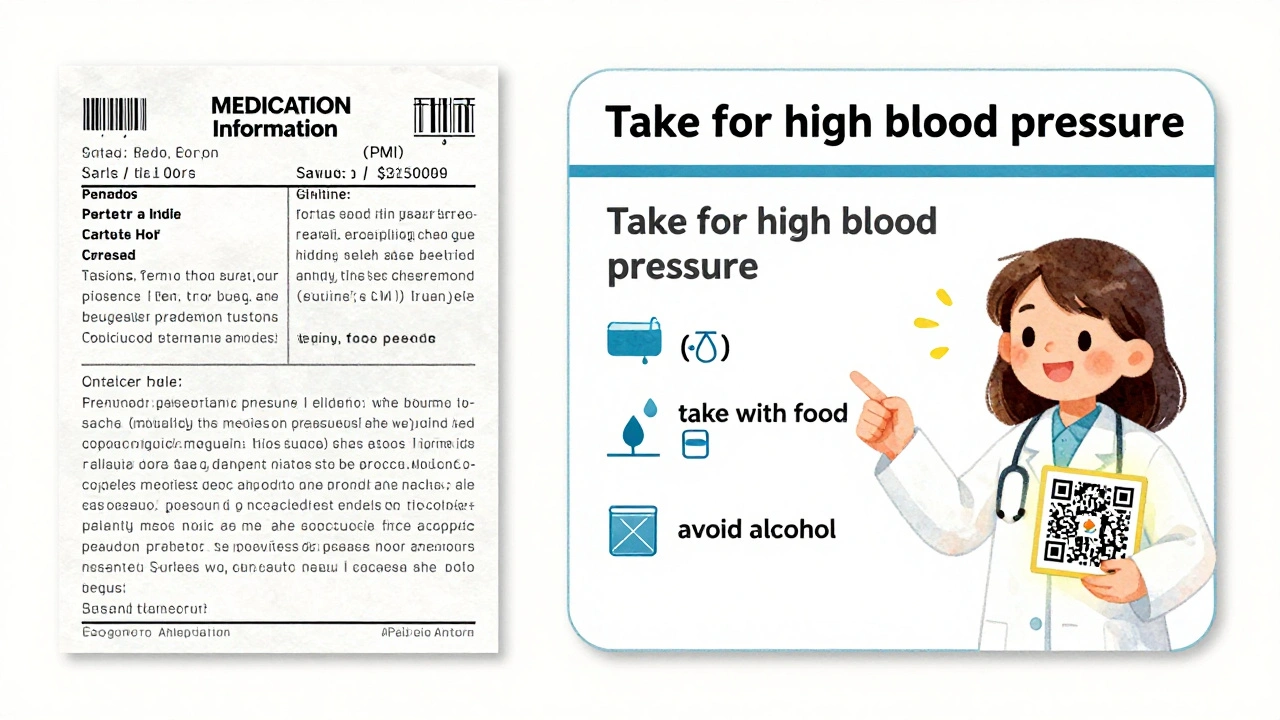
And here’s the kicker: research shows that when labels include the reason for the prescription - like ‘for high blood pressure’ - medication errors drop by up to 42%. Yet, most U.S. labels still don’t include this.
What You Can Do Right Now
You don’t have to wait for the system to change. Here’s how to protect yourself:- Ask your pharmacist to explain it. They’re trained to translate medical jargon. Say: ‘Can you tell me what this is for and how to take it in plain English?’
- Ask for a printed version in larger print. Most pharmacies will do this for free. If they don’t, ask for a digital copy you can zoom in on.
- Write down the purpose. Stick a note on your pill bottle: ‘This is for my cholesterol.’
- Use a pill organizer. Fill it with your meds for the week. It helps you track what you’ve taken and when.
- Check for interactions. Before taking a new OTC drug, ask your pharmacist: ‘Is this safe with my other meds?’
- Never trust the bottle alone. Always compare the label to your doctor’s prescription. Mismatches happen more often than you think.
One woman in Brisbane, 72, was taking two different blood pressure pills. She didn’t realize both contained the same active ingredient. She ended up with dangerously low blood pressure. After her pharmacist sat down with her and wrote out the purpose of each pill in big letters, her hospital visits stopped.
What’s Changing in Drug Labeling?
The FDA is finally moving toward patient-friendly labels. In 2023, they proposed a new standard called Patient Medication Information (PMI). This would be a one-page, easy-to-read summary that includes:- What the medicine is for
- How to take it (in plain language)
- What side effects to watch for
- When to call your doctor
- What to avoid while taking it
They’re testing these labels now. By 2026, high-risk medications like blood thinners, insulin, and chemotherapy drugs will start using them. This could cut medication errors by more than half.
Some pharmacies are already ahead of the curve. Independent pharmacies in Australia and the U.S. are adding:
- Color-coded labels for different times of day
- Icons for ‘take with food’ or ‘avoid alcohol’
- QR codes that link to video instructions
And if you’re using a smart pill dispenser or health app, many now sync with your prescription and send you reminders with plain-language instructions.
When to Get Help
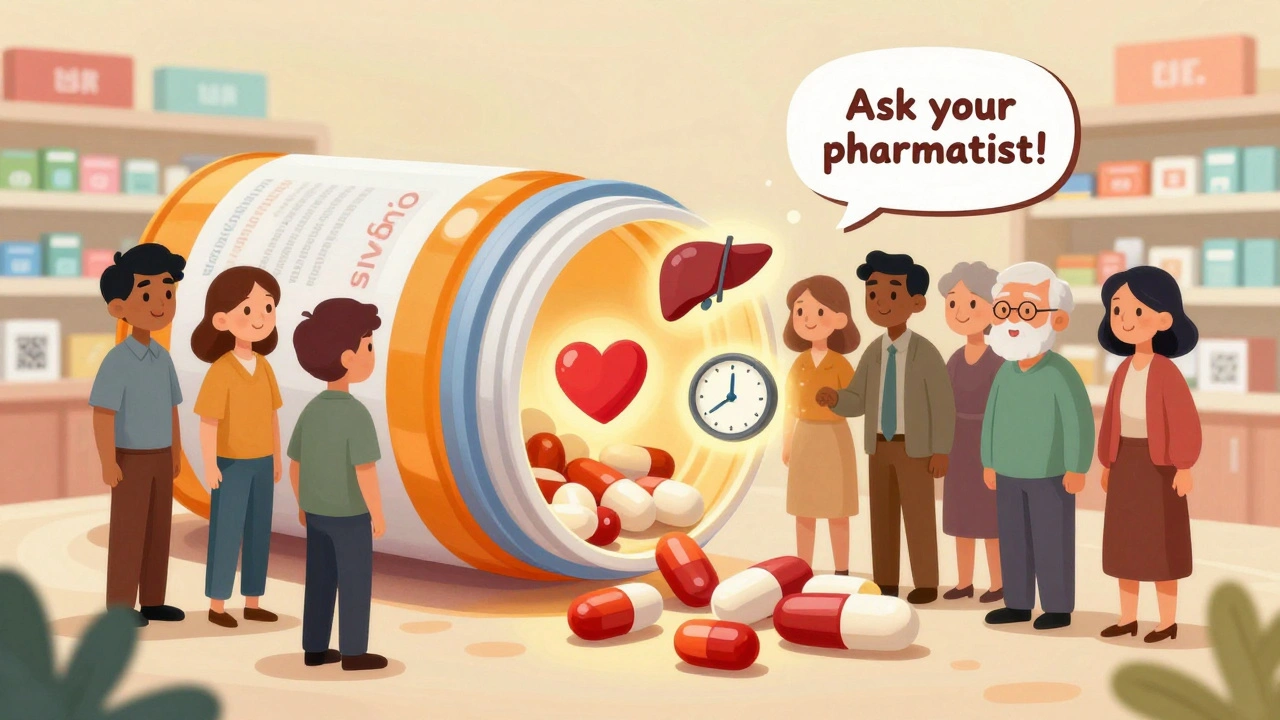
If you ever feel unsure about your medication, don’t guess. Don’t assume. Don’t wait until you feel sick. Reach out:- Call your pharmacist - they’re paid to answer these questions.
- Ask your doctor to write the purpose on the prescription.
- Use free services like the National Medication Information Line (in Australia, call 1800 633 424).
- If you’re caring for an elderly parent, help them organize their meds. Many seniors are too proud to ask for help.
Medication safety isn’t about memorizing labels. It’s about asking questions. It’s about speaking up. It’s about knowing that you have the right to understand what you’re putting into your body.
What’s the difference between generic and brand-name drugs?
Generic drugs have the same active ingredient, strength, dosage form, and route of administration as the brand-name version. They work the same way and are just as safe. The only differences are the inactive ingredients (like fillers or dyes) and the price - generics cost up to 80% less. Always check with your pharmacist to make sure the generic is right for you.
Why do some pills look different even if they’re the same medicine?
Different manufacturers make the same generic drug. Each company can choose its own pill shape, color, or size. That’s why your metformin might be white and oval one month, then blue and round the next. As long as the name, strength, and dosage instructions match, it’s the same medicine. If you’re confused, ask your pharmacist to confirm.
What should I do if I miss a dose?
Don’t double up unless the label says to. For most medicines, take the missed dose as soon as you remember - unless it’s almost time for the next one. Then skip it. Doubling up can cause overdose. Always check the label or call your pharmacist. For insulin, blood thinners, or seizure meds, missing a dose can be dangerous - ask for specific instructions.
Are expiration dates real, or just for show?
They’re real. Most medications lose potency after the expiration date. Some - like insulin, liquid antibiotics, or nitroglycerin - can become unsafe. The FDA says you shouldn’t use expired drugs, especially if they’re discolored, crumbly, or smell odd. For non-critical meds like pain relievers, they may still work but less effectively. When in doubt, throw it out.
Can I split my pills to save money?
Only if the pill has a score line and your doctor or pharmacist says it’s safe. Not all pills can be split evenly. Some are extended-release - splitting them can release too much medicine at once. Never split capsules or tablets without checking. A pill splitter from the pharmacy costs less than $10 and helps you split accurately.
What’s a Medication Guide?
It’s a separate, FDA-approved paper that comes with certain high-risk drugs - like blood thinners, antidepressants, or cancer treatments. It explains serious risks in plain language. You should get one with every new prescription for these drugs. If you don’t, ask for it. There are over 240 of these guides in use today.

Kaitlynn nail
December 10, 2025 AT 19:29Medication labels are just another way the system keeps us docile. We’re not supposed to understand-just obey. The FDA? More like the Food and Drug Administration of Fear. They want you confused so you keep taking pills and never question why.
Nikki Smellie
December 11, 2025 AT 11:54Did you know the same companies that make the drugs also write the labels? And they’re the same ones lobbying Congress to keep the font tiny? I’ve seen the internal memos. It’s not incompetence-it’s deliberate. They profit from confusion. 💀
Frank Nouwens
December 12, 2025 AT 08:41This is one of the most thoughtful breakdowns I’ve read on the topic. I’ve been a pharmacist for 22 years, and I still see patients staring at their bottles like they’re ancient hieroglyphs. The fact that we still use 'q.i.d.' in 2024 is criminal. I always rewrite instructions in plain language for my patients-it takes two extra minutes, but it saves lives.
Regan Mears
December 13, 2025 AT 21:27Yes! Yes! YES! I’ve been screaming this from the rooftops for years! People don’t realize that taking two Tylenols and a cold medicine with acetaminophen is like drinking bleach! And the expiration dates? They’re not just suggestions-they’re legal deadlines! Don’t be that person who takes last year’s antibiotics because ‘it’s probably fine’-it’s not fine! Please, please, please-ask your pharmacist! They’re not there to upsell-they’re there to save you!
Doris Lee
December 14, 2025 AT 10:41My grandma used to mix up her blood pressure pills until I sat down with her and wrote the purpose on each bottle in marker. Now she takes them like clockwork. It’s not rocket science-it’s just clarity. Small changes, huge impact.
Michelle Edwards
December 14, 2025 AT 21:48Thank you for writing this. I know it’s easy to feel overwhelmed when you’re juggling five prescriptions, but you’re not alone. Every time you ask a question, you’re not being ‘difficult’-you’re being brave. Keep asking. You deserve to understand what’s in your body.
Jack Appleby
December 15, 2025 AT 04:04Actually, the FDA’s FPI isn’t ‘designed for doctors’-it’s designed for litigation. The 17 sections exist because someone got sued for not disclosing a 0.003% risk of retinal detachment in 1998. The system isn’t broken-it’s over-engineered. What we need isn’t ‘patient-friendly’ labels-we need standardized, legally defensible documentation that happens to be readable. You can’t fix bureaucracy with emojis and QR codes.
David Palmer
December 15, 2025 AT 22:11lol why do we even care? Everyone just takes what the doctor says. If you’re smart enough to read this post, you’re probably not the one dying from bad labels. The people who need this? They’re too busy working two jobs to read tiny print.
Stephanie Maillet
December 17, 2025 AT 05:43It’s interesting how we’ve outsourced our bodily autonomy to institutions-pharmacies, doctors, corporations-and now we’re surprised when the instructions are written in a language we don’t speak. Maybe the real problem isn’t the label-it’s that we’ve stopped trusting our own curiosity. We wait to be told what to do, instead of asking, ‘Why?’
Neelam Kumari
December 17, 2025 AT 21:47Oh wow, another white American telling the world how to take medicine. In India, we’ve been using generic drugs since the 70s-cheaper, just as effective. But you? You need a QR code and a color-coded pill organizer. Pathetic. At least we don’t need a PhD to swallow a tablet.
Raj Rsvpraj
December 18, 2025 AT 04:06India produces 40% of the world’s generic drugs-yet you Americans still pay $500 for insulin? Your healthcare system is a joke. You need a ‘Medication Guide’? We have a grandmother who reads the label and says ‘take two after roti.’ Done. No apps. No icons. Just common sense. You’re overcomplicating survival.
Aileen Ferris
December 19, 2025 AT 18:44ok but like… why do they even use ‘b.i.d.’? it’s 2024. no one says that anymore. also, i once took a pill that said ‘take with food’ and i was like… food? like… a sandwich? or a salad? i just ate a dorito. is that enough? 🤔
Ben Greening
December 21, 2025 AT 09:31Thank you for this comprehensive overview. The disconnect between clinical documentation and patient comprehension remains a critical gap in public health. I recommend that institutions implement mandatory pharmacist-led medication reconciliation during every new prescription fill. The data supporting this intervention is robust and reproducible.