
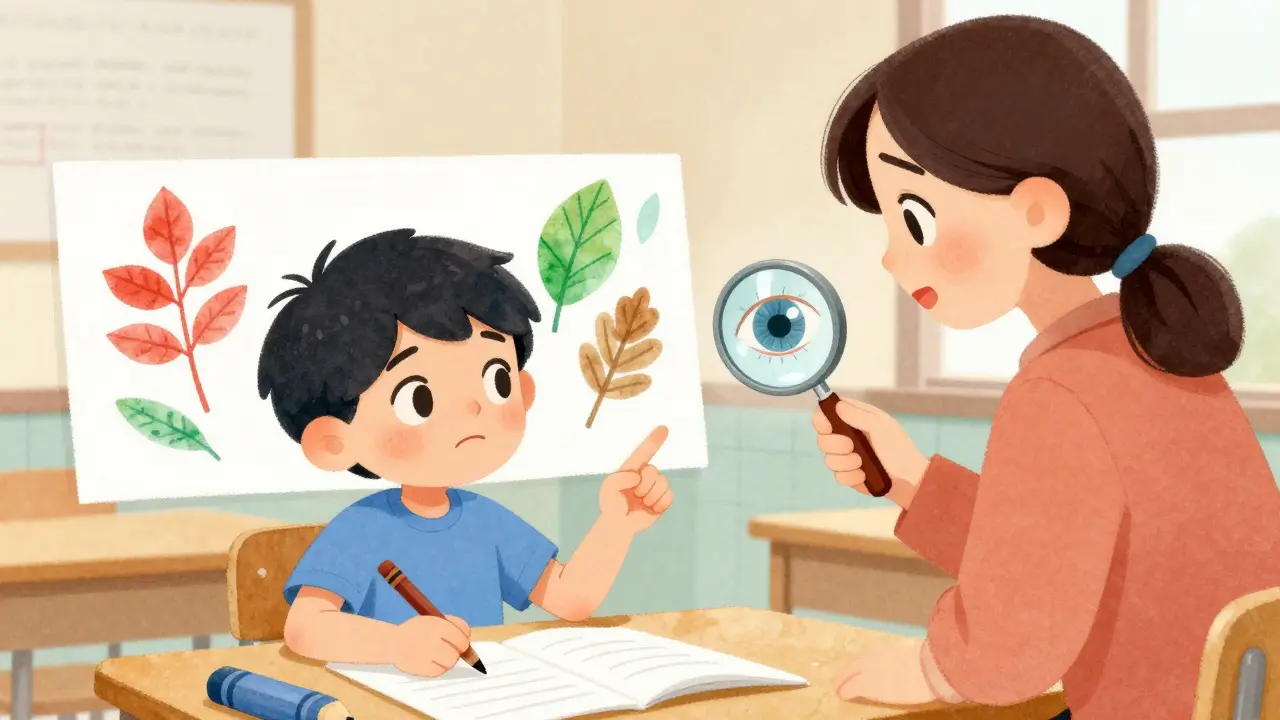
Most people think of color blindness as seeing only in black and white, but that’s not how it works for the vast majority of people. In fact, fewer than 1 in 30,000 people have true monochrome vision. The most common form - affecting about 8% of men and 0.5% of women worldwide - is red-green color blindness. It’s not a disease. It’s not something that gets worse with age. It’s a genetic trait, passed down through families, that changes how the eye processes certain colors. If you’ve ever struggled to tell apart red and green wires, confused a traffic light in fog, or been told your shirt and pants don’t match when you thought they did, you might be one of them.
How Red-Green Color Blindness Actually Works
Your eyes have three types of cone cells that detect color: one for red, one for green, and one for blue. These cones contain light-sensitive proteins called photopsins. For red-green color blindness, the problem lies in either the red or green photopsin. When these proteins don’t work right, the brain gets mixed or incomplete signals. That’s why someone with this condition sees reds, greens, browns, and oranges as more similar than they really are.
There are two main types of red-green deficiency: protanopia and deuteranopia. Protanopes lack the red cone pigment entirely. To them, reds look darker, almost black, and greens appear more like yellow or beige. Deuteranopes lack the green pigment. Their world is mostly shades of red and yellow, with greens looking muddy or brownish. Deuteranopia is far more common - about 5% of men have it. Protanopia affects only about 1%.
Then there are the milder forms: protanomaly and deuteranomaly. These aren’t full losses - the cones are just misaligned. People with these types can still see color, but they need more contrast to tell the difference. Deuteranomaly is the most common overall, making up about 80% of all red-green cases.
Why Men Are Affected Much More Than Women
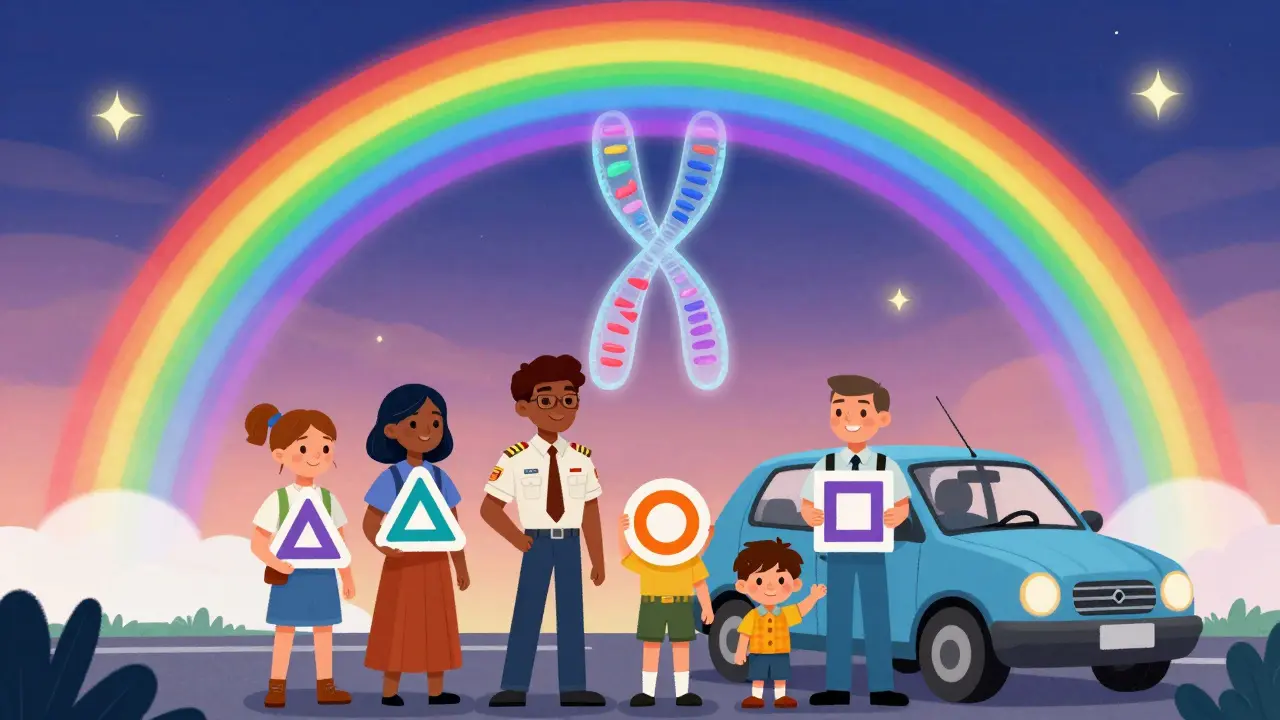
This is where genetics come in. The genes that make the red and green photopsins are located on the X chromosome. Men have one X and one Y chromosome. Women have two Xs. If a man inherits a faulty gene on his single X chromosome, he has no backup. He will be color blind. A woman needs two faulty copies - one on each X - to be affected. That’s rare.
Think of it like this: if 8% of men carry the gene, then statistically, about 0.64% of women should be affected (0.08 × 0.08). But real-world numbers are even lower - around 0.5% - because of something called X-inactivation. In women, one X chromosome is randomly turned off in each cell. Sometimes, the healthy X stays active enough to compensate. That’s why most women with one faulty gene are carriers - they don’t show symptoms but can pass the gene to their kids.
This is why you’ll see more men with color blindness. It’s not about biology being unfair - it’s just how the X chromosome works. A mother who carries the gene has a 50% chance of passing it to her son. If he gets it, he’ll be color blind. If she passes it to her daughter, the daughter becomes a carrier unless the father is also color blind.
What It Feels Like to Live With It
Most people with red-green color blindness don’t realize they see the world differently until someone points it out. A child might get confused in art class. A driver might misread a signal. An electrician might mix up wires. A pilot might fail a screening test - and that’s not just about safety. In Australia, commercial pilots must pass color vision tests. Many with mild forms still fly, but severe cases are disqualified.
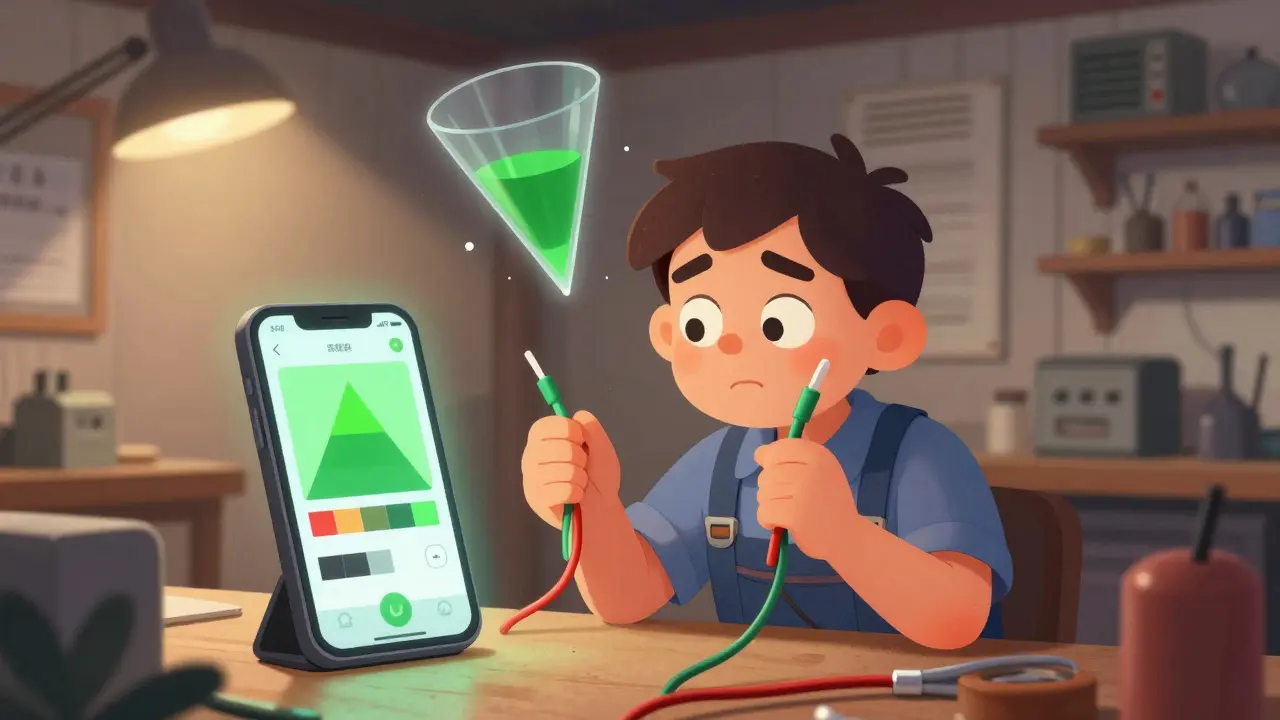
On forums like Reddit’s r/ColorBlind, people share stories. One user said he once wore a red shirt to a job interview because he thought it matched his tie. His boss didn’t say anything - but he never got the job. Another said he relies on labels on his USB cables because he can’t tell red from green.
But many adapt. A graphic designer from Brisbane told me she uses brightness and pattern instead of color to differentiate elements in her designs. She says it made her work better. Another guy, a mechanic, uses a small color checker app on his phone to verify wire colors before he starts working. These aren’t fixes - they’re workarounds. And they work.
How It’s Tested - And What the Tests Miss
The most famous test is the Ishihara test. It uses colored dots to form numbers. People with normal color vision see one number. Those with red-green deficiency see another - or nothing at all. But this test has limits. It doesn’t catch mild cases. It doesn’t test for how well someone sees in low light. And it doesn’t tell you whether you’re a protanope or deuteranope.
More advanced tests exist. The Farnsworth-Munsell 100 Hue Test asks you to arrange colored caps in order. It’s used in design, aviation, and military fields. But most people never take it. Most are screened once - usually in school - and told they’re fine.
The problem? Many don’t know they’re color blind until it affects them in real life. A 2022 survey of over 1,200 people found that 78% had trouble with color-coded charts in school. 65% struggled with traffic lights in fog. And 42% said digital apps were hard to use because buttons or icons relied too much on color.
Tools That Help - And What Doesn’t
There’s no cure. Gene therapy has worked in monkeys - and human trials are coming. But right now, we rely on tools.
EnChroma glasses are popular. They cost between $329 and $499 and filter out overlapping wavelengths to sharpen the difference between red and green. Studies show about 80% of users report improved color perception - especially in bright light. But they don’t restore normal vision. They don’t help everyone. And they don’t work in dim lighting.
There are apps too. Sim Daltonism and Color Oracle are free tools designers use to simulate how colorblind people see their work. Apple and Microsoft have built-in color filters in their operating systems. They let users shift hues to make reds and greens stand out more. These aren’t flashy - but they’re practical.
The Colour Blind Awareness organization offers a free Photoshop plugin that simulates color blindness. Over 45,000 people have downloaded it. It’s not just for designers - teachers, web developers, and even parents use it to make content clearer.
What Society Is Doing - And What’s Coming
More organizations are recognizing color blindness as a real accessibility issue. The European Union’s Accessibility Act requires public websites to avoid color-only cues. The UK’s Equality Act 2010 classifies it as a disability, meaning employers must make reasonable adjustments. In Australia, universities now offer color-accessible handouts on request.
There’s also ColorADD - a universal symbol system that uses shapes to represent colors. It’s used in public transport systems in 17 countries. A bus route might be marked with a green circle instead of just a green line. A warning sign might have a red triangle instead of just red paint.
On the tech side, companies are building tools into their products. Microsoft says over 2.3 million people have used Windows’ color filter since 2015. Apple reports 0.8% of iPhone users have color filters turned on - that’s hundreds of thousands of people who need help seeing color.
And the market is growing. The global color blindness testing and assistive tech market was worth $148 million in 2022. It’s expected to hit $215 million by 2027. Why? Because more people are speaking up. More designers are listening. And more companies are realizing that accessibility isn’t optional - it’s just good design.
What You Can Do - If You’re Affected or Know Someone Who Is
- If you suspect you’re color blind, get tested. A simple online test won’t cut it - see an optometrist who uses advanced tools.
- Don’t assume it’s a handicap. Most people adapt well. It’s not a barrier - just a difference.
- If you design websites, apps, or educational materials: never use color alone to convey meaning. Add patterns, labels, or icons.
- Use tools like Color Oracle or the WCAG contrast checker to test your designs.
- If you’re a parent of a child with color blindness, talk to their school. Many textbooks and digital platforms are color-dependent. Ask for alternatives.
- Don’t feel embarrassed. You’re not alone. One in 12 men and one in 200 women have this trait. It’s common. It’s genetic. It’s not your fault.
Color blindness doesn’t mean you can’t see color. It means you see it differently. And that’s okay. In fact, some of the best designers, engineers, and problem-solvers in the world have it. They just learned to work around it - and sometimes, they made the world better because of it.
Can color blindness get worse over time?
No. Red-green color blindness is congenital, meaning it’s present from birth and doesn’t change. Unlike age-related vision loss, it doesn’t progress. You won’t suddenly lose more color vision as you age. However, other eye conditions like cataracts or macular degeneration can affect color perception later in life - but those are separate issues.
Can women be color blind?
Yes, but it’s rare. Women need two copies of the faulty gene - one on each X chromosome - to be affected. Since the gene is carried on the X chromosome and men pass their X to daughters, a woman is more likely to inherit the gene from her father (who is color blind) and her mother (who is a carrier). Only about 0.5% of women have red-green color blindness, compared to 8% of men.
Are color-correcting glasses a cure?
No. Glasses like EnChroma help some people see more colors by filtering out overlapping wavelengths, but they don’t fix the underlying genetic issue. They don’t restore normal color vision. They make certain colors stand out more, especially in bright daylight. Results vary - about 20% of users report little to no improvement. They’re a tool, not a cure.
Can you be color blind and still drive safely?
Yes. Most people with red-green color blindness drive without issue. Traffic lights are arranged in a standard order - red on top, green on bottom. Many learn to recognize the position, not the color. In fog or glare, it can be harder - which is why some use apps or filters. In Australia, drivers don’t need to pass a color test to get a license, unless they’re applying for commercial roles like trucking or aviation.
Is red-green color blindness linked to other health problems?
No. It’s purely a genetic variation in the cone cells of the retina. People with red-green color blindness have normal visual acuity, depth perception, and night vision. It doesn’t increase risk for other eye diseases. It’s not connected to diabetes, glaucoma, or neurological disorders. It’s simply a difference in how the eye processes specific wavelengths of light.
Can gene therapy cure color blindness?
Not yet - but it’s getting close. In 2022, scientists successfully restored full color vision in adult squirrel monkeys using gene therapy. The treatment delivered a functional human gene into the retina, and the monkeys could distinguish colors they couldn’t before - for over two years. Human trials are in planning stages. It’s not a guarantee, but it’s the first real sign that a biological fix might be possible one day.





Rama Rish
March 24, 2026 AT 03:21Caroline Dennis
March 24, 2026 AT 04:21Kevin Siewe
March 25, 2026 AT 11:16Chris Farley
March 25, 2026 AT 12:08Darlene Gomez
March 25, 2026 AT 14:51Amber Gray
March 26, 2026 AT 02:21Katie Putbrese
March 27, 2026 AT 21:17Jacob Hessler
March 28, 2026 AT 12:37Danielle Arnold
March 29, 2026 AT 11:32James Moreau
March 30, 2026 AT 15:07J. Murphy
March 30, 2026 AT 20:14Jesse Hall
April 1, 2026 AT 01:33Kenneth Jones
April 2, 2026 AT 23:34winnipeg whitegloves
April 4, 2026 AT 22:33