
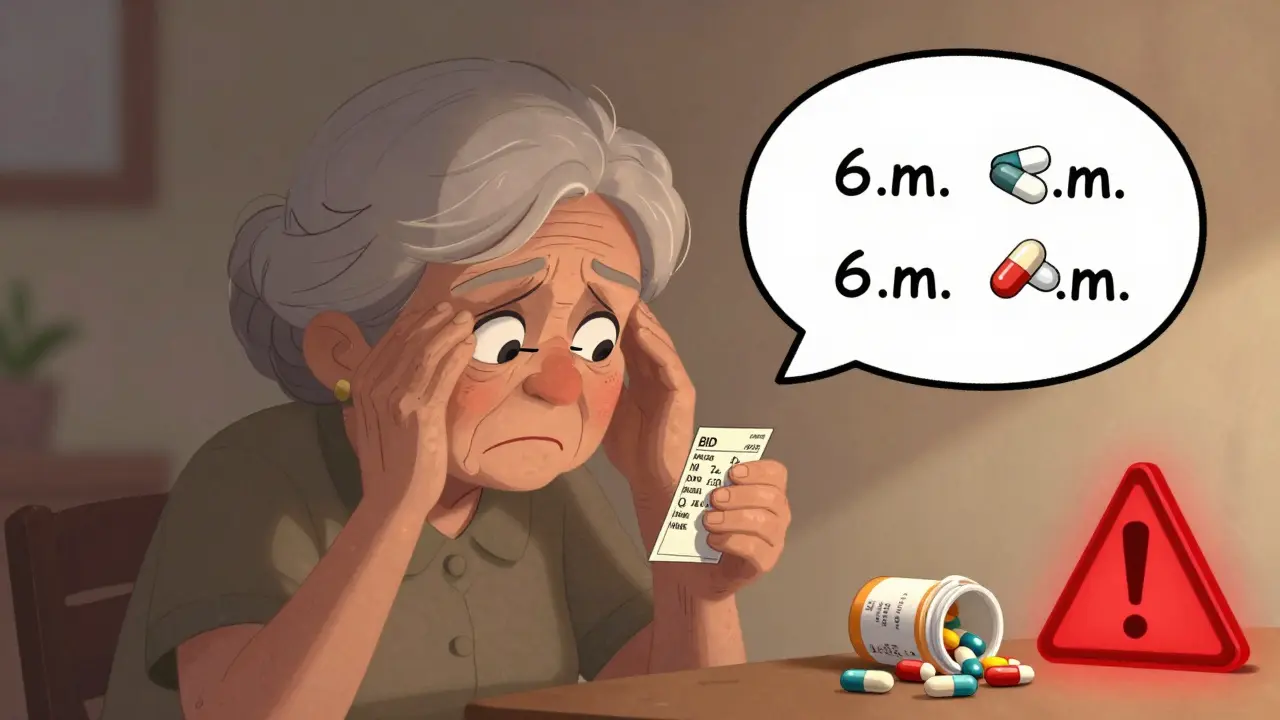
Prescription labels are meant to keep you safe-but too often, they do the opposite. You pick up your medicine, read the label, and think you understand. But what if the words are too complicated? What if the timing is unclear? What if the symbols mean something totally different than you thought? You’re not alone. Millions of people misread their prescription labels every year, leading to missed doses, overdoses, and even hospital visits. The problem isn’t that patients aren’t paying attention. It’s that the labels themselves are designed poorly.
Why Prescription Labels Confuse People
Most prescription labels are written by pharmacists using medical jargon that even college-educated people struggle with. Terms like "BID," "QHS," or "PO" show up on labels without explanation. A 2006 study found that 46% of patients misunderstood at least one instruction on their label. Even worse, 71% of those with low literacy skills got it wrong. You might think, "I’m smart-I read the label." But research shows that 23% of people with college degrees still misinterpret common directions like "take once daily" or "take with food." The biggest culprits? Multistep instructions, vague time frames, and confusing symbols. "Take every 4 to 6 hours" sounds flexible-but many people end up taking it four times a day because 24 divided by 6 equals 4. "Take with food" gets misread as "take instead of food," leading people to skip meals. And those little icons? A plate with a fork might mean "take with food," but 68% of patients don’t recognize it. One Reddit user shared how they took their antibiotic four times a day thinking "q6h" meant four doses because "24 divided by 6 is 4." They ended up in the ER with stomach bleeding.What’s Actually on the Label (And What’s Missing)
Many prescription labels skip critical details. About 6% of labels don’t include the exact number of pills to take or how often. Some don’t mention whether the medicine should be taken with food, on an empty stomach, or at bedtime. Others use font sizes too small to read-some as low as 10-point, while others go up to 14-point. Color contrast matters too. If the text is light gray on white, it’s nearly unreadable for older eyes or people with low vision. The worst offenders? Labels that use passive voice. Instead of saying "Take 1 tablet daily," they write "One tablet should be taken daily." That extra wording adds confusion. Studies show active voice cuts misunderstanding by nearly half. Also, instructions that list multiple steps-like "Take 1 tablet in the morning, 1 tablet at night, and do not take with grapefruit juice"-are harder to follow than simple, single-step directions.How Chain Pharmacies Are Fixing This (And Why Independent Ones Aren’t)
Big pharmacy chains like CVS, Walgreens, and Walmart have made major changes. Since 2015, Walgreens rolled out its "ClearView" label system: larger fonts, clearer language, and clock icons showing exact times (like 8 a.m. and 8 p.m.). They also added pictograms for "take with food" and "avoid alcohol." A 2018 study found these redesigned labels improved patient understanding by 31% compared to traditional labels. But most independent pharmacies still use outdated templates. Why? Cost. Updating software to support standardized labels can cost $2,500 to $5,000 per location. That’s a big hit for small businesses. As of 2023, only 32% of independent pharmacies use the USP Chapter <17> standards, while 78% of chain pharmacies do. Hospitals? Nearly 90% are compliant. The gap is real-and dangerous.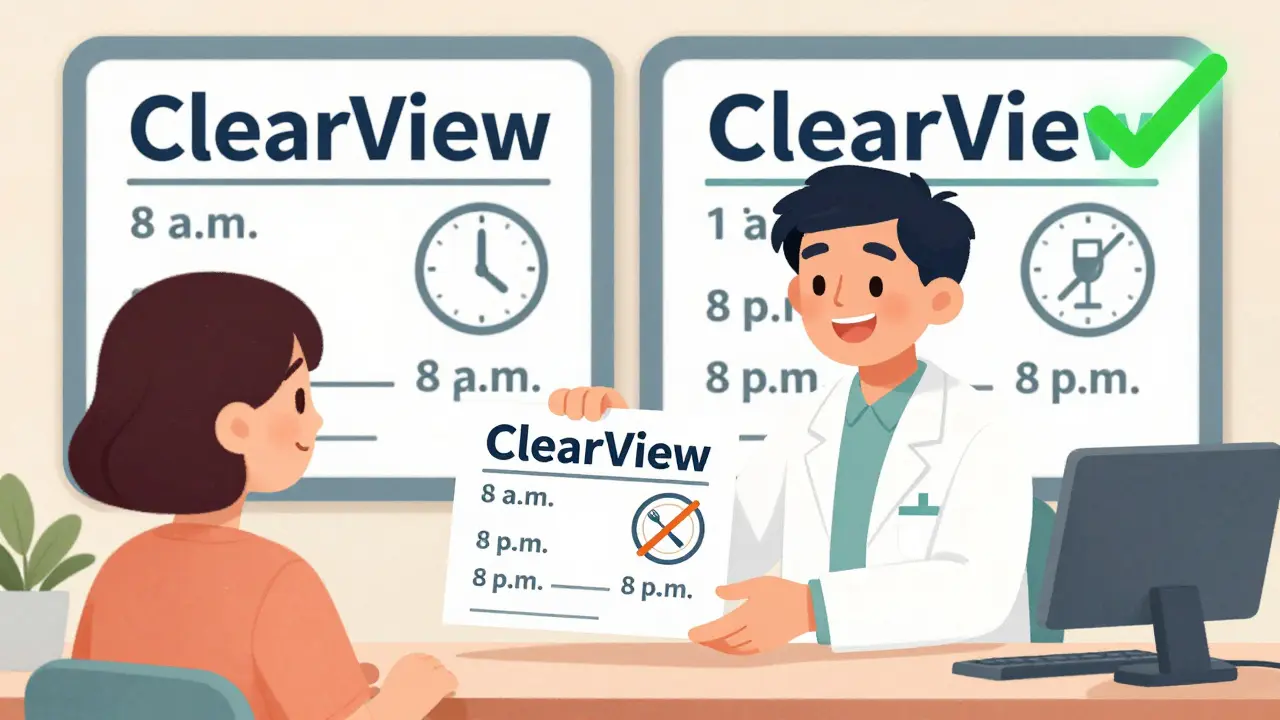
What You Can Do Right Now
You don’t have to wait for the system to fix itself. Here’s what works:- Ask for a plain-language label. Say: "Can you print this with simple words and times like 8 a.m. and 8 p.m. instead of BID?" Most pharmacies will do it.
- Use the "Teach-Back" method. After the pharmacist explains, say: "Just to make sure I got it right-you want me to take one pill at 8 a.m. and one at 8 p.m., right?" This cuts errors by over 50%.
- Request large-print or audio labels. CVS, Walgreens, and Walmart all offer large-print labels on request. Some even offer QR codes that link to voice instructions-new since 2025.
- Use your phone. Take a picture of the label and use apps like GoodRx’s "Label Lens" to translate it into plain English. It works 89% of the time.
One patient in Brisbane started writing down instructions on sticky notes and sticking them to her pill bottle. Another recorded her pharmacist’s explanation on her phone. These aren’t fancy solutions-but they work.
Language and Cultural Barriers
If English isn’t your first language, prescription labels become even harder. Only 12% of U.S. pharmacies offer labels in Spanish-even though over 41 million people speak it. Translated labels often use inconsistent terms. "Take with food" might be translated as "take along with food" in one pharmacy and "take during a meal" in another. A 2015 study found Spanish-speaking patients had 3.2 times more confusion than English speakers. If you need a label in another language, ask. Some pharmacies can print it. Others can refer you to a translator.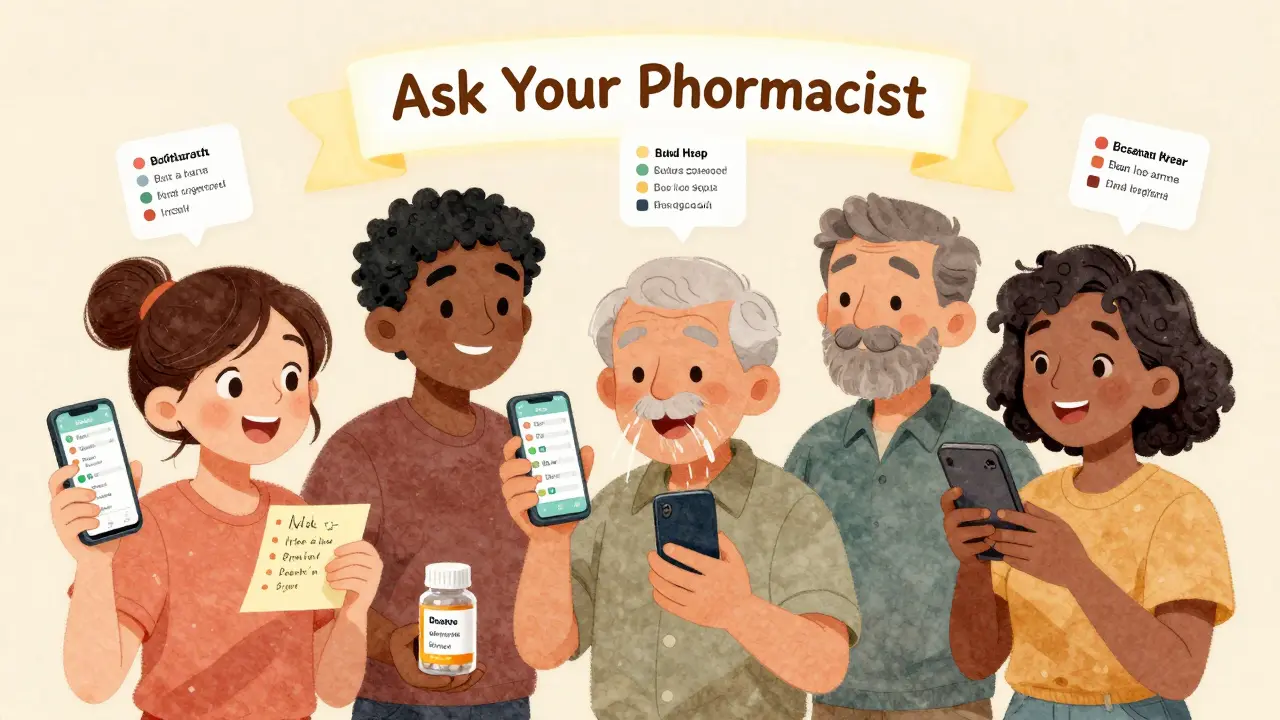
The Bigger Picture: Why This Matters
Misreading a prescription label isn’t just a small mistake. It leads to 1.3 million emergency room visits and over 350,000 hospital stays every year in the U.S. alone. The cost? Around $200 billion annually in avoidable care. These aren’t numbers on a chart-they’re real people. A senior skipping doses because they didn’t understand "twice daily." A parent giving too much medicine because "every 4 to 6 hours" sounded like "four times a day." The good news? We know how to fix this. Standardized labels with clear language, big fonts, clock icons, and active voice reduce errors from 46% down to 12%. The FDA, USP, and CDC have all published guidelines. The problem isn’t the solution-it’s the lack of enforcement. Only 17 states have passed laws requiring health-literate labels by 2025. Federal rules could come as soon as 2025.Final Tips: Don’t Guess. Ask.
Your health is too important to leave to chance. If you’re unsure about your prescription:- Don’t assume you know what it means.
- Don’t rely on memory.
- Don’t be afraid to ask again.
Pharmacists are trained to help. Use them. Ask for a written copy. Ask for a clock diagram. Ask for a second explanation. You’re not being difficult-you’re being smart. And in a system where labels are still confusing, asking is the best protection you have.
What does "BID" mean on a prescription label?
"BID" stands for "bis in die," which is Latin for "twice a day." But many people misunderstand it as "every two hours." The safest way to read it is: "Take 1 tablet in the morning and 1 tablet in the evening." Always ask your pharmacist to write it out in plain language.
Why do some prescription labels use symbols instead of words?
Symbols are meant to be universal, but they’re not always clear. A plate with a fork might mean "take with food," but 68% of patients misinterpret it. A cup with a slash might mean "avoid alcohol," but some think it means "take with water." The FDA is working on standardized pictograms, but they’re not yet mandatory. Until then, ask your pharmacist to explain what each symbol means.
Can I ask for a large-print label?
Yes. All major pharmacy chains (CVS, Walgreens, Walmart) offer large-print labels at no extra cost. You can request them in person or over the phone. Some pharmacies also offer labels in high-contrast colors (black text on yellow background) for better visibility.
What should I do if I miss a dose because I misunderstood the label?
Call your pharmacist or doctor immediately. Don’t double up on the next dose unless they tell you to. Many medications are safe if you miss one dose, but some can be dangerous if you take too much. Always check before adjusting your dose.
Are there apps that help me understand my prescription label?
Yes. GoodRx’s "Label Lens" app uses AI to scan your prescription label and rewrite instructions in plain English. It works with 89% accuracy and is free to use. Amazon Pharmacy also offers voice-enabled labels that read instructions aloud when you scan the QR code. Both are available in Australia and the U.S.


Agnes Miller
February 16, 2026 AT 06:35Man, I just read this and thought about my grandma. She took her blood pressure med 'with food' and always ate it with a bowl of cereal. Turns out, the pharmacist meant 'take while eating a meal,' not 'take with your morning Crunchies.' She ended up in the hospital twice. I showed her the ClearView labels at Walgreens and now she’s fine. Seriously, just ask for plain language. It’s not that hard.
Philip Blankenship
February 17, 2026 AT 22:52I’ve been a pharmacy tech for 14 years and let me tell you, the labels are a disaster. Not because pharmacists are lazy - we’re not - but because the software we’re forced to use is from 2008. I’ve seen people take 12 pills in one day because the label said 'q6h' and they thought it meant 'every 6 hours, so 4 times a day.' I’ve had to call doctors just to clarify instructions that should’ve been written in plain English. The system’s broken. Chains like CVS fixed it with icons and big fonts. Independent pharmacies? They’re still printing on 10-point Courier. It’s not a patient problem. It’s a corporate cost-cutting problem.
Adam Short
February 18, 2026 AT 05:35Of course this is a problem - because we let corporations dictate healthcare. In Britain, we’ve had standardized prescription labels since the 90s. Big font. Clear times. No Latin. No symbols. No guesswork. But here? You need a PhD just to read a pill bottle. And don’t even get me started on the QR code nonsense. My mate in London just gets a printed slip with 'Take 1 tablet at 8am, 1 at 8pm.' Simple. Human. Why can’t America do that? Because profit > safety. Always.
Tony Shuman
February 18, 2026 AT 15:52Wait - you’re telling me the FDA hasn’t mandated clear labels yet? That’s insane. This isn’t even a debate. It’s a public health emergency. And yet, 17 states have laws and the rest? Still using 'BID' like it’s 1987. I bet the pharmaceutical lobby is behind this. They don’t want you understanding your meds - they want you confused so you’ll keep buying more. And don’t even get me started on how 'take with food' is interpreted as 'take instead of food.' That’s not a misunderstanding - that’s negligence. We need a national law. Now.
Logan Hawker
February 18, 2026 AT 21:39Let’s be honest: this is a literacy issue, not a design issue. If people can’t parse 'q6h' or 'BID,' maybe they shouldn’t be managing their own prescriptions. I mean, I get it - the system’s imperfect - but shouldn’t there be some baseline cognitive threshold? I’m not saying to gatekeep - but if someone can’t understand 'twice daily,' maybe they need a caregiver. Or a pill dispenser. Or a nurse. This isn’t a label problem - it’s a societal problem wrapped in a healthcare bow.
James Lloyd
February 19, 2026 AT 03:32Actually, the USP Chapter 40 standards are clear and well-researched. They recommend active voice, 14-point font minimum, clock icons for times, and no Latin abbreviations. The data is solid: error rates drop from 46% to 12% when these are implemented. The real issue isn’t the lack of solutions - it’s the lack of enforcement. Pharmacies aren’t required to follow them. That’s the gap. And yes, small businesses struggle with the cost - but federal grants exist. This isn’t a technical problem. It’s a policy failure.
John Haberstroh
February 19, 2026 AT 21:29Here’s the wild part: the most effective solution isn’t tech, isn’t regulation - it’s *ritual*. One guy I know writes every instruction on a sticky note and sticks it on his fridge. Another records his pharmacist’s voice and plays it back every morning. My cousin? She draws little stick figures: pill, clock, plate. And it works. Why? Because humans don’t read - we *remember*. We need anchors, not instructions. The label isn’t the problem. The *absence of personal meaning* is. If you turn a prescription into a story - not a sentence - you’ll never mess it up.
Digital Raju Yadav
February 21, 2026 AT 11:52USA is a joke. In India, we have a national digital pharmacy system. Every prescription is scanned, translated into 8 languages, and sent to your phone with a voice note and video demo. No guesswork. No 'q6h.' No 'BID.' Just: 'Take 1 tablet at 7am, 1 at 9pm.' Simple. Efficient. Why does America still use paper slips from the Stone Age? Because they’re too busy selling pills to fix the system. The real villain? Profit. Not patients. Not pharmacists. Corporations. And you’re all just letting it happen.
Carrie Schluckbier
February 22, 2026 AT 14:08They’re hiding something. Why do the labels use symbols? Why do they avoid plain English? Why do they use Latin? It’s not an accident. It’s a control tactic. The government, the pharma giants, the FDA - they want you confused. Why? So you don’t realize how many drugs are overprescribed. So you don’t know that 'take with food' actually means 'don’t take if you’re fasting.' So you keep taking them. And keep paying. This isn’t incompetence. It’s a system designed to keep you dependent. Wake up.
Liam Earney
February 23, 2026 AT 01:09You know… I’ve been thinking about this a lot. I mean, it’s not just the labels, right? It’s the entire medical-industrial complex that treats patients like… I don’t know… like problems to be managed, not people to be cared for. I’ve had pharmacists rush me out the door with a label I couldn’t read, and then act like I’m being difficult when I ask for clarification. It’s exhausting. And the worst part? It’s not even about the Latin. It’s about the tone. The silence. The dismissal. Like, 'It’s on the label. You should’ve known.' No. No, I shouldn’t have had to. And if you’re a pharmacist who’s tired of this, you’re not alone. We’re all just trying to survive a system that doesn’t care whether we live or die - as long as the receipts clear.