

For millions of Americans, even generic prescription drugs can feel too expensive. You might think generics are cheap-because they are, compared to brand names. But when you’re paying $10, $15, or even $30 a month for each one, and you’re on three or four of them, that adds up fast. Especially if you’re living paycheck to paycheck, on a fixed income, or just trying to stretch your budget. The truth? You don’t have to pay full price. There are real ways to get help-even for generic medications.
Why Generics Still Cost Too Much
Generic drugs are supposed to be the affordable alternative. The FDA says they’re just as safe and effective as brand-name drugs, and they cost 80-85% less. That’s why doctors push them. But cost doesn’t mean zero out-of-pocket. Insurance plans still charge copays. For many people, $5-$10 per prescription adds up. A single pill of metformin might be $6. Levothyroxine? $12. Lisinopril? $8. Multiply that by 30 days and three meds-that’s $70 a month. That’s $840 a year. For someone on Social Security or working two part-time jobs, that’s not small change. And here’s the cruel part: if you’re on Medicare, you still have to count those copays toward your $8,300 out-of-pocket limit in 2024. Even though you’re paying for cheap drugs, you’re still climbing the same expensive ladder to reach catastrophic coverage. And if you’re just above Medicaid income limits? You’re stuck in a gap. No manufacturer copay cards (they don’t exist for generics), no government help, and no relief in sight.Where Real Help Actually Comes From
Forget what you’ve heard about brand-name drug coupons. Those don’t work for generics. The companies that make them don’t have the profit margin to offer them. So where does the help come from? Three places: government programs, pharmacy discount cards, and nonprofits. Medicare Extra Help is the biggest lifeline. If you qualify, you pay just $4.90 for every generic prescription in 2025. That’s it. No deductible. No coverage gap. No surprise bills. To qualify, your income must be below $22,590 for a single person or $30,660 for a couple in 2025. You might already qualify if you get Medicaid, SSI, or a Medicare Savings Program. Apply through Social Security. It takes a few weeks, but once approved, it’s automatic. Pharmacy discount programs are the easiest to use. No paperwork. No waiting. Just walk in with a coupon. Walmart’s $4/$10 list covers over 150 common generics-like metformin, lisinopril, atorvastatin, and levothyroxine. Kroger, Publix, and CVS have similar lists. SingleCare, GoodRx, and Blink Health offer free discount cards you can print or show on your phone. These aren’t insurance-they’re cash prices. Sometimes they’re cheaper than your insurance copay. Always ask the pharmacist to compare. Nonprofit organizations like PAN Foundation, NeedyMeds, and the Patient Access Network help people who earn too much for Medicaid but too little to afford meds. They cover specific diseases-diabetes, heart disease, thyroid conditions-and pay part or all of your copay. You need to apply, and you need to prove income. Approval rates are high if you’re under 250% of the federal poverty level. But if you’re between 250% and 400%? Your chances drop to 12%. Still worth trying.What Doesn’t Work (And Why)
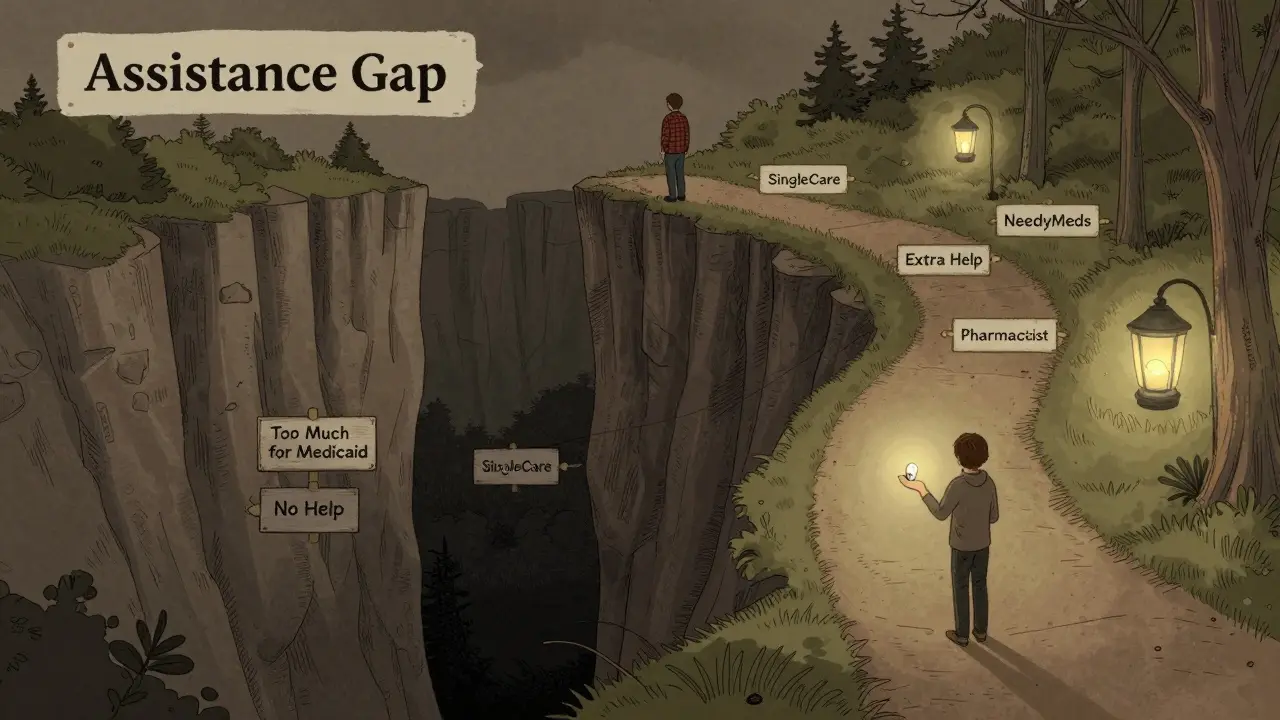
Many people waste time looking for manufacturer copay cards for generics. They don’t exist. Generic makers don’t offer them. It’s not a loophole-it’s a business reality. Their profit is pennies per pill. If they gave away coupons, they’d go out of business. So don’t waste hours searching for something that isn’t there. Also, don’t assume your insurance copay is the lowest price. Some plans force you to pay $15 for a generic, but the cash price at Walmart is $4. That’s a 73% savings. Always ask the pharmacist: “What’s your cash price?” Then ask: “Can I use a discount card?” You might be shocked. And don’t ignore the “assistance cliff.” If you make $300 more than the Medicaid limit, you lose everything. No Extra Help. No manufacturer cards. No nonprofit aid. That’s the gap. It’s real. And it’s leaving millions behind.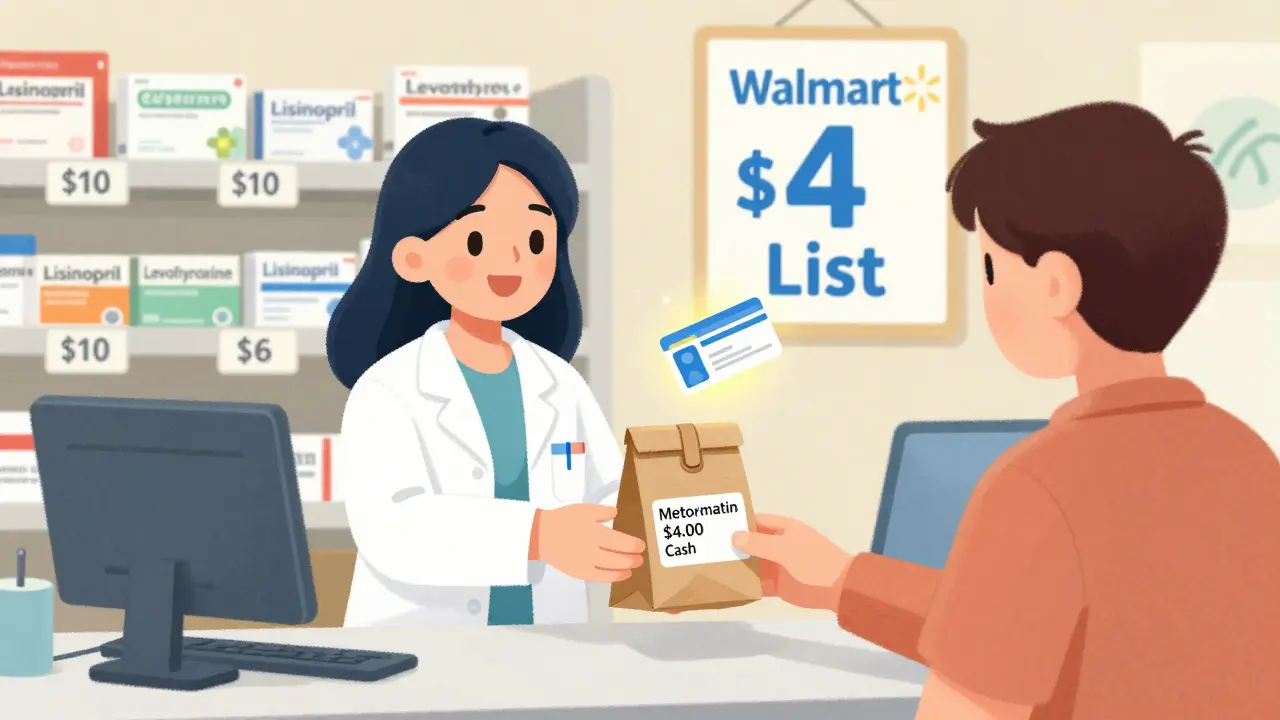
How to Get Help Fast
Here’s what to do right now:- Write down every generic drug you take. Include the name, dose, and how often you take it.
- Check Walmart, CVS, and Kroger’s generic drug lists. See what they charge for your meds.
- Download SingleCare or GoodRx. Enter your drugs. Compare the cash price to your insurance copay.
- Go to Medicare.gov/extra-help and use the eligibility tool. It takes 5 minutes.
- Call your local SHIP (State Health Insurance Assistance Program). They help people navigate Medicare for free. Find yours at shiphelp.org.
- Visit NeedyMeds.org and search for your condition. Apply if you qualify.
- If you’re on Medicare and pay more than $50/month for generics, call your plan. Ask if they offer a lower-cost alternative or a therapeutic interchange program.
Big Changes Coming in 2025
Starting January 1, 2025, everything changes for Medicare beneficiaries. The Inflation Reduction Act kicks in:- Your out-of-pocket spending cap drops from $8,300 to $2,000 per year.
- Extra Help recipients will pay $0 deductible and $2.00 per generic prescription.
- Insulin costs are capped at $35/month-even the generic versions.
- Pharmacies must now cover you during the coverage gap without extra charges.
What You Can Do Today
Don’t wait for 2025. Even if you’re not on Medicare, you can still save. Use discount cards. Ask for cash prices. Apply for nonprofit help. Talk to your pharmacist. They know the deals. They’ve seen people struggle. They want to help. And if you’re in that middle-income gap-earning too much for Medicaid, too little to afford meds-you’re not alone. Millions are in your shoes. You’re not failing. The system is broken. But you can still fight it. Start with one drug. Find the lowest price. Apply for one program. Call one counselor. Small steps add up. You don’t need to fix everything at once. Just make one prescription cheaper this month. That’s progress.Frequently Asked Questions
Can I use a discount card with my insurance?
No. Discount cards like GoodRx or SingleCare are cash prices. You can’t combine them with insurance. But you can choose which one to use-your insurance copay or the cash price. Always ask your pharmacist to compare both before you pay.
Why don’t generic drug companies offer copay cards like brand-name companies?
Generic manufacturers make very little profit per pill-often less than $0.10. Brand-name companies charge $500 or more per pill and can afford to give away coupons. Generic makers can’t afford to give away discounts without raising prices, which would defeat the whole purpose of generics.
I make too much for Medicaid but still can’t afford my meds. What can I do?
Apply for nonprofit help through NeedyMeds or PAN Foundation. Even if you earn above 250% of the federal poverty level, some programs still consider your total expenses. Also, use pharmacy discount cards-they work regardless of income. And ask your doctor if there’s a lower-cost generic alternative you haven’t tried.
Does Medicare Part D cover all generic drugs?
Medicare Part D plans cover most generics, but not all. Each plan has its own formulary. Some may require prior authorization or step therapy. Always check your plan’s drug list before filling a prescription. If your drug isn’t covered, ask your doctor to request an exception.
What if I’m not on Medicare? Can I get help?
Yes. Use pharmacy discount cards (Walmart, CVS, GoodRx). Apply to nonprofit programs if your condition qualifies. Some states have prescription assistance programs for low-income residents-even if you’re under 65. Call your state’s health department or visit NeedyMeds.org to search by state.
Can I switch to a cheaper generic version of my drug?
Sometimes. Many drugs have multiple generic versions with different prices. For example, levothyroxine comes in dozens of brands, but they’re all the same drug. Ask your pharmacist if a different generic is cheaper. Or ask your doctor if they can prescribe a different formulation that’s on a lower-cost tier.



Becky Baker
December 27, 2025 AT 05:16Walmart’s $4 list saved my life. I’ve been paying $18 for levothyroxine through my insurance. Walked in, showed my phone, paid $4. No drama. No forms. Just magic. 🙌
sakshi nagpal
December 27, 2025 AT 11:26This is incredibly helpful. I’m from India and we don’t have this system, but I’ve seen friends in the US struggle with drug costs. The fact that generics are still unaffordable for many is heartbreaking. Thank you for outlining real solutions - not just theory.
Sandeep Jain
December 27, 2025 AT 20:13ugh i been tryna find help for my dad’s blood pressure meds n i kept lookin for copay cards like a fool. turns out walmart’s got it for $3.50. why dont they tell u this stuff upfront??
Amy Lesleighter (Wales)
December 29, 2025 AT 12:55Stop waiting for the system to fix itself. Start with one pill. One pharmacy. One discount card. That’s how you win. Not with rage. Not with petitions. With a phone call and a printed coupon. Small steps. Big wins.
Sophia Daniels
December 30, 2025 AT 19:24Oh honey, you think this is bad? Wait till you see what happens when your insulin gets capped at $35 but your blood pressure med still costs $47 because your plan 'has a tier' and the pharmacist says 'it's not on our formulary' even though it's literally the same damn chemical. The system is a rigged casino and we're the suckers buying the tickets with our prescriptions.
And don't get me started on how they make you pay $15 for a pill that costs 12 cents to make. That's not capitalism. That's theft with a white coat.
They'll give you a $500 coupon for Ozempic but laugh in your face if you ask for help with metformin. It's not about health. It's about profit. Always profit.
I've been doing this for 8 years. I know every loophole. I know every scam. And the only thing that works? Cash. Always cash. Insurance is a trap wrapped in a bureaucracy.
And if you're lucky enough to be over 65? You still get to fight through the Part D donut hole like it's a haunted maze. Meanwhile, Big Pharma is sipping champagne on a yacht in Monaco.
2025 helps? Yeah, right. It helps the ones who can fill out the forms. The ones who can call 5 times a week. The ones who have time to waste. What about the single mom working two jobs who can't even afford to miss work to apply?
So yeah. Use GoodRx. Ask for cash. Call SHIP. But don't fool yourself. This isn't justice. It's damage control.
And if you think this is 'just how it is'? You're not seeing the full picture. You're just not poor enough yet.
Steven Destiny
December 31, 2025 AT 16:36Stop crying and start acting. You want help? Get off your ass and go to Walmart. Download SingleCare. Call your pharmacist. Don’t wait for Congress. Don’t wait for a miracle. The tools are already here. Use them. Now. Your life depends on it.
Fabio Raphael
January 1, 2026 AT 14:14I just want to say thank you for writing this. My mom’s on three generics and she’s 72. She used to skip doses because she couldn’t afford it. After I showed her the Walmart list, she cried. Not from sadness-from relief. It’s crazy that something this simple isn’t common knowledge.
Also, I didn’t know about SHIP. I just called mine. The counselor spent 40 minutes with her. No sales pitch. Just help. People like that exist. They’re just quiet.
Thank you for making this feel less lonely.
Sumler Luu
January 2, 2026 AT 11:11Thank you for sharing this with such clarity. I’ve seen too many people give up because they think there’s no help. This isn’t just about money-it’s about dignity. Everyone deserves to take their meds without choosing between food and their health.
I’ll be sharing this with my church group. Many of our seniors are in this exact situation.
Nikki Brown
January 4, 2026 AT 03:23Wow. Just… wow. I can’t believe people still don’t know about this. You’d think the government would scream this from the rooftops. But no. They’d rather let people suffer quietly so they don’t have to fix the system. Pathetic. And you know what? People who don’t use these tools? They’re complicit. You’re not innocent if you’re paying full price and know better.
Also, why are we still letting Big Pharma get away with this? This isn’t capitalism. It’s feudalism with a pharmacy counter.
Rajni Jain
January 5, 2026 AT 06:24omg i just tried goodrx for my thyroid med and it was $1.50 at cvs?? i was paying $14!! i feel so dumb for not trying this sooner 😭 thank you for this post!!
Natasha Sandra
January 7, 2026 AT 03:10My grandma started using SingleCare last year. She’s 81. Now she says she’s ‘a discount card queen.’ 💅 She even taught her bridge club how to use it. I’m crying. This is the kind of power we need more of.
Erwin Asilom
January 7, 2026 AT 05:35One thing people miss: pharmacists know the deals. They see this every day. Ask them. Don’t just assume your insurance is the best. They’ll help you if you ask nicely. It’s not their job to push insurance-they want you to be healthy.
roger dalomba
January 8, 2026 AT 12:25Wow. A 12-page essay on how to save $10 a month. Groundbreaking. I’m sure the pharmaceutical CEOs are sweating bullets right now.
Brittany Fuhs
January 8, 2026 AT 21:56Let’s be real. This is just a Band-Aid. The real problem? The FDA lets generics be made by companies in India and China who cut corners. That’s why prices are still high-because the ‘cheap’ ones are often low quality. We need to buy American generics. That’s the real solution.