
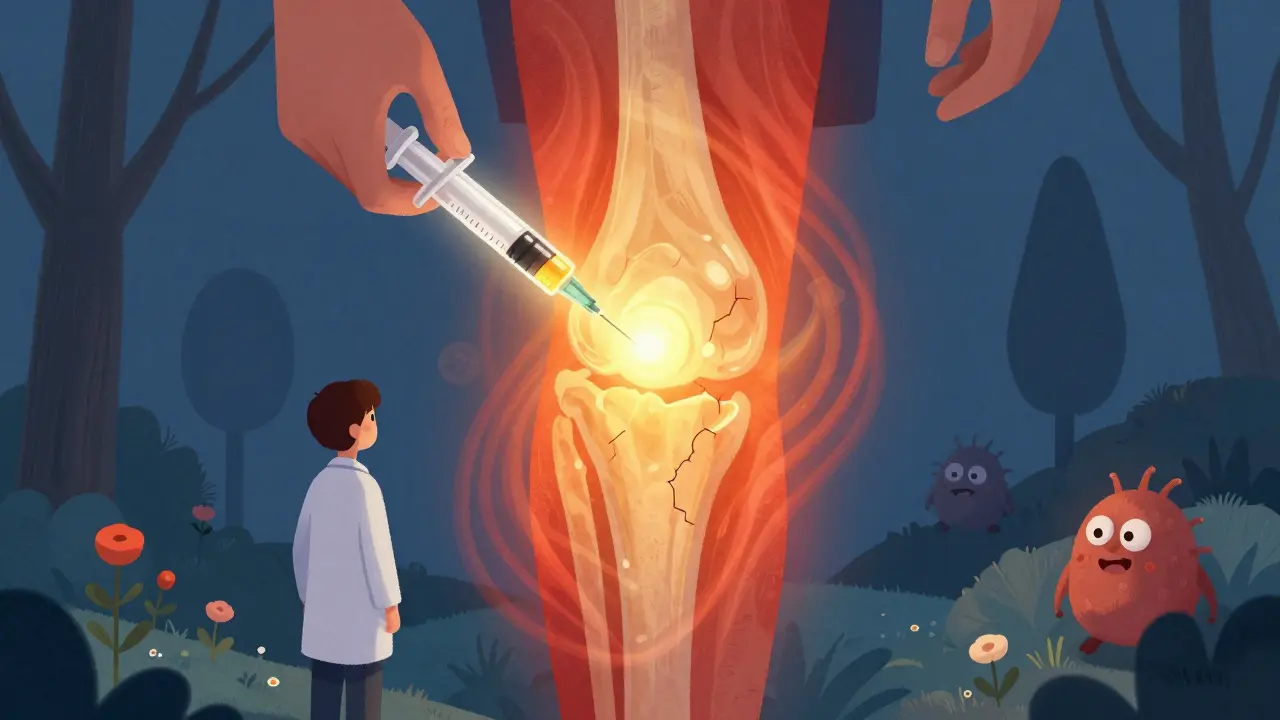
When your knee, shoulder, or hip hurts so badly you can’t walk, lift, or sleep, it’s easy to see why corticosteroid injections-commonly called cortisone shots-have become one of the most popular treatments for joint pain. They’re fast, widely available, and often work when nothing else does. But here’s the thing: corticosteroid injections don’t fix the problem. They quiet the noise. And if you don’t understand that difference, you could end up hurting yourself more than helping.
How Corticosteroid Injections Actually Work
Corticosteroids are synthetic versions of cortisol, a hormone your body makes naturally to manage stress and inflammation. When injected directly into a joint, they don’t repair torn cartilage, worn-out tendons, or damaged ligaments. Instead, they shut down the inflammation that’s causing the pain.
Here’s how: the drug enters the joint space and binds to receptors inside cells. This switches off the production of key inflammatory chemicals like interleukin-1, tumor necrosis factor-alpha, and prostaglandins. These are the same molecules that make your joint swell, get hot, and feel tender. By blocking them, the pain drops-often within 24 to 72 hours.
Most injections combine a corticosteroid (like triamcinolone or methylprednisolone) with a local anesthetic like lidocaine. The anesthetic gives you immediate relief, while the steroid kicks in over the next few days. The dose depends on the joint: a big joint like the knee might get 40-80 mg, while a small joint like a finger gets 10-20 mg.
What Conditions Do They Help?
Corticosteroid injections aren’t a one-size-fits-all fix. They work best for inflammatory conditions-not degenerative ones. Here’s what they’re actually good for:
- Acute bursitis (inflamed fluid sacs near joints)
- Tendinitis (inflamed tendons, like tennis elbow or rotator cuff)
- Gout flares (sudden, intense inflammation from uric acid crystals)
- Rheumatoid arthritis flares (when joints flare up despite medication)
- Trigger finger (inflamed tendon sheath in the hand)
They’re less effective-or even risky-for osteoarthritis (wear-and-tear arthritis). If your joint pain comes from cartilage wearing away, a cortisone shot might mask the pain for a few weeks, but it won’t slow the damage. In fact, studies show repeated injections in arthritic knees can actually speed up cartilage loss.
How Long Does the Relief Last?
Don’t believe the hype that cortisone shots last for months. The truth is messier.
Most people feel better within 2-3 days. Pain relief typically peaks around week 2 and starts fading by week 4. On average, relief lasts 4-6 weeks. A 2023 meta-analysis of 15 studies found no significant benefit beyond 6 weeks compared to a saline placebo. That means if you’re hoping for a permanent fix, you’re setting yourself up for disappointment.
Some people get lucky. One patient from the Arthritis Foundation community reported 12 weeks of pain-free golf after a hip injection. But that’s rare. More common? A Reddit user wrote: “First two shots gave me 8 weeks each. The third? Three weeks-and a 3-day flare afterward.” That pattern-diminishing returns-isn’t unusual.
What’s the Cost?
Without insurance, a single corticosteroid injection costs $100-$300 in the U.S. That’s far cheaper than alternatives:
- PRP (platelet-rich plasma): $500-$1,500
- Viscosupplementation (hyaluronic acid shots): $500-$1,000
- Stem cell therapy: $3,000-$7,000
But here’s the catch: PRP and stem cell treatments aim to heal. Cortisone just hides the pain. If you’re paying $300 for a shot that lasts 5 weeks, you’re spending $720 a year if you need it every 5 weeks. And if you’re getting multiple injections a year? The long-term cost isn’t just financial-it’s physical.
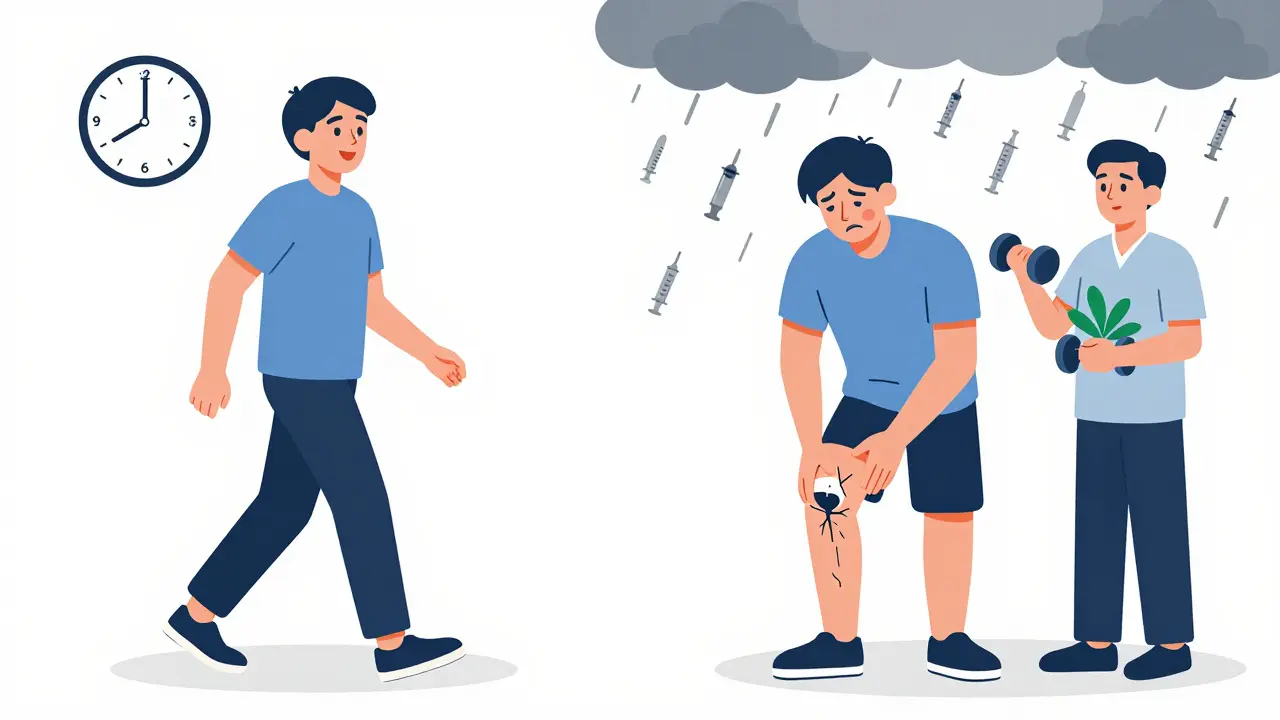
The Hidden Risks
Most people think cortisone shots are harmless. They’re not.
Here’s what can go wrong:
- Post-injection flare: 2-8% of people get worse pain for 24-72 hours after the shot. It’s not an infection-it’s the steroid crystals irritating the joint. Ice and ibuprofen usually fix it.
- Tendon rupture: Corticosteroids weaken tendons. That’s why athletes who get repeated shoulder or Achilles injections risk sudden tears-even during normal activity.
- Joint damage: A 2023 study found patients who got knee injections had 3.2 times higher odds of radiographic osteoarthritis progression. If you’re getting them every 2 months? That risk jumps to 4.67 times higher.
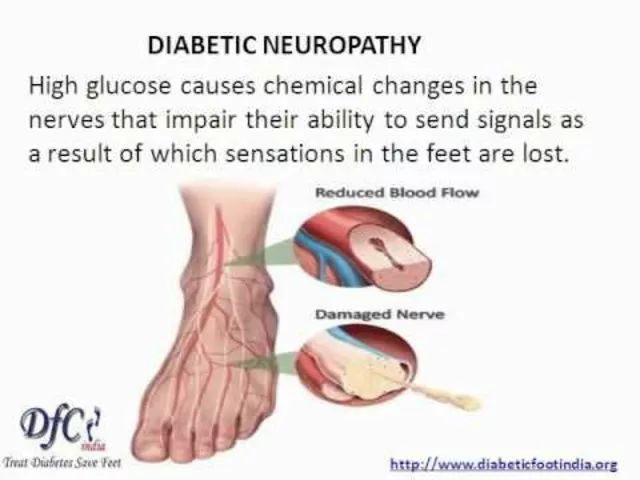
- High blood sugar: Diabetics can see spikes for up to 72 hours. Monitor your levels closely.
- Skin thinning or lightening: If the shot leaks under the skin, you might get a white patch or a dent where the fat tissue breaks down.
- Post-surgery infection risk: A 2023 study showed patients who got cortisone shots within 3 months of knee or hip replacement had over twice the risk of prosthetic joint infection.
The American College of Rheumatology recommends no more than 3-4 injections per joint per year. Some doctors say every 3 months is safe. But that’s not the same as saying it’s smart.
Who Should Avoid Them?
Not everyone should get these shots. Avoid them if you:
- Have an active infection anywhere in your body
- Have uncontrolled diabetes
- Are allergic to corticosteroids or lidocaine
- Have had a joint replacement within the last 3 months
- Have advanced osteoarthritis with bone-on-bone damage (radiographs show severe joint space narrowing)
- Are pregnant (unless the benefit clearly outweighs the risk)
And if you’ve had 3 or more injections in the same joint over the past year? It’s time to stop and ask: What’s next?
What Should You Do After the Shot?
Don’t go back to the gym or play tennis the next day. Your joint is temporarily numbed and weakened. Here’s what to do:
- Rest the joint for 24-48 hours. No heavy lifting, running, or high-impact activity.
- Apply ice if you feel swelling or a flare.
- Take an NSAID (like ibuprofen) if pain returns after the numbing wears off.
- Monitor blood sugar if you’re diabetic.
- Track how long the relief lasts. Write it down. That data helps your doctor decide if another shot is worth it.
Also, don’t assume the shot “worked” just because you feel better. If your pain came from a torn tendon or worn cartilage, the shot didn’t fix it. It just turned down the volume. The real work-physical therapy, strength training, weight management-still needs to happen.
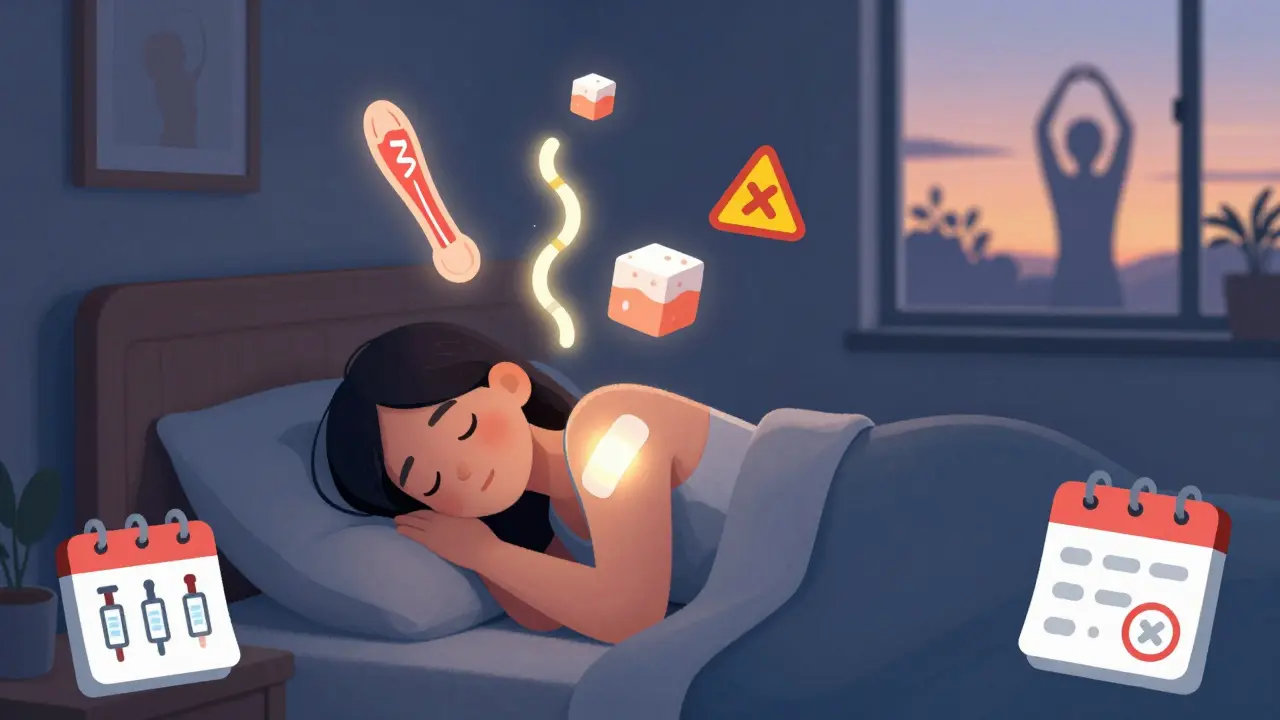
Alternatives That Actually Heal
Corticosteroids are a band-aid. What if you wanted to fix the wound instead?
- Physical therapy: The most underused tool. Strengthening muscles around the joint reduces stress on it. Studies show PT is just as effective as cortisone for knee osteoarthritis-with no side effects.
- Weight loss: Losing 10 pounds reduces knee pressure by 40 pounds per step. That’s more effective than any shot.
- PRP or stem cell therapy: These are still expensive and not always covered by insurance, but they aim to repair tissue, not just silence pain. They’re not magic, but they don’t damage joints like cortisone can.
- Activity modification: If your job or sport is wrecking your joint, changing how you move can be the real cure.
The bottom line: corticosteroid injections are a powerful tool-but only if you use them like a tool, not a crutch.
When to Call Your Doctor
Call your doctor if:
- Pain gets worse after 72 hours
- You develop fever, redness, or warmth around the joint (signs of infection)
- Your blood sugar stays high for more than 3 days
- You notice sudden weakness or a snapping sensation in a tendon
- You’ve had 3 or more injections in the same joint in the past year
How long do corticosteroid injections last in a joint?
Most people get relief for 4 to 6 weeks, with peak improvement around day 14. After that, pain typically returns. Studies show no significant benefit beyond 6 weeks, and some people experience diminishing returns with repeated injections.
Can corticosteroid injections damage your joint?
Yes. Repeated injections-especially more than 3-4 times a year-can weaken tendons, accelerate cartilage breakdown, and increase the risk of osteonecrosis. A 2023 study found patients with knee osteoarthritis who received frequent injections had over 4 times higher odds of radiographic joint deterioration.
Are cortisone shots better than PRP or hyaluronic acid?
For short-term relief (1-4 weeks), cortisone works faster and cheaper. But PRP and hyaluronic acid aim to repair tissue, not just reduce inflammation. PRP may offer longer-lasting benefits for early osteoarthritis, though it costs 3-5 times more. Hyaluronic acid is often used for knee osteoarthritis but has mixed evidence. Cortisone is best for acute inflammation; alternatives are better for long-term joint health.
Why do some people feel worse after a cortisone shot?
About 2-8% of people have a temporary flare-up 24-72 hours after the injection. This happens when the crystalline steroid irritates the joint lining. It’s not an infection-it’s a reaction. Ice, rest, and NSAIDs usually help. If pain lasts longer than 3 days or gets worse, call your doctor.
Should I get a cortisone shot before joint surgery?
No. Research shows patients who received corticosteroid injections within 3 months before knee or hip replacement had more than double the risk of post-surgical joint infection. Surgeons now recommend avoiding these shots for at least 6 months before planned surgery.
Is there a limit to how many cortisone shots I can get?
Yes. The American College of Rheumatology recommends no more than 3-4 injections per joint per year. More than that increases the risk of tissue damage. Some doctors suggest spacing them at least 3 months apart. If you need more frequent injections, it’s a sign you need a different treatment plan.
Do cortisone shots work for arthritis?
They can help with pain from rheumatoid arthritis flares or early osteoarthritis, but they don’t stop joint degeneration. For advanced osteoarthritis, guidelines now recommend against repeated injections because they may speed up cartilage loss. They’re useful for short-term relief, not long-term management.
Final Thought: The Real Solution Isn’t in the Syringe
Corticosteroid injections have saved people from pain so bad they couldn’t work, walk, or sleep. That’s real. But they’re not a cure. They’re a pause button. If you keep hitting it, you’re not healing-you’re delaying the real work.
The best outcomes come when people use the shot to buy time-to get into physical therapy, lose weight, adjust their movement patterns, or try something that actually rebuilds strength. The shot doesn’t fix your joint. But it can give you the window you need to fix it yourself.





Stephen Rudd
March 8, 2026 AT 21:49Cortisone shots are a scam disguised as medicine. You think you're healing but you're just numbing the problem until your tendon snaps. I've seen three guys in my gym go from lifting heavy to needing surgery because they kept getting shots instead of fixing their form. The system is built to keep you dependent. They don't want you to heal-they want you to keep coming back.
Peter Kovac
March 10, 2026 AT 01:34The data is unequivocal: repeated intra-articular corticosteroid administration correlates with accelerated cartilage degeneration in radiographic studies. The 2023 meta-analysis by Chen et al. demonstrated a dose-dependent relationship between injection frequency and joint space narrowing. Clinical guidelines must be enforced, not ignored. This is not anecdotal-it's biomechanical fact.
Jazminn Jones
March 10, 2026 AT 17:14How is it possible that anyone still believes corticosteroid injections are a viable long-term solution? The very premise betrays a fundamental misunderstanding of pathophysiology. Inflammation is not the enemy-it's a signal. Suppressing it without addressing the root mechanical or metabolic dysfunction is akin to silencing an alarm system while the house burns down. The medical industrial complex thrives on this ignorance. Patients are being sold a placebo wrapped in a syringe.
Leon Hallal
March 11, 2026 AT 06:37I got one last year and it worked for like two weeks then my knee felt worse than before. Now I just walk funny and pretend it's fine. Why do they even give these if they make things worse?
Ray Foret Jr.
March 12, 2026 AT 08:15Man I got my first cortisone shot for tennis elbow last month and holy crap it was a game changer. Felt like a new arm. Still doing PT but man... I'm not mad at the shot. Sometimes you need a break to even start healing. Don't hate the tool, hate the overuse.
APRIL HARRINGTON
March 13, 2026 AT 00:01YALL JUST DON'T GET IT I GOT 4 SHOTS IN MY KNEE LAST YEAR AND NOW I CAN'T EVEN CLIMB STAIRS WITHOUT CRYING AND MY DOCTOR JUST SMILED AND SAID 'IT'S FINE' LIKE WHAT THE ACTUAL F
Janelle Pearl
March 13, 2026 AT 15:43I just want to say to anyone reading this: if you're in pain, you're not weak. And if you've been told 'just get a shot' over and over, that doesn't mean you're failing-it means the system failed you. There's so much pressure to 'fix it fast' but healing isn't a race. I started PT after my third shot and it took months, but now I'm stronger than I've ever been. You're not behind. You're just on a different path.
rafeq khlo
March 13, 2026 AT 19:21The real issue is not the injection it's the lack of systemic support for physical therapy and preventative care. Insurance covers a shot but not a single session of PT. This isn't medical-it's economic. We're incentivized to bandage, not heal. The doctors know this. The pharmaceutical companies bank on it. And the patient? They're just collateral.
Tom Sanders
March 14, 2026 AT 12:44why are people so mad about this like its not just a shot. if it works for a few weeks who cares. i'd rather be in pain than pay 500 bucks for some snake oil 'healing' treatment. just sayin.
Neeti Rustagi
March 15, 2026 AT 07:38As a physiotherapist with over 15 years of experience, I must emphasize that corticosteroid injections are appropriate only as a bridge-not a destination. The most successful outcomes occur when patients engage in structured rehabilitation within two weeks of injection. Without this, the temporary relief becomes a trap. I have seen patients who avoided surgery entirely because they used the window of reduced pain to rebuild strength. The injection is not the cure. The discipline is.
George Vou
March 17, 2026 AT 02:58they say cortisone shots damage joints but what they dont tell you is that the real damage is from the doctors who dont tell you the truth. i got 3 shots in 6 months and now my knee is shot. my doctor said 'it's normal' like its a car part. we are not machines. and why is it that every time i ask about alternatives they just shrug? because they dont make money off of stretching.
Philip Mattawashish
March 18, 2026 AT 09:50There's a deeper truth here that no one dares speak: corticosteroids are a symptom of our society's refusal to accept vulnerability. We want instant relief from pain, from discomfort, from the natural decay of the body. But pain is wisdom. It's the body screaming, 'Something is wrong.' We silence it with chemicals and call it progress. We are not healing. We are numbing our way into oblivion.
Judith Manzano
March 20, 2026 AT 04:09My mom got a cortisone shot for her hip and it gave her just enough relief to start walking again. She didn't go back to the gym. She started doing chair yoga every day. Now, 18 months later, she's hiking on weekends. The shot didn't fix her-but it gave her the chance to fix herself. Sometimes all we need is a little time.
Morgan Dodgen
March 21, 2026 AT 00:52Did you know the FDA hasn't approved corticosteroid injections for intra-articular use in knees? They're off-label. The whole industry is built on loopholes. Big Pharma funds the studies. The guidelines are written by consultants who get paid by the manufacturers. The truth? It's all a profit-driven illusion. They want you dependent. They want you afraid to move. And they want you to keep paying.
Mantooth Lehto
March 21, 2026 AT 22:05I got one last month and it felt like magic... until I tried to carry groceries and my shoulder gave out. Now I'm terrified to move. I just cried in the grocery aisle. I thought I was healing. I was just waiting for the next crash. Why didn't anyone warn me?