
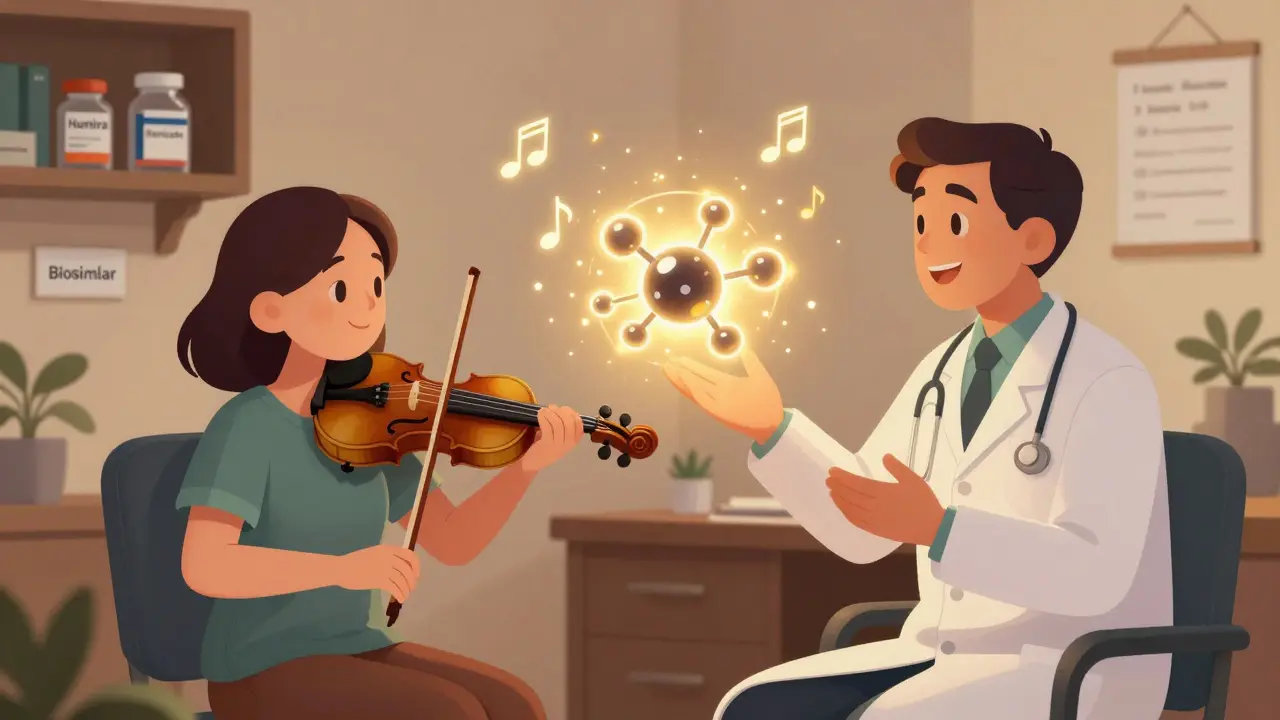
When your doctor talks about a biologic drug-maybe for rheumatoid arthritis, Crohn’s disease, or cancer-you might hear the word biosimilar for the first time. It sounds confusing. Is it a copy? Is it safe? Is it cheaper? Here’s the plain truth: biosimilars aren’t generics, but they’re just as reliable-and they’re helping more people get the medicines they need without breaking the bank.
What exactly is a biosimilar?
A biosimilar is a biologic medicine that works almost exactly like an already-approved biologic drug, called the "reference product." Think of it like this: if the original biologic is a handmade violin crafted by a master luthier, a biosimilar is another violin made with the same wood, strings, and techniques by a different craftsman. It doesn’t sound *identical* under a microscope-but to your ear, and to your body, it plays the same tune.
Biologics are made from living cells-yeast, bacteria, or animal cells-engineered to produce complex proteins like antibodies or hormones. These aren’t simple chemicals like aspirin. They’re huge, fragile molecules that can change slightly depending on how they’re grown, purified, or stored. That’s why you can’t make a perfect copy. Instead, scientists make a version that’s "highly similar" with no meaningful difference in how it works, how safe it is, or how strong it is.
The U.S. Food and Drug Administration (FDA) requires biosimilars to go through over 100 tests before approval. These include checking the molecule’s shape, how it binds to targets in your body, how your immune system reacts, and whether it works just as well in clinical trials. One biosimilar for rheumatoid arthritis, Renflexis, was tested on 541 patients before it was approved. That’s not a small study-it’s rigorous science.
Biosimilars vs. generics: what’s the difference?
This is where people get mixed up. Generics and biosimilars both save money-but they’re not the same thing.
Generics are exact chemical copies of small-molecule drugs. Take metformin for diabetes. The generic version has the same atoms, same structure, same everything as the brand-name version. It’s like swapping one blue pill for another blue pill.
Biosimilars? They’re not exact. They’re complex. Even small changes in the manufacturing process-like using a different type of cell or changing the temperature during production-can affect the final product. That’s why biosimilars can’t be called "identical." But here’s the key: after all the testing, the FDA says there are no clinically meaningful differences in safety or effectiveness. That means your body responds the same way. Your doctor can prescribe it with confidence.
Another big difference? Generics are usually 80-90% cheaper than brand-name drugs. Biosimilars? They’re typically 15-30% cheaper. Why the smaller discount? Because making biologics is expensive. It’s like building a jet engine instead of a bicycle. The tools, the labs, the quality control-it all adds up.
What conditions do biosimilars treat?
Biosimilars aren’t just for one disease. They’re used for serious, long-term conditions where biologics have changed lives:
- Arthritis (rheumatoid, psoriatic, ankylosing spondylitis)
- Inflammatory bowel diseases (Crohn’s, ulcerative colitis)
- Certain cancers (breast, colorectal, lymphoma)
- Diabetes (biosimilar insulins like Semglee)
- Eye diseases (macular degeneration)
- Autoimmune skin conditions (psoriasis)
Some of the most common biosimilars you might hear about include versions of Humira (adalimumab), Remicade (infliximab), and Herceptin (trastuzumab). These drugs used to cost $20,000 a year or more. With biosimilars, many patients now pay a fraction of that.
Are biosimilars safe? What about side effects?
Yes, they’re safe. The FDA doesn’t approve a biosimilar unless it matches the reference product in safety and effectiveness. In Europe, where biosimilars have been used for over 15 years, millions of patients have taken them with no new or unexpected side effects.
Side effects? They’re the same as the original biologic. If your original drug causes fatigue, nausea, or increased risk of infection, the biosimilar will too. That’s not a flaw-it’s proof it works the same way.
Some patients worry about switching from the brand-name drug to a biosimilar. But studies show switching is safe. The Arthritis Foundation reviewed dozens of trials and found no drop in effectiveness or rise in side effects when patients switched. Your doctor may suggest switching to save money-but you always have the right to ask questions or stick with the original if you’re comfortable.
How do you know if you’re getting a biosimilar?
Look at the name. Biosimilars have a four-letter suffix added to the generic name. For example:
- Reference: infliximab
- Biosimilar: infliximab-dyyb (Renflexis)
- Biosimilar: infliximab-abda (Renflexis)
This isn’t random. It’s so pharmacists and doctors can track exactly which product you’re taking-especially if something happens. The FDA keeps a public database of every approved biosimilar and tracks any safety reports.
Insurance companies might push you toward a biosimilar because it’s cheaper. That’s legal and common. But your doctor can override it if they think the original is better for you. Always talk to your provider before switching.
What about "interchangeable" biosimilars?
There’s a special category called "interchangeable" biosimilars. These are biosimilars that the FDA says can be swapped for the original drug even without your doctor’s approval-just like a generic at the pharmacy.
The first one approved in the U.S. was Semglee, an interchangeable version of Lantus insulin. That means if you’re on Lantus, your pharmacist can give you Semglee instead, unless you or your doctor say no.
Interchangeable biosimilars are still rare-only a few have been approved so far. But they’re the future. More will come as manufacturers prove they can switch back and forth without any risk.
Why should you care about biosimilars?
Because they’re changing access to life-saving treatments.
Biologics used to be out of reach for many people. A single year’s supply of Humira could cost $25,000. Now, with biosimilars, the same treatment can cost $10,000 or less. That’s not just savings-it’s dignity. It’s being able to keep working, play with your kids, or live without constant pain.
By 2028, the global biosimilars market is expected to hit $30.5 billion. That’s because more drugs are coming off patent, and more countries are adopting them. In the U.S., biosimilars currently make up about 10% of the biologics market. In Europe, it’s 25%. We’re catching up-and fast.
And the savings? The RAND Corporation estimates biosimilars could save the U.S. healthcare system $54 billion between 2017 and 2026. That money doesn’t just help insurers. It helps patients pay for rent, groceries, or transportation to their appointments.
What should you do if your doctor suggests a biosimilar?
Ask these three questions:
- Is this biosimilar approved by the FDA for my exact condition?
- Will my insurance cover it, and how much will I pay out of pocket?
- Has this been tested in people like me-with my health history and other medications?
Don’t feel pressured. If you’re nervous, ask for time to think. Bring this article to your next appointment. Talk to your pharmacist. You’re not just a patient-you’re a partner in your care.
Biosimilars aren’t a compromise. They’re a breakthrough. They’re science meeting affordability. And for millions of people, they’re the reason they can keep living well.
Ishmael brown
February 3, 2026 AT 10:29So let me get this straight - we’re OK with a ‘highly similar’ version of a drug that costs $20K a year… but only if it’s $15K? 😅 That’s not saving lives, that’s just making the rich slightly less rich. I’ve seen biosimilars cause weird immune reactions in my cousin’s RA treatment. They’re not magic. They’re just cheaper. And yeah, I’m still skeptical.
Also - who decided ‘dyyb’ and ‘abda’ are good suffixes? Sounds like a WiFi password gone wrong. 🤷♂️
Nancy Nino
February 5, 2026 AT 00:09How utterly delightful that we’ve managed to turn life-saving medicine into a cost-cutting spreadsheet exercise. Truly, the pinnacle of modern healthcare innovation: ‘It’s not identical, but it’s close enough, so here’s your discount coupon.’
How noble. How… corporate. I’m sure the patients feel so empowered by their new four-letter suffixes. 🙃
franklin hillary
February 5, 2026 AT 01:06Look - if you’re on Humira and it’s working, stay on it. No shame. But if you’re struggling to afford it? Switching to a biosimilar isn’t settling - it’s surviving.
The FDA doesn’t approve these things lightly. Over 100 tests. Real people. Real data. This isn’t snake oil. It’s science that finally caught up with affordability.
And yes - I’ve seen people go from skipping doses to hiking again, playing with their grandkids, working full-time - all because biosimilars made it possible. That’s not a compromise. That’s justice.
Stop overthinking the suffixes. Your body doesn’t care if it’s ‘infliximab-dyyb’ or ‘infliximab-abda’. It just cares if it stops the pain.
And if your doctor says it’s safe? Trust them. They didn’t go to med school to sell you a lie.
This isn’t about marketing. It’s about access. And access? That’s everything.
Don’t fear the biosimilar. Embrace it. It’s the future - and it’s already here.
Be well. 🙌
Bob Cohen
February 5, 2026 AT 04:39It’s amusing how the entire healthcare system has been reduced to a cost-per-dose algorithm, and now we’re celebrating the fact that we’ve replaced a masterpiece with a knockoff that’s 85% as good - and we call that progress. The fact that we need to justify a drug’s safety by saying ‘it’s not different enough to matter’ is a profound indictment of our pharmaceutical industrial complex.
And let’s not pretend the 15–30% savings are going to patients - they’re going to shareholders. Meanwhile, we’re told to be grateful that we’re not being charged $25,000, as if $10,000 is a gift from heaven. What happened to the idea that medicine should be a right, not a negotiated discount?
Also - ‘interchangeable’? Please. The FDA approves things based on statistical noise, not biological certainty. And the four-letter suffixes? A bureaucratic joke disguised as pharmacovigilance. We’re not tracking drugs - we’re tracking corporate liability.
Someone please tell me why we don’t just regulate drug prices instead of inventing this whole charade.
June Richards
February 5, 2026 AT 18:55LOL biosimilars? More like biosimilars™. You know what’s wild? The same people who scream ‘big pharma is evil!’ are now cheering for ‘almost-the-same’ drugs because they’re cheaper. So now evil is acceptable if it’s 20% cheaper? 🤦♀️
My aunt switched and got a rash. Her doctor said ‘it’s normal.’ I said ‘it’s not normal if it didn’t happen before.’
Also - ‘Semglee’? Who named this? A bot? A toddler? I can’t even say it without laughing. 🤣
Nidhi Rajpara
February 6, 2026 AT 00:59Thank you for this comprehensive overview. However, I must point out a minor inconsistency: in the section regarding biosimilar naming, the example lists ‘infliximab-abda’ as Renflexis, but Renflexis is actually ‘infliximab-dyyb’. The correct biosimilar for ‘infliximab-abda’ is Inflectra. This error may lead to confusion among patients who rely on accurate information for safety purposes. Kindly correct this to ensure patient trust and regulatory clarity.
Additionally, the term ‘highly similar’ is not a regulatory term - it is a colloquialism. The FDA uses ‘highly similar and no clinically meaningful differences’ - precision matters in medical communication.
Thank you for your attention to detail.
Rachel Liew
February 6, 2026 AT 03:08My mom switched to a biosimilar for her Crohn’s last year. She was scared too. But after 6 months? Same results. Same side effects. Same life.
She saves $800 a month. That’s groceries. That’s gas to get to her appointments. That’s not a discount - that’s peace of mind.
Don’t let the fancy names scare you. If your doc says it’s safe, give it a shot. You’ve got nothing to lose but the bill.
And if you’re nervous? Ask for a trial run. No rush. You’re not alone in this.
vivian papadatu
February 8, 2026 AT 02:19I’m from India, and biosimilars are the reason my uncle could even begin treatment for his lymphoma. In the U.S., they’re a cost-saving tool. In places like mine? They’re the only tool.
Seeing this article in English makes me proud - it’s not just about American healthcare. It’s about global access.
Yes, the science is complex. Yes, the names are weird. But the outcome? Human.
Let’s stop arguing over suffixes and start celebrating that someone, somewhere, can now afford to live.
And if you’re scared to switch? Talk to your pharmacist. They’re the real heroes who know every brand, every biosimilar, every side effect - and they’ll help you decide, no pressure.
It’s not about being ‘original’ or ‘copy.’ It’s about being alive.
Thank you for writing this.
- From one patient’s family to another 🌍
franklin hillary
February 8, 2026 AT 07:57Thanks for the correction, Nidhi - you’re absolutely right about Inflectra vs Renflexis. That’s a big deal. I’ve seen people get confused by that and panic thinking they got the wrong med. You’re right - precision saves lives.
And Vivian - your point about India? That’s the real story. We’re all talking about savings like it’s a luxury. For millions, it’s survival.
Let’s not make this a U.S.-only conversation. Biosimilars are global equity in a vial.
Also - I’m not a doctor, but I’ve talked to enough patients to know: the fear isn’t about the drug. It’s about being heard.
So if you’re scared? Say it. Ask for time. Ask for data. Ask for a second opinion.
That’s your power. Not the name on the bottle. Your voice.
Keep asking. Keep caring. That’s what changes medicine.