
22
Jan
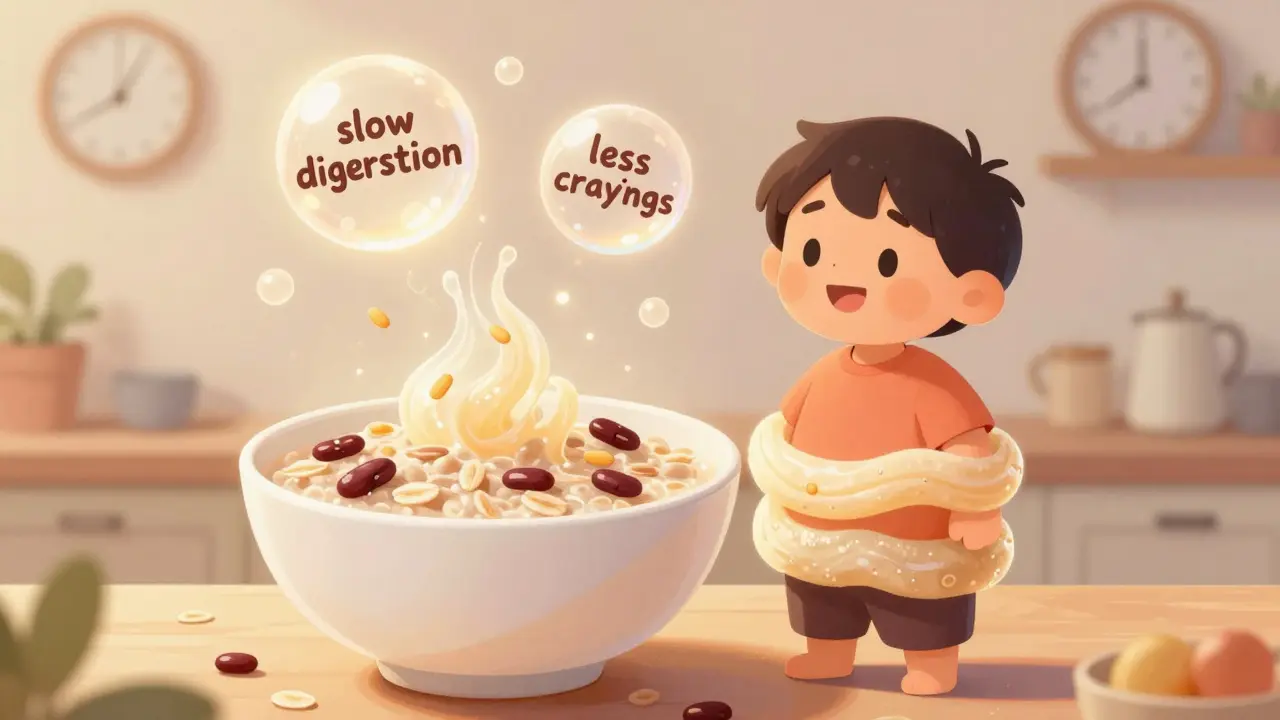
Want to feel fuller longer, eat less, and lose weight without starving yourself? You might be overlooking something simple: fiber. Not just any fiber-specific types that actually change how your body handles hunger, digestion, and fat storage. The difference between soluble and insoluble fiber isn’t just technical jargon; it’s the key to making fiber work for your weight goals.
What’s the Real Difference Between Soluble and Insoluble Fiber?
Fiber doesn’t break down in your gut. That’s why it passes through mostly unchanged. But how it behaves in your digestive system depends entirely on whether it’s soluble or insoluble. Soluble fiber dissolves in water. Think of it like a sponge that soaks up liquid and turns into a thick, gooey gel. This gel slows down digestion, which means food takes longer to leave your stomach. That’s why you feel full after eating oatmeal or beans-you’re not just full from the food, you’re full because your stomach is emptying slowly. Insoluble fiber? It doesn’t dissolve at all. It’s like roughage that pushes food through your system faster. It adds bulk to your stool and helps prevent constipation. You’ll find it in whole wheat bread, nuts, and vegetable skins. It keeps things moving, but it doesn’t directly affect hunger or calorie absorption. The bottom line: soluble fiber talks to your brain and hormones. Insoluble fiber talks to your intestines.Why Soluble Fiber Is Your Secret Weapon for Weight Loss
If you’re trying to lose weight, soluble fiber-especially the viscous kind-is your best friend. Viscous soluble fibers like psyllium, beta-glucans, glucomannan, and pectin don’t just make you feel full. They actively interfere with how your body absorbs calories. Studies show these fibers can block 15-20% of dietary fat from being absorbed. They also slow down the release of sugar into your bloodstream, preventing spikes and crashes that lead to cravings. A 2023 study in PMC10253086 found that people who took psyllium daily lost 3.2% of their body weight over eight weeks-nearly three times more than the placebo group. Here’s how it works in real life:- Psyllium husk can absorb up to 50 times its weight in water. That means one tablespoon swells in your stomach, creating a sense of fullness without adding calories.
- Beta-glucans from oats reduce post-meal blood sugar spikes by 12-15%, which cuts down on sugar cravings later.
- Glucomannan from konjac root delays stomach emptying by 25-30%, keeping you satisfied for an extra hour or two after meals.
Insoluble Fiber: The Silent Helper
Don’t write off insoluble fiber just because it doesn’t make you feel full. It’s still essential for weight control-just in a different way. When your digestion runs smoothly, you’re less likely to bloat, feel sluggish, or overeat out of discomfort. Insoluble fiber adds 3-5 grams of bulk per 10 grams consumed, speeding up transit time by 24-48 hours. That means fewer toxins sitting around, less water retention, and better overall gut function. It also helps you eat more whole foods. Think about it: broccoli, whole grains, and apples are packed with insoluble fiber. You don’t eat them because they’re low-calorie-they’re nutrient-dense, filling, and hard to overeat. That’s the real power of insoluble fiber: it keeps you eating real food instead of processed snacks. The American Institute for Cancer Research points out that people who get most of their fiber from whole foods-not supplements-stick with their weight loss plans longer. Why? Because food gives you more than fiber. It gives you vitamins, antioxidants, and phytochemicals that support metabolism and reduce inflammation.
What the Science Says: Soluble Fiber Wins, But Only If You Use It Right
Let’s cut through the noise. Fiber supplements aren’t a magic pill. But when used correctly, they can give you an edge. The strongest evidence points to psyllium as the most effective soluble fiber for weight loss. In the same 2023 study, psyllium users lost more weight, reduced visceral fat, and improved cholesterol levels compared to placebo. Glucomannan and beta-glucans came in strong too. But here’s the catch: supplements only work if you pair them with real food. Harvard’s Dr. Walter Willett says, “Fiber from whole plant foods is better for weight loss than fiber supplements.” Why? Because whole foods come with fiber, water, and nutrients in their natural form. Your body responds better to that. A 2023 Healthline survey of over 1,200 people found that 63% of those who successfully lost weight with fiber did it by eating more beans, oats, apples, and vegetables-not pills.How to Actually Use Fiber for Weight Control (No Guesswork)
Knowing what fiber does isn’t enough. You need to know how to use it. Start slow. Jumping from 10g to 30g of fiber in a week will make you bloated and miserable. Increase by 5 grams per week until you hit 25-38g total daily. The Mayo Clinic says most people need at least 10-15g of soluble fiber for weight benefits. Time it right. Take 3-5 grams of soluble fiber (like psyllium or glucomannan) 15-30 minutes before meals. This is when the gel forms and starts slowing digestion. Clinical trials show this cuts your next meal’s calorie intake by 10-15%. Drink water. Fiber needs water to work. For every 5 grams of supplement, drink 16-24 ounces. Without enough water, fiber turns from a helper into a clog. Focus on whole foods. Aim for two high-fiber meals a day. Example:- Breakfast: 1/2 cup oats (4g soluble fiber) + 1 apple (2.4g total fiber, mostly soluble)
- Dinner: 1 cup lentils (15g total fiber, 6g soluble) + steamed broccoli (5g insoluble)

Common Mistakes People Make (And How to Avoid Them)
Most people fail with fiber not because it doesn’t work, but because they do it wrong.- Mistake: Taking fiber supplements without water. Result: Constipation.
- Mistake: Eating only insoluble fiber (like bran cereal). Result: No appetite control.
- Mistake: Relying on fiber bars or shakes. Result: Added sugar, artificial ingredients, and no real benefit.
- Mistake: Expecting miracles overnight. Result: Giving up after a week.
What About Fiber Supplements?
They’re not evil-but they’re not the answer either. Psyllium-based supplements (like Metamucil) are the most studied and effective. Look for products with at least 3g of viscous soluble fiber per serving. Avoid inulin-based products if you’re sensitive-many users report bloating. Amazon reviews show psyllium products average 4.2/5 stars, with 76% of 5-star reviews mentioning “less snacking.” Inulin? Only 3.8/5, with bloating as the top complaint. Bottom line: Use supplements as a bridge-not a replacement. If you’re struggling to get enough soluble fiber from food, a daily psyllium dose can help. But once you’re eating more beans, oats, and apples, you might not need them at all.The Bigger Picture: Fiber Isn’t a Diet. It’s a Lifestyle.
The global fiber supplement market is booming-projected to hit $9.5 billion by 2028. But here’s what the data really shows: people who eat more fiber naturally have 27% lower obesity rates than those who don’t. It’s not about popping pills. It’s about choosing foods that fill you up without filling you out. Fiber is the quiet hero of weight control-not because it burns fat, but because it helps you eat less without feeling deprived. Your body isn’t broken. You just need to feed it the right kind of fuel.Want to lose weight? Don’t count calories. Count fiber. Aim for 10-15 grams of soluble fiber daily. Get it from food first. Use supplements only if you need to. Drink water. Be patient. And let your gut do the work.





Sue Stone
January 23, 2026 AT 15:50Been eating oatmeal with chia seeds every morning for 3 months. No more 3pm snack attacks. My jeans feel looser and I didn’t even try to diet. Fiber just works.
Susannah Green
January 25, 2026 AT 07:59Psyllium husk is the real MVP-but you MUST drink water with it. I learned the hard way: one day I took a scoop without enough H2O, and let’s just say my colon staged a protest. Now I drink 32oz with every dose. Game changer.
Dawson Taylor
January 25, 2026 AT 12:23Insoluble fiber’s role in reducing processed food intake is underappreciated. It’s not about satiety-it’s about friction. Whole foods require chewing, slow eating, and metabolic engagement. That’s the real weight control mechanism.
Laura Rice
January 26, 2026 AT 15:04I tried glucomannan after reading this-and holy cow. I ate dinner, then sat on the couch for an hour and didn’t think about snacks once. I thought I was broken, but turns out I was just fiber-deprived. Tears. Literally.
Sallie Jane Barnes
January 27, 2026 AT 00:35Don’t forget: fiber doesn’t fix a diet full of junk. I used to take Metamucil and still eat cookies at 2 a.m. Guess what? I didn’t lose weight. Fiber supports good habits-it doesn’t replace them.
Andrew Smirnykh
January 27, 2026 AT 16:24My Nigerian uncle swears by okra water-boil it overnight, drink the slime in the morning. He’s 72, still runs 5Ks. Turns out, okra’s full of soluble fiber. Maybe traditional wisdom isn’t so outdated after all.
Kerry Evans
January 29, 2026 AT 02:36Anyone who says fiber supplements are better than whole foods is either selling something or hasn’t read the actual studies. The Harvard quote is spot-on. Whole foods = nutrients + fiber + phytochemicals. Pills = cellulose and disappointment.
Kerry Moore
January 29, 2026 AT 08:15Thank you for this meticulously referenced breakdown. The distinction between viscous soluble fiber and insoluble bulk is critical, and too often conflated in popular media. The 15–20% fat absorption reduction with viscous fibers is a clinically validated phenomenon, not anecdotal. The data is compelling.
Janet King
January 31, 2026 AT 03:54Start slow. Drink water. Eat beans. That’s it. No magic. No pills. Just food. You don’t need a degree to do this.
Anna Pryde-Smith
January 31, 2026 AT 12:16Why is no one talking about how psyllium makes you feel like a balloon? I took it for two weeks. Felt like I swallowed a beach ball. And then I had to go to the ER because I couldn’t poop. Don’t be a fool. This isn’t wellness-it’s a trap.
charley lopez
January 31, 2026 AT 17:31Empirical evidence supports the physiological mechanism of viscous soluble fiber delaying gastric emptying via increased viscosity of chyme, thereby enhancing CCK and PYY secretion. The 3.2% body weight reduction in the 2023 PMC10253086 trial is statistically significant (p<0.01). However, adherence remains the primary confounder in longitudinal studies.
Oladeji Omobolaji
February 2, 2026 AT 17:10My grandma used to give me soaked flaxseeds every morning. Said it kept the belly flat and the mind clear. Turns out she was a nutritionist without a degree. Wisdom doesn’t need a label.