

Why Calibration Isn’t Just a Paperwork Exercise
Think of calibration like checking your car’s odometer. If it’s off by 10%, you might think you’ve driven 100 km when you’ve actually driven 110. In manufacturing, that kind of error doesn’t just mean a wrong number-it means defective parts, unsafe devices, or worse, patients getting the wrong dose of medicine. Calibration ensures your tools-micrometers, scales, thermometers, pressure gauges-give you the truth. Not close enough. Not approximately. The truth.
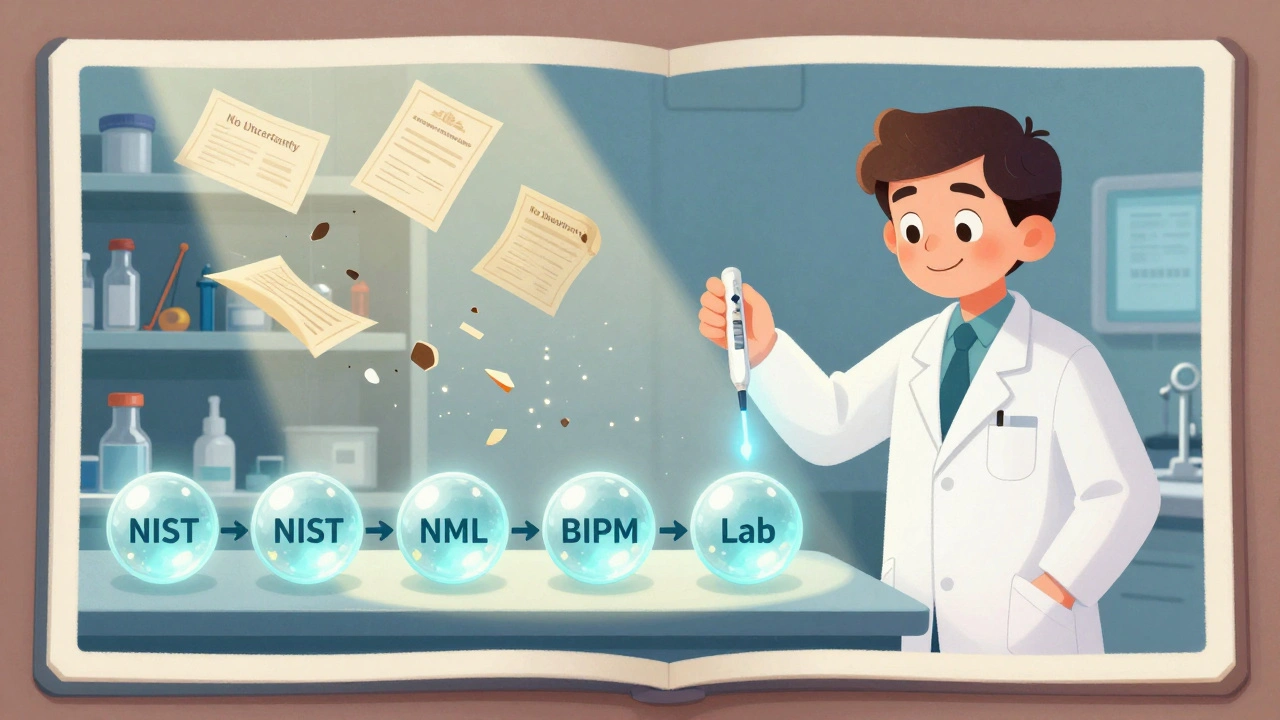
ISO 13485:2016, the global gold standard for medical device quality systems, says calibration isn’t optional. It’s mandatory. Every instrument used to make decisions about product safety or performance must be calibrated against standards that trace back to the International System of Units (SI). That means your lab’s thermometer can’t just be checked against another thermometer. It has to link, step by step, to a national standard like NIST in the U.S. or NML in Australia. And every link in that chain must be documented with uncertainty values. If you can’t prove that traceability, regulators will shut you down.
Calibration vs. Validation: Don’t Mix Them Up
People often say “calibration” when they mean “validation.” They’re not the same. Calibration checks if a device reads correctly against a known standard. Validation asks: does this machine do what it’s supposed to do in real-world conditions?
For example, a scale might be perfectly calibrated to read 100.00 grams. But if it’s used in a sterile room with constant airflow, and the product keeps floating off the pan, the scale is calibrated but the system isn’t validated. Validation means proving the whole process works-Installation Qualification (IQ), Operational Qualification (OQ), and Performance Qualification (PQ). That’s not a one-time thing. It’s a proof of function under actual operating conditions. In medical device manufacturing, validation can take 18 to 24 months and cost up to half a million dollars per system. But skipping it? That’s how recalls happen.
How Often Should You Calibrate? It’s Not One-Size-Fits-All
Manufacturers often default to “calibrate every 6 months” because it’s easy. But ISO 9001:2015 and ISO 13485:2016 both say intervals must be based on risk, not routine. A micrometer used daily in aerospace, measuring parts to 0.001 mm tolerance? Maybe every 3 months. A basic digital thermometer in a food packaging line? Once a year might be fine-if the data proves it.
Successful companies use the “Method 5” approach from SAE AS9100D:2016. They combine three things: manufacturer recommendations, historical performance data, and risk assessment. One biomedical lab in Brisbane extended calibration for their electronic scales from quarterly to biannual after collecting 18 months of stability data. Saved $18,500 a year. No incidents. No audit findings.
But don’t ignore environment. NIST found 57.8% of out-of-tolerance readings happen when temperature swings exceed ±5°C from calibration conditions. If your lab runs hot in summer or has high humidity, you need to calibrate more often-or control the environment. Simple fixes: air conditioning, dehumidifiers, or even just moving equipment away from windows and vents.
Traceability Isn’t a Buzzword-It’s Your Legal Shield
When an FDA inspector asks, “Can you prove this gauge was accurate when it measured the batch?” you need a paper trail that goes back to a national standard. That’s traceability. And it’s not just about the certificate. You need:
- Unique ID on every device
- Calibration procedure with environmental conditions (e.g., 20°C ±2°C, 40% RH ±10%)
- Uncertainty values for each calibration point
- Signature and date from the technician
- Retention for product lifecycle plus 2 years (per FDA 21 CFR 820.180)
One company lost its ISO 13485 certification because they stored calibration certificates in a folder labeled “2023 Calibrations.” No IDs, no uncertainty values, no traceability chain. The inspector flagged it immediately. They spent six months fixing it.
Regulatory Differences Matter-Especially if You Sell Globally
If you’re selling medical devices in the U.S., you follow FDA 21 CFR Part 820 and accept NIST-traceable calibrations. In Europe, under EU MDR 2017/745, you need traceability to BIPM (International Bureau of Weights and Measures). That’s not the same thing. Many companies end up doing dual calibrations-once for the U.S., once for Europe. It adds 18.7% to compliance costs, according to a McKinsey study of 45 global manufacturers.
China’s YY/T 0287-2017 (their version of ISO 13485) used to require shorter calibration intervals than the rest of the world-30% shorter-because of past quality issues. But as CNAS accreditation grows, that gap is closing. Still, if you export to China, you need to know their rules. One Australian manufacturer got a shipment rejected because their calibration certificate didn’t list the CNAS-accredited lab number. Simple fix. Costly mistake.
Software and AI Are Changing Calibration-But Not Replacing It
AI-driven scheduling is now a real thing. Pfizer cut calibration costs by 31.7% using AI to predict when equipment would drift based on usage patterns and environmental logs. That’s smart. But NIST warned in 2024: 44.2% of automated systems fail to properly document the chain of custody for reference standards. That’s a gap. If the AI says “calibrate next month,” but no one logs who sent the device to the lab, when it was received, or how it was transported-you’re not compliant.
And now, ISO 13485:2016 Amendment 1 (March 2024) requires continuous validation for AI/ML-based measurement systems. If your device uses machine learning to adjust readings, you can’t just calibrate it once. You need ongoing monitoring to detect algorithm drift. This isn’t science fiction. It’s happening now in automated inspection systems for implantable devices.
What Happens When You Skip It?
Let’s get real. GageList’s 2023 analysis of FDA warning letters found 37.2% cited inadequate calibration procedures. That’s more than mislabeled packaging or poor documentation. It’s direct risk to patient safety. One company got a Class I recall after a pressure sensor in a ventilator drifted by 8%. Patients received too much oxygen. The company paid over $2 million in fines, legal fees, and lost sales.
Small manufacturers suffer most. A 2024 FDA Small Business Survey found they spend 22.3% more per device on compliance than large companies. Why? They can’t negotiate bulk discounts with calibration labs. They don’t have dedicated metrology staff. But here’s the good news: cloud-based calibration software like GageList or Trescal cuts documentation time by 63%. One company went from 84 hours a week of audit prep to 31. That’s 53 hours back for engineering, quality, or sleep.
Where to Start: A Realistic 6-Month Plan
If you’re starting from scratch, here’s how to do it without drowning in paperwork:
- Month 1-2: Inventory every measuring device. Give each one a unique ID. No exceptions. Use a simple spreadsheet or free calibration software.
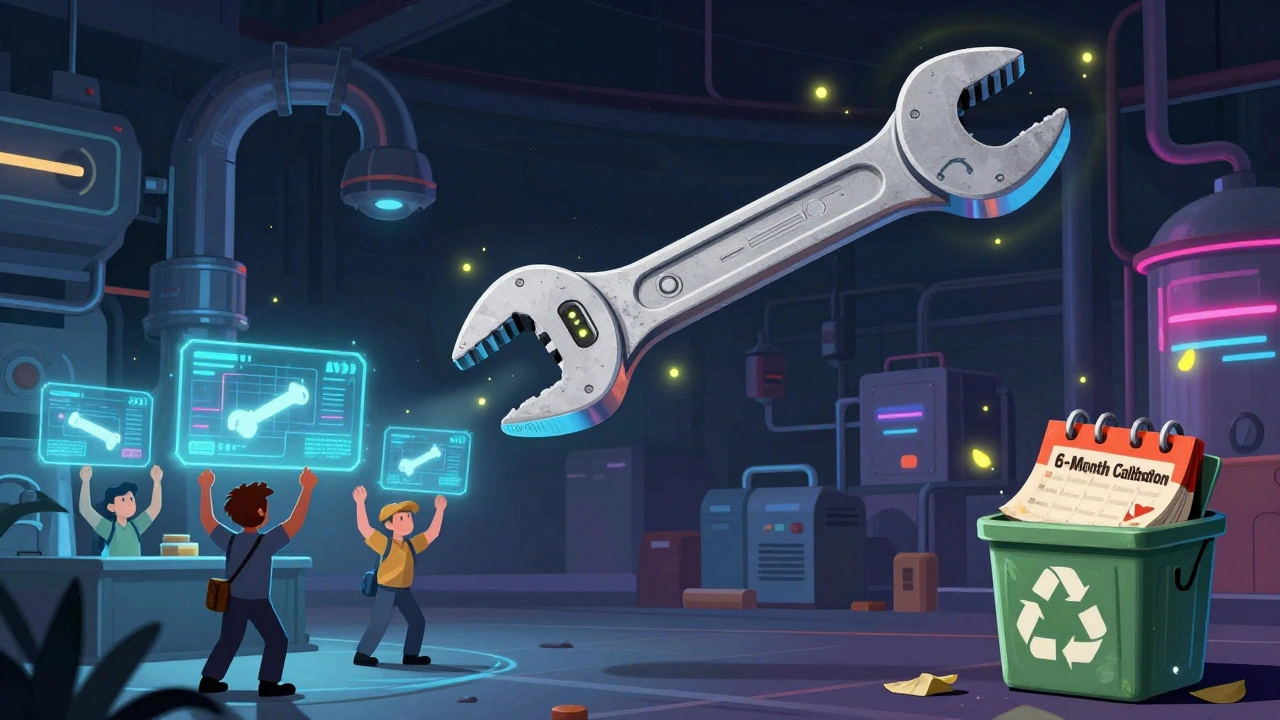
- Month 3: Classify by risk. High-risk (affects safety): calibrate every 3-6 months. Medium-risk (affects performance): every 6-12 months. Low-risk (affects efficiency only): annually or based on usage.
- Month 4: Find an accredited lab. Look for ISO/IEC 17025 accreditation. Ask for traceability certificates with uncertainty values. Don’t accept “we calibrate to manufacturer specs.”
- Month 5: Train your team. Even a 4-hour session on what traceability means and why documentation matters prevents 80% of audit failures.
- Month 6: Start collecting data. Track every calibration result. Look for trends. If a device stays in tolerance for 18 months? Propose extending the interval. Document the rationale. That’s risk-based thinking.
Common Pitfalls and How to Avoid Them
- Pitfall: Using a calibration certificate without uncertainty values. Solution: Only accept certificates that include expanded uncertainty (k=2) and traceability chain.
- Pitfall: Calibration done in a cold room, then used in a hot production area. Solution: Calibrate under conditions as close as possible to actual use-or document the correction factor.
- Pitfall: Assuming “new equipment doesn’t need calibration.” Solution: Even brand-new devices can be out of spec. Always calibrate before first use.
- Pitfall: No backup for calibration records. Solution: Cloud storage with version control. Paper backups are outdated and risky.
What’s Next? The Future Is Continuous
By 2027, 62.3% of quality leaders plan to use embedded sensors to monitor equipment in real time. Think: a torque wrench that sends a signal when it’s drifting. No more scheduled calibrations. Just alerts when action is needed. It’s called condition-based maintenance. It’s cheaper. It’s smarter. And it’s coming fast.
NIST’s roadmap for quantum-based standards could make electrical measurements 100x more accurate by 2030. That means fewer calibrations, higher confidence, and less waste. But until then, the rules are clear: if you measure it, you must prove it’s right. And if you can’t prove it, regulators won’t let you make it.
What’s the difference between calibration and verification?
Calibration compares your device to a known standard and adjusts it if needed. Verification checks if your device still meets specifications without adjustment. For example, you might calibrate a scale once a year, but verify it with a known weight every week. Verification is quick. Calibration is technical.
Can I calibrate my own equipment?
Yes, if you have the right tools, trained personnel, and traceable standards. Many manufacturers do internal calibration for simple tools like calipers or thermometers. But for high-precision devices or regulated environments, using an ISO/IEC 17025 accredited lab is safer and more defensible during audits. You must still document everything-procedure, environmental conditions, uncertainty, and results.
What happens if a device is out of tolerance after calibration?
You must quarantine any product made with that device since the last known good calibration. Then, assess whether the out-of-tolerance reading affected product quality. Document the root cause, corrective action, and re-calibration. If the device can’t be fixed, replace it. Regulators expect you to trace back and evaluate risk-not just fix the tool.
Do I need to calibrate software?
Software itself isn’t calibrated, but the inputs and outputs it relies on are. If your software uses sensor data to make decisions (like automated inspection systems), you must validate the entire system. That includes validating the sensors, the algorithms, and the calibration of the hardware feeding data into the software. ISO 13485:2016 Amendment 1 now requires continuous validation for AI-driven systems.
How do I know if my calibration lab is accredited?
Ask for their ISO/IEC 17025 accreditation certificate and check the scope. It should list the exact types of equipment they can calibrate. You can also verify accreditation through national bodies like NATA in Australia, A2LA in the U.S., or UKAS in the UK. Don’t accept a lab that says “we’re ISO certified”-that’s for quality management systems, not calibration competence.





Shannon Gabrielle
December 2, 2025 AT 18:24soorya Raju
December 4, 2025 AT 06:06Lucinda Bresnehan
December 4, 2025 AT 14:01Louise Girvan
December 6, 2025 AT 03:01Michelle Smyth
December 7, 2025 AT 00:11Patrick Smyth
December 7, 2025 AT 02:33Jeremy Butler
December 7, 2025 AT 08:33Kshitij Shah
December 7, 2025 AT 12:58Dennis Jesuyon Balogun
December 7, 2025 AT 21:09Bee Floyd
December 9, 2025 AT 14:44