
Acetaminophen Daily Intake Calculator
Calculate Your Daily Acetaminophen Intake
This tool helps you track how much acetaminophen you're taking from all medications to stay below the 4g/day safety limit.
Add Your Medications
Your Current Intake
Add medications to see your total daily intake
Total acetaminophen intake: 0 mg/day
Daily Acetaminophen Safety Guide
Safety Limit: Maximum 4,000 mg (4 grams) per day for adults.
Warning Signs: Nausea, vomiting, abdominal pain, yellowing of skin/eyes (jaundice), confusion. If you experience these symptoms while taking acetaminophen, seek emergency care immediately.
What to do: If you exceed 4,000 mg, stop all acetaminophen products immediately and contact your doctor or go to the emergency room. N-acetylcysteine (NAC), the antidote, must be given within 8 hours of overdose for maximum effectiveness.
When someone suddenly becomes confused, yellow-eyed, and vomits nonstop - and they didn’t have liver disease before - it could be fulminant hepatic failure. This isn’t a slow decline. It’s a lightning strike on the liver. In under a week, a healthy person can slip into coma and die if no one acts. And the worst part? In nearly half of all cases, it’s caused by something they took on purpose: a pill they thought was safe.
Every year in the U.S., about 2,000 people develop this. More than 46% of those cases come from medications. And the biggest culprit? Acetaminophen. Not the illegal kind. Not some street drug. The stuff you buy at the pharmacy. The one you take for headaches, fevers, back pain. You think it’s harmless. You’re wrong.
What Exactly Is Fulminant Hepatic Failure?
Fulminant hepatic failure - or acute liver failure - means your liver stops working fast. Like, hours to days fast. It’s not cirrhosis. It’s not from drinking too much. It’s in people with no prior liver problems. Three things happen together: jaundice (yellow skin), encephalopathy (confusion or coma), and coagulopathy (blood that won’t clot).
The liver doesn’t just filter toxins. It makes proteins for clotting, breaks down ammonia, and manages energy. When it fails, your brain floods with poison. Your blood turns to water. Your body starts shutting down. Survival without a transplant drops to 28% if you wait. With fast action? It jumps to 63%.
Acetaminophen: The Silent Killer in Your Medicine Cabinet
Acetaminophen causes nearly half of all drug-induced liver failures in the U.S. That’s 45.8%, according to the Acute Liver Failure Study Group. And here’s the trap: most people don’t overdose on purpose. They take four pills a day - the recommended dose - but they’re also taking hydrocodone-acetaminophen for pain, or cold medicine with acetaminophen, or a sleep aid with it. Total? 5, 6, even 8 grams a day. That’s over the 4-gram safety limit.
The damage isn’t immediate. You feel fine for 24 to 48 hours. Then nausea hits. Then confusion. By then, your ALT (a liver enzyme) is already over 1,000 IU/L - ten times normal. Your INR (a clotting test) climbs past 1.5. That’s your body screaming for help.
Here’s the critical window: N-acetylcysteine (NAC), the antidote, works best if given within 8 hours of ingestion. After 24 hours? It’s still helpful, but survival plummets. Yet 38% of cases don’t get NAC until after that window - because no one connected the dots.
It’s Not Just Acetaminophen
Other drugs can do this too - and they’re harder to spot.
- Amoxicillin-clavulanate: A common antibiotic. It causes liver failure slowly - jaundice for weeks before confusion shows up. ALT might be normal. Alkaline phosphatase? Sky-high. Doctors often mistake it for hepatitis.
- Valproic acid: Used for seizures. It causes microvesicular steatosis - fat builds up in liver cells. Ammonia levels spike before encephalopathy. If you see a patient with seizures, confusion, and vomiting - check the meds.
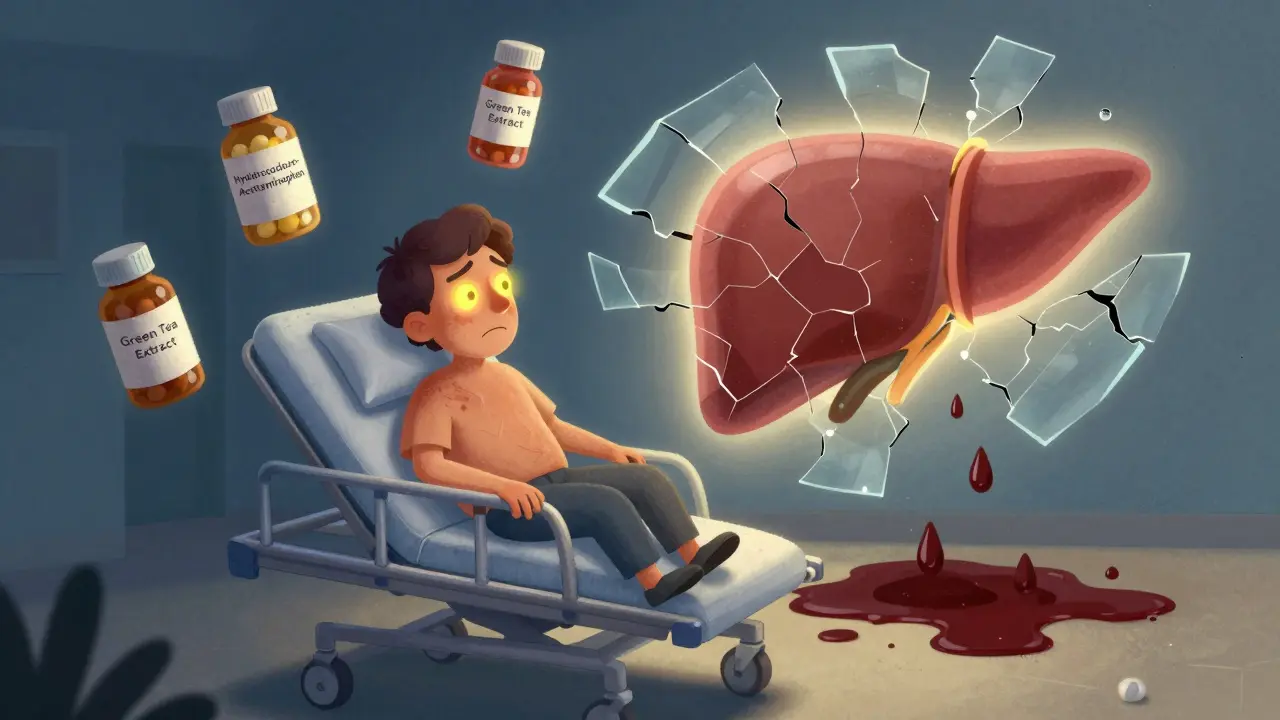
- Herbal supplements: Green tea extract, kava, comfrey. These aren’t regulated like drugs. A woman takes 800 mg of green tea extract daily for weight loss. Three months later, she’s in the ER with INR of 6.8. No fever. No alcohol. No other explanation. Just supplements.
And here’s the kicker: 42% of herbal supplement-related liver failures involve green tea extract. Most patients are women. Most didn’t tell their doctor they were taking it.
How Emergency Teams Spot It - Fast
Time is everything. The Acute Liver Failure Study Group’s 30-minute triage protocol is simple:
- If someone has nausea or vomiting and yellow skin - get an ALT, INR, and acetaminophen level right now.
- Check mental status every hour. Use the West Haven Criteria: Is the patient confused? Slurring words? Sleeping too much? That’s encephalopathy.
- If INR is over 1.5, recheck every 6 hours. If it hits 6.5? That’s transplant territory.
Don’t wait for the full picture. If ALT is over 500 IU/L - even if they deny taking acetaminophen - test for it anyway. 23% of acetaminophen-induced liver failure cases lie about it. They’re embarrassed. They thought it was safe. Or they didn’t realize how much they’d taken.
And don’t forget Hy’s Law: If ALT or AST is more than 3 times the upper limit - and bilirubin is more than 2 times normal - that’s a red flag. The European Association for the Study of the Liver says: hospitalize them. Monitor INR daily. Don’t send them home.
What Families and Patients Miss
Patients often say: “I just took my usual pain pills.” Or: “I’ve been taking green tea for months - it’s healthy.”
But the symptoms are subtle at first. The most common sign before hospitalization? Persistent nausea - with no loss of appetite. That’s the opposite of what you’d expect. You think if you’re sick, you won’t eat. But here, you’re still hungry. Just nauseous.
Families notice personality changes. “She’s not herself.” “She’s forgetful.” “She keeps falling asleep in the chair.” That’s encephalopathy. It looks like depression. Or aging. Or stress. It’s not.
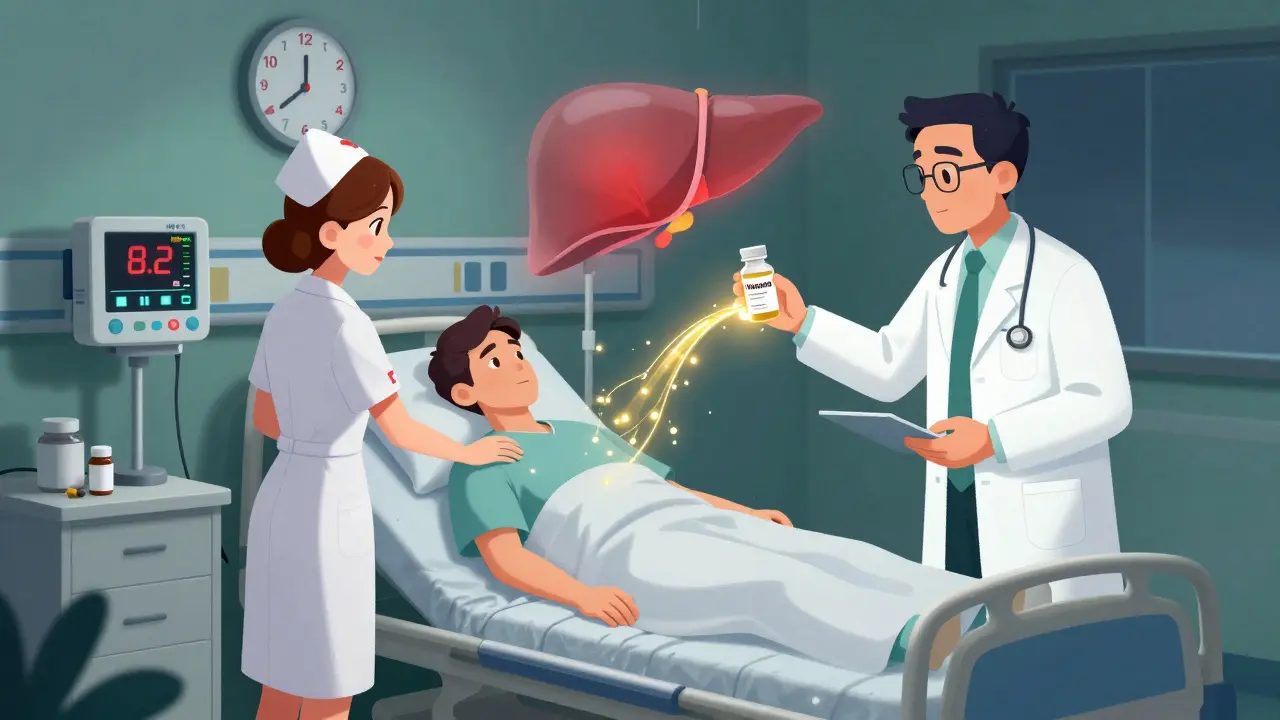
A nurse in Ohio saw a 45-year-old woman with confusion and vomiting. Initial labs looked fine. Only when someone checked the INR - it was 8.2 - did they realize. She was hours from death. She survived because they acted fast. But she could’ve died because no one thought to test clotting.
The New Tools That Are Changing Outcomes
There’s hope. New tech is helping.
AI systems like HepaPredict analyze 17 data points - labs, vitals, meds, symptoms - and predict liver failure progression with 89% accuracy within 24 hours. That’s huge. No more guessing.
And a new blood marker - miR-122 - can detect acetaminophen damage as early as 6 hours after ingestion. Sensitivity? 94%. This could become the new standard for early detection.
By mid-2024, a national FHF Alert System will require ERs to report suspected cases within one hour. That means transplant centers get called faster. More people get on the list before they crash.
What You Can Do - Right Now
If you’re a patient:
- Know how much acetaminophen you’re taking - total. Add up every pill, syrup, cold med, sleep aid.
- Never exceed 4 grams a day. Period.
- Stop herbal supplements if you feel off. Green tea extract, kava, and comfrey aren’t safe just because they’re “natural.”
- If you’re nauseous for more than 2 days and feel confused - go to the ER. Don’t wait.
If you’re a caregiver or family member:
- Watch for subtle changes: forgetfulness, drowsiness, personality shifts.
- Ask: “What meds are they taking? Even the ones they bought without a prescription?”
- If they’re yellow, vomiting, and confused - don’t call the doctor. Go to the ER. Say: “I’m worried about liver failure.”
If you’re a clinician:
- Test acetaminophen levels in every patient with ALT >500 - even if they deny it.
- Check INR in anyone with nausea and jaundice. Don’t wait for the full panel.
- Document every supplement. Ask twice. Write it down.
- Know the King’s College Criteria. If INR >6.5 and encephalopathy grade III-IV - call transplant now.
Final Reality Check
This isn’t rare. It’s predictable. And it’s preventable.
Acetaminophen is the #1 cause of liver failure in the U.S. - and we still treat it like an accident. But it’s not. It’s a systemic failure of awareness. People think “OTC” means “safe.” It doesn’t. It just means “easy to get.”
The data is clear: early recognition saves lives. A 3-hour delay in NAC drops survival by 30%. A missed INR test can kill. A dismissed herbal supplement? Could be the difference between life and death.
We have the tools. We have the protocols. We have the knowledge. What we need now is action - in every ER, in every home, in every pharmacy. Because when the liver fails, you don’t get a second chance.
Can you recover from fulminant hepatic failure without a transplant?
Yes - but only if caught early. About 67% of acetaminophen-induced cases recover with N-acetylcysteine and supportive care if treated within 8 hours. For other drug causes, survival without transplant drops to 29%. The key is speed. If encephalopathy progresses to grade III or IV and INR exceeds 6.5, transplant becomes the only option.
Is acetaminophen safe if I take it as directed?
Only if you don’t exceed 4 grams total per day - and don’t combine it with other products containing acetaminophen. Many prescription painkillers (like hydrocodone/acetaminophen) contain it. Taking two of those plus a cold medicine can easily push you over 6 grams. That’s enough to cause liver failure. Always check labels.
Can herbal supplements cause liver failure?
Absolutely. Green tea extract, kava, and comfrey are among the most common culprits. These aren’t regulated like drugs, so dosing is inconsistent. A 2019-2022 U.S. Poison Control study found 42% of herbal supplement-related liver failures involved green tea extract - often taken daily for months. Symptoms appear slowly, making them easy to miss. Always tell your doctor what supplements you take.
What should I do if I suspect someone has drug-induced liver failure?
Go to the emergency room immediately. Don’t wait. Say: “I’m concerned about acute liver failure.” Request an ALT, INR, and acetaminophen level. If they’re vomiting and confused, don’t assume it’s the flu or food poisoning. Ask: “What medications or supplements have they taken?” Bring a list if possible. Time is critical - every hour matters.
Why don’t doctors always catch this early?
Because the symptoms mimic other common illnesses - flu, gastroenteritis, depression. Many patients don’t mention supplements. Others deny taking too much acetaminophen. And without a clear history, liver enzymes can be misinterpreted. Studies show 41% of antitubercular drug cases are misdiagnosed as hepatitis B. The only way to avoid missing it is to test INR and acetaminophen levels in anyone with unexplained nausea and jaundice - no exceptions.
Is there a way to prevent this from happening?
Yes. First, never take more than 4 grams of acetaminophen in 24 hours - and count every source. Second, avoid herbal supplements unless approved by a doctor familiar with liver risks. Third, if you’re on multiple medications, ask your pharmacist to review them for hidden acetaminophen. Fourth, educate your family. This isn’t rare. It’s preventable - if we pay attention.



Vicky Zhang
January 14, 2026 AT 03:01OMG I had no idea acetaminophen could do this. I take it for my back pain and sometimes throw in a cold med on top - I just thought it was harmless. I’m going to check every bottle in my cabinet right now. My mom almost died from liver issues last year and no one knew why. This post saved my life. Thank you.
Allison Deming
January 15, 2026 AT 23:54It is both tragic and entirely preventable that so many individuals succumb to a condition caused by over-the-counter substances they believe to be benign. The normalization of polypharmacy without professional oversight reflects a broader cultural disregard for medical science. Pharmacists must be empowered to intervene, and public education campaigns should be mandatory - not optional - in every pharmacy and grocery store. This is not merely a medical issue; it is a moral failure of public health infrastructure.
Susie Deer
January 16, 2026 AT 16:06TooAfraid ToSay
January 18, 2026 AT 02:34Dylan Livingston
January 18, 2026 AT 09:50How delightfully quaint that we still treat pharmaceuticals like they’re not biochemical grenades wrapped in cheerful packaging. The real tragedy isn’t the liver failure - it’s the fact that we’ve normalized self-medication as a form of spiritual self-care. "I just took my usual pain pills" - as if the liver is some passive roommate who doesn’t mind being slowly poisoned by your desire to feel "normal." And don’t get me started on herbal supplements - the new-age equivalent of drinking unicorn tears. At least opioids have a warning label. Green tea extract? Just a pretty bottle with a yoga pose on it. How poetic.
Andrew Freeman
January 19, 2026 AT 23:55says haze
January 21, 2026 AT 09:13What we’re witnessing here isn’t pharmacological ignorance - it’s epistemological collapse. The postmodern subject has internalized the myth of the self-sufficient body: I am the authority on my own physiology, and labels are mere suggestions. The liver, once revered as the organ of detoxification, is now treated as a disposable filter. The rise of miR-122 as a biomarker is less a scientific breakthrough than a testament to our collective failure to treat biochemistry with reverence. We didn’t need AI to tell us this was coming - we needed humility.
Alvin Bregman
January 22, 2026 AT 11:00