
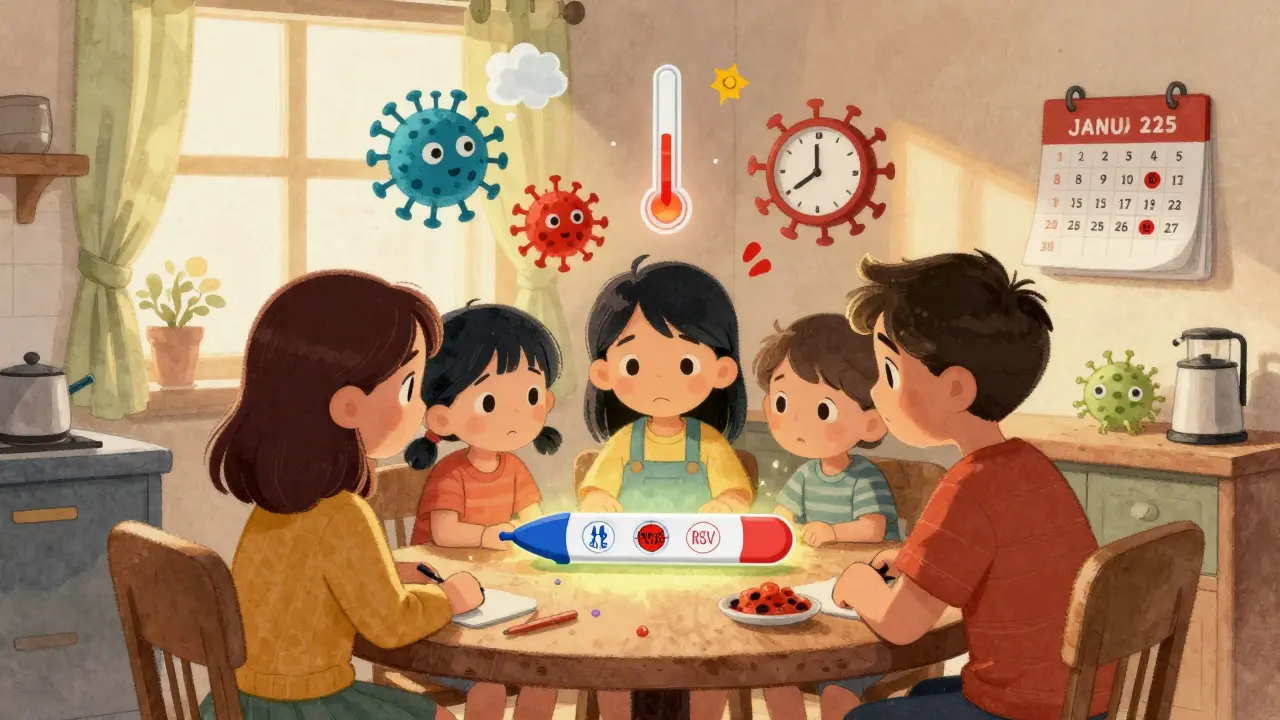
By early 2025, something unexpected happened: influenza surpassed COVID-19 in hospitalizations and deaths across the U.S. For the first time since the pandemic began, more people were ending up in the hospital from the flu than from SARS-CoV-2. This shift didn’t come out of nowhere. It was the result of changing virus strains, improved vaccines, and better public health responses. But here’s the catch - if you’re sick with a fever, cough, and body aches, you still can’t tell whether it’s the flu or COVID-19 just by how you feel. That’s why knowing the differences in testing, treatment, and isolation isn’t just helpful - it’s essential.
Testing: Don’t Guess, Test
Both influenza and COVID-19 cause similar symptoms: fever, chills, fatigue, sore throat, and cough. But the timing and severity can vary. Flu symptoms usually show up within 1 to 4 days after exposure. COVID-19? It can take up to two weeks. That delay makes early detection harder - and more important.
During the 2024-2025 season, nearly 9 out of 10 U.S. hospitals started using multiplex PCR tests that check for flu A/B, SARS-CoV-2, and RSV all at once. These tests cut diagnosis time by almost two days compared to running separate tests. Rapid antigen tests are still common in clinics and at-home kits, but their accuracy varies. Flu antigen tests catch about 75-85% of cases; COVID-19 antigen tests are slightly better at 80-90%. That means a negative rapid test doesn’t rule out either illness - especially if you’re still feeling awful.
If you’re high-risk - over 65, pregnant, or have asthma, diabetes, or heart disease - don’t wait for a test result to start treatment. Doctors often begin antivirals based on symptoms alone during peak season. The same goes for kids under 5 or anyone with weakened immunity. Delaying treatment can mean the difference between recovering at home and ending up in the ICU.
Treatment: Antivirals Are Time-Sensitive
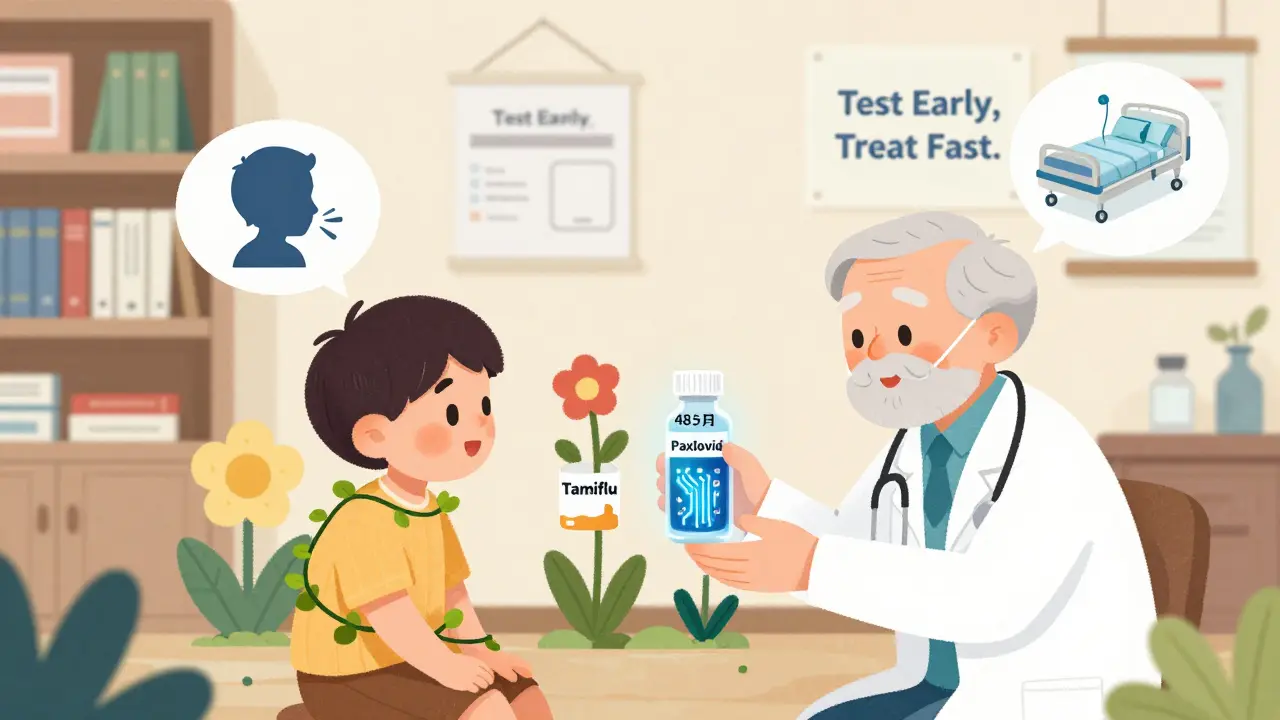
For influenza, oseltamivir (Tamiflu) is still the go-to antiviral. When taken within 48 hours of symptoms, it cuts hospital stays by about 30% and reduces complications like pneumonia. During the 2024-2025 season, the CDC found it was 70% effective at preventing hospitalization in high-risk groups. But here’s the problem: only about 63% of hospitalized flu patients got it within that critical window. Many waited too long because they thought it was just a bad cold.
For COVID-19, Paxlovid (nirmatrelvir/ritonavir) is the most effective oral treatment. When taken within five days of symptoms, it reduces hospitalization and death by 89% in high-risk adults. That’s a huge win. But here’s the twist: only 41% of hospitalized COVID-19 patients received it in time during the 2024-2025 season. Why? Some didn’t know they had it. Others couldn’t get a prescription fast enough. Insurance coverage also played a role - 87% of flu antiviral prescriptions were fully covered, but only 63% of Paxlovid prescriptions were.
There’s also a key difference in complications. Flu patients are more likely to get bacterial pneumonia on top of the viral infection - about 30-50% of severe cases. That’s why antibiotics are often used alongside antivirals for flu. For COVID-19, viral pneumonia is more common, and bacterial co-infections happen less often. So, antibiotics aren’t usually needed unless there’s clear evidence of a secondary infection.
In January 2025, the FDA approved a new flu antiviral - a prodrug of zanamivir - that’s even more effective against the dominant H1N1 pdm09 strain, with 92% efficacy. It’s not widely available yet, but it’s a sign that treatment options are evolving.
Isolation: One Rule Doesn’t Fit Both
The CDC recommends isolating for five days for both illnesses. But that’s where the similarity ends.
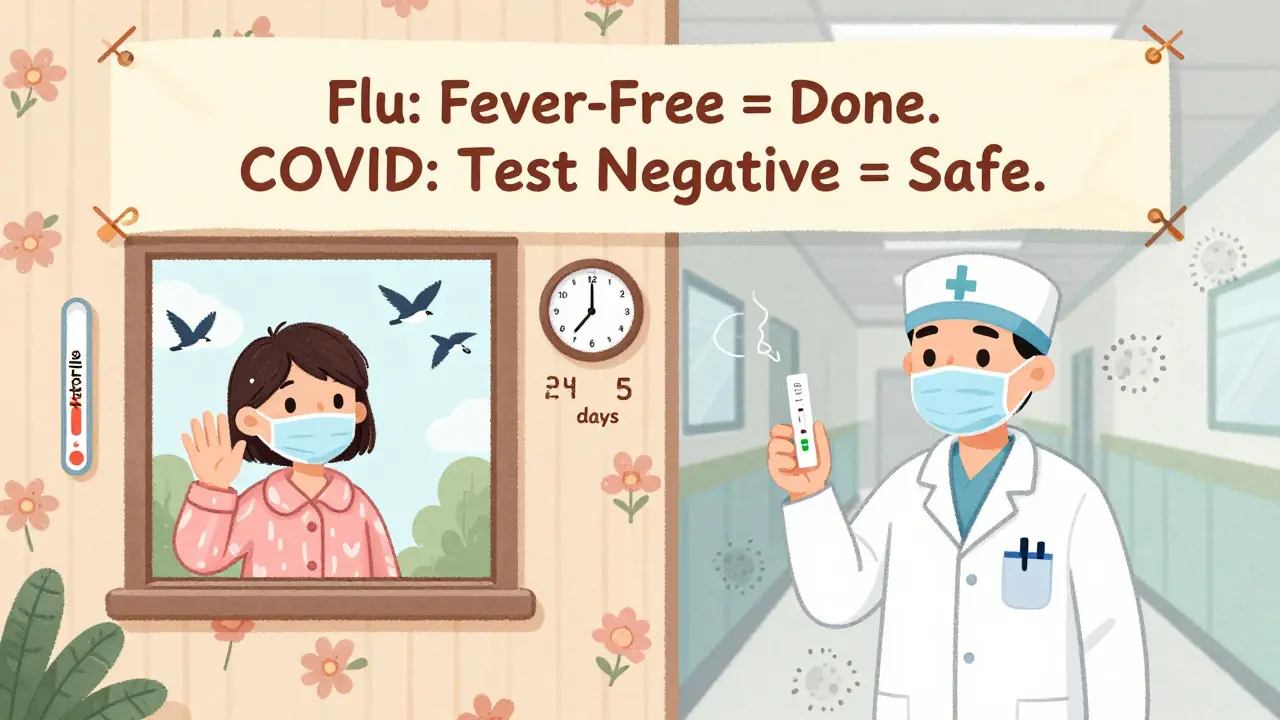
For influenza, you can end isolation after 24 hours without fever (and without fever-reducing meds) - even if you’re still coughing or feeling tired. That’s because flu is most contagious the day before symptoms start and for the next 5 to 7 days. Kids can shed the virus longer - up to two weeks - but adults usually stop being infectious after a week.
For COVID-19, especially with the XEC subvariant, the rules are stricter. You must isolate for five days, but you also need a negative rapid antigen test on day five to go back to work or school. Why? Because SARS-CoV-2 sticks around longer. People can still shed infectious virus for 8 to 10 days, even after symptoms fade. That’s why healthcare workers treating COVID-19 patients are required to wear N95 masks - 92% of hospitals enforce that rule. For flu, only 68% require N95s.
Another big difference: loss of taste or smell. It’s rare with the flu - happening in just 5-10% of cases. But with COVID-19, it’s common. Up to 80% of people infected with earlier variants lost their sense of taste or smell. While less frequent with newer strains, it’s still a strong indicator of COVID-19 if it happens.
Who’s at Higher Risk?
The people most likely to get seriously sick from flu are often younger, healthier individuals - about 42% of hospitalized flu patients had no pre-existing conditions. That’s surprising, but it’s true. Flu hits hard and fast, even in people who think they’re fine.
COVID-19, on the other hand, targets those with underlying health issues. Hospitalized COVID-19 patients are more likely to have chronic kidney disease, cancer, autoimmune disorders, or be on immunosuppressants. Men are also more likely to be hospitalized with COVID-19 than flu. That’s why vaccines matter differently for each. The 2024-2025 flu vaccine was 52.6% effective in the U.S. population. The updated COVID-19 vaccine? Only 48.3%. But that small gap closed the mortality gap - and saved lives.
What to Do If You’re Sick
- Stay home if you have a fever, cough, or trouble breathing - even if you think it’s just the flu.
- Get tested as soon as possible. Use a multiplex test if available, or at least a rapid flu/COVID combo test.
- If you’re high-risk, call your doctor before going in. Ask about antivirals - don’t wait.
- Follow isolation rules strictly. For flu: 24 hours fever-free. For COVID-19: negative test on day five.
- Wear a mask around others for at least 10 days, even after isolation ends. You might still be shedding virus.
- Hydrate, rest, and monitor for warning signs: shortness of breath, chest pain, confusion, or bluish lips.
Prevention: Vaccines Still Work
The best way to avoid both illnesses is to get vaccinated. Flu shots are updated every year to match circulating strains. The 2025-2026 version includes protection against the H1N1 pdm09 strain, which dominated last season. The updated COVID-19 vaccine targets the XEC subvariant and other recent strains.
Don’t wait until you’re sick to get vaccinated. Flu season can start as early as October and last through May. COVID-19 waves can pop up any time - especially in winter and spring. Getting both vaccines by late September gives your body time to build protection before peak season hits.
And yes, masks still help. In crowded indoor spaces during respiratory season - like public transit, hospitals, or schools - wearing a well-fitting mask reduces your risk of catching either virus. N95s or KN95s are best. Cloth masks? They offer some protection, but not enough in high-risk settings.
What’s Changing in 2026?
The CDC’s 2025-2026 Respiratory Disease Season Outlook warns that if a new immune-escape variant of SARS-CoV-2 emerges, hospitalizations could spike again - possibly surpassing flu numbers by early 2026. But the bigger trend is clear: we’re moving toward integrated care. Hospitals now use unified clinical pathways that test for both flu and COVID-19 at the same time, treat based on risk, and isolate based on virus type.
Antiviral access is improving. More pharmacies now carry Paxlovid and Tamiflu without a prescription in some states. Insurance companies are updating policies to cover both equally. And at-home testing kits are getting smarter - BinaxNOW’s combined flu/COVID test now has 89% sensitivity for both viruses.
But the bottom line hasn’t changed: if you’re sick, don’t assume it’s just the flu. Don’t assume it’s just COVID. Test. Treat early. Isolate correctly. And protect others.
Can I have the flu and COVID-19 at the same time?
Yes. Co-infections happen. During the 2024-2025 season, about 8% of patients tested positive for both influenza and SARS-CoV-2. These cases tend to be more severe, especially in older adults or those with chronic conditions. Multiplex testing helps catch both at once. If you’re hospitalized with respiratory illness, doctors will check for both.
How long am I contagious with the flu or COVID-19?
With flu, you’re most contagious the day before symptoms start and for the next 5 to 7 days. Kids can spread it longer - up to 14 days. With COVID-19, especially the XEC variant, you can be contagious 2 to 3 days before symptoms and for 8 to 10 days after. Even if you feel better, you might still be shedding virus. That’s why testing on day five is required for COVID-19 isolation.
Should I take antibiotics for the flu or COVID-19?
No - unless you have a confirmed bacterial infection. Both flu and COVID-19 are caused by viruses, so antibiotics won’t help. But flu patients are more likely to develop secondary bacterial pneumonia, so doctors may prescribe antibiotics if they suspect a complication. For COVID-19, bacterial infections are rarer, so antibiotics are used less often. Never take antibiotics without a doctor’s order.
Is Paxlovid still effective against newer COVID-19 strains?
Yes. Paxlovid works by blocking a key enzyme the virus needs to replicate. That enzyme hasn’t changed significantly in newer variants like XEC. The FDA updated its emergency authorization in February 2025 to expand eligibility to more people, including those with mild symptoms who have risk factors. It’s still one of the most effective outpatient treatments we have.
Why did flu kill more people than COVID-19 in early 2025?
It was a perfect storm. The H1N1 pdm09 strain was highly contagious and hit younger, healthier people harder. At the same time, COVID-19 vaccination rates were low, but the virus had become less deadly due to prior immunity and better treatments. Meanwhile, flu vaccine coverage improved to 52.6%, and more people got tested and treated early. The result? More flu cases, but fewer deaths from COVID-19. That doesn’t mean COVID-19 is gone - it just means the balance shifted temporarily.



Skye Kooyman
January 25, 2026 AT 06:03Been sick twice this season. Both times I thought it was just the flu. Turned out to be COVID. Never again guessing. Got the multiplex test on day two. Saved my sanity.
Uche Okoro
January 26, 2026 AT 09:39The epidemiological convergence of viral pathogenesis and public health infrastructure optimization has precipitated a paradigmatic shift in respiratory disease triage protocols. The differential diagnostic efficacy of multiplex PCR platforms, particularly in high-risk cohorts, demonstrates statistically significant reductions in time-to-treatment initiation (p < 0.01). Furthermore, the pharmacoeconomic disparity in antiviral access-particularly Paxlovid’s suboptimal insurance coverage (63%) versus Tamiflu (87%)-exacerbates health inequities in a neoliberal healthcare milieu. The temporal dynamics of viral shedding, especially with XEC, necessitate reevaluation of CDC isolation paradigms. Bacterial co-infection rates remain underdiagnosed in influenza, warranting prospective cohort studies.
Peter Sharplin
January 27, 2026 AT 03:17As someone who works in urgent care, I see this every day. People come in saying, 'It's just the flu,' and then they're in the ER three days later. The key isn't just testing-it's acting fast. If you're over 50, pregnant, or have any chronic condition, don't wait for a test result. Call your doctor the moment you feel off. Tamiflu works best within 48 hours, and Paxlovid even more so. I've seen people recover fully because they got it early. Don't be the person who waits for a miracle. Be the person who calls first.
And yes, masks still matter. Not because you're scared, but because you care. Wearing one in a crowded store or on the bus isn't about fear-it's about not being the reason someone else ends up in the hospital.
The new flu antiviral? Still not widely available, but it's coming. Until then, get your shots. Both of them. September isn't too early. It's perfect.
shivam utkresth
January 27, 2026 AT 16:04Man, I remember when we used to fight about whether masks were dumb or not. Now? My grandma wears a KN95 to the temple. My cousin in Mumbai swears by the combo test kit. We’re all just trying not to end up on a ventilator. Funny how a virus made us all a little more human, huh? No more 'I'm fine' lies. No more 'it's just a cold' excuses. We got smarter. Not perfect, but smarter.
And yeah, Paxlovid’s a pain to get-insurance drama, pharmacy shortages-but when you see someone in their 70s walk out of the ER after taking it? Worth every bureaucratic headache.
Flu’s still a beast. Don’t sleep on it. It doesn’t care if you’re 'healthy.' It just wants to crash your party.
James Nicoll
January 29, 2026 AT 03:18So let me get this straight-we spent three years panicking about a virus that became less deadly, while the flu, the OG seasonal killer, quietly took the crown? Classic. We treated COVID like the end of the world and flu like a bad Tuesday. Now the flu’s out here with a crown made of hospital beds and we’re all like 'oh wow, interesting.'
Meanwhile, the same people who refused vaccines for COVID are now getting flu shots because 'it’s just common sense.' Tell me again why we need a pandemic to become reasonable?
Also, Paxlovid’s coverage is worse than my ex’s texts. How is a drug that cuts death by 89% not covered like insulin? We’re literally choosing who lives based on insurance forms.
And yes, I still wear a mask on the subway. Not because I’m afraid. Because I refuse to be the reason someone’s grandkid loses their grandma.
Aurelie L.
January 30, 2026 AT 23:13My brother got both at once. He was in the hospital for 12 days. He’s fine now. But I’m never letting him skip a test again.
Joanna Domżalska
January 31, 2026 AT 07:03So flu killed more people? Big deal. That just means COVID was *too* well-managed. We were too safe. Too protected. Too vaccinated. Maybe we should’ve let it run wild and built natural immunity like the old days. Now we’re all just scared of a sniffle. Pathetic.
John Wippler
February 1, 2026 AT 11:00Reading this made me realize something: we’ve been fighting viruses like they’re enemies to defeat. But they’re not. They’re just… existing. We’re the ones who make them dangerous-with delays, with fear, with unequal access, with ignoring the science until it’s too late.
But here’s the good part-we’re learning. Faster. Smarter. More together. The fact that hospitals now test for both at once? That’s progress. The fact that people are asking for antivirals before they even leave the house? That’s power.
You don’t need to be a hero to do the right thing. Just be the person who tests. Who calls. Who masks up. Who doesn’t wait. That’s enough. That’s everything.