
PPI Bone Health Risk Calculator
Assess Your Bone Health Risk
Low Risk
Your fracture risk appears to be within normal range based on current information.
Based on the information you provided, your risk of fracture is lower than average. Continue taking preventive measures like adequate calcium and vitamin D intake and regular exercise.
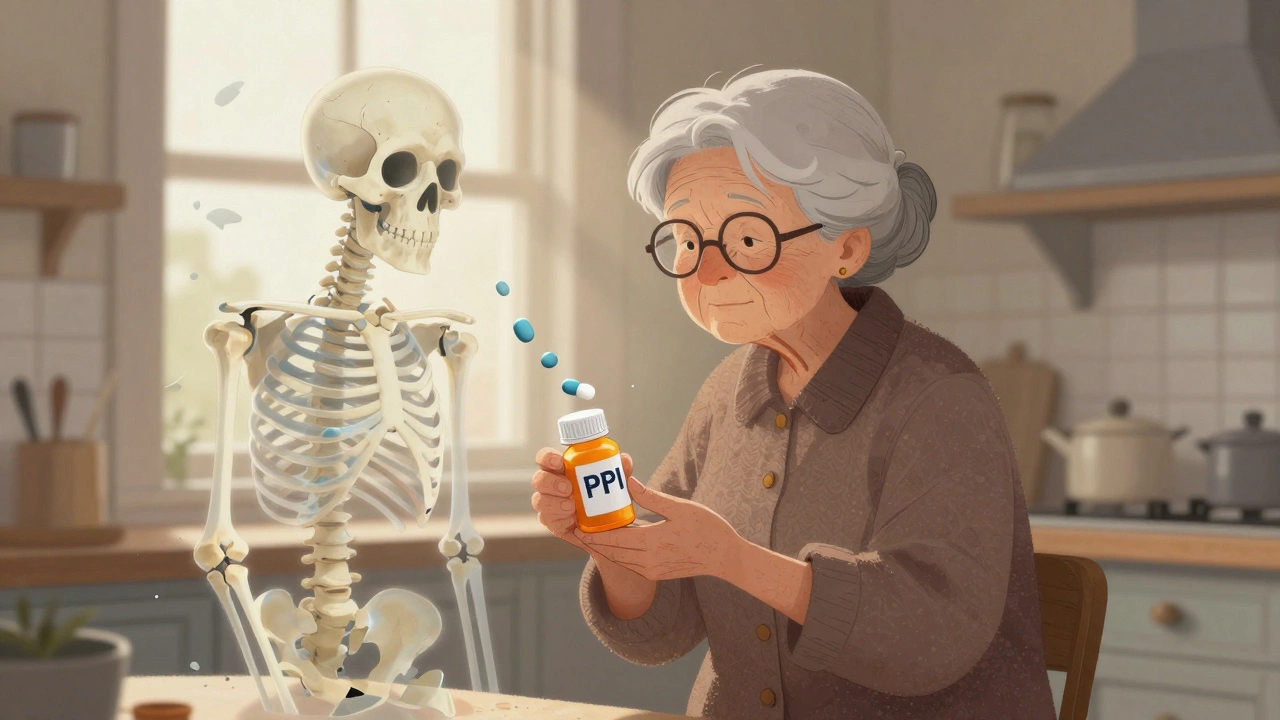
Millions of people take proton pump inhibitors (PPIs) every day to manage heartburn, acid reflux, or ulcers. These drugs-like omeprazole, esomeprazole, and pantoprazole-are powerful, effective, and often life-changing for those with chronic stomach issues. But behind their success lies a quiet, growing concern: proton pump inhibitors might be quietly weakening bones over time.
If you’ve been on PPIs for more than a year, especially if you’re over 65, female, or have other risk factors for osteoporosis, this isn’t just theoretical. Studies show a real, measurable link between long-term PPI use and higher fracture risk-particularly in the hip, spine, and wrist. It’s not a guarantee. But it’s a risk you can’t ignore.
How PPIs Might Weaken Your Bones
PPIs work by shutting down the acid pumps in your stomach. Less acid means less heartburn. But acid isn’t just there to digest food-it helps your body absorb calcium, magnesium, and other minerals critical for bone strength. When acid levels drop too low for too long, your body struggles to absorb calcium from food or supplements, especially calcium carbonate, the most common form found in over-the-counter pills.
Here’s the catch: your bones are constantly remodeling. Old bone breaks down, new bone forms. If your body doesn’t get enough calcium, it pulls from your skeleton to keep your heart, muscles, and nerves working. Over years, this leads to thinner, more fragile bones. A 2019 meta-analysis in the Journal of Bone and Mineral Research found that long-term PPI users had a 20-30% higher risk of hip and spine fractures compared to non-users.
It’s not just calcium. Some research suggests PPIs may also trigger excess gastrin production, which could stimulate bone-resorbing cells called osteoclasts. Other studies point to reduced magnesium absorption, which plays a role in vitamin D activation and bone mineralization. The exact mechanism isn’t fully settled, but the outcome is consistent across multiple large studies: prolonged acid suppression = higher fracture risk.
Who’s at the Highest Risk?
Not everyone on PPIs will break a bone. But certain groups face much higher odds:
- People over 65-bone density naturally declines with age, and PPIs add to that stress.
- Postmenopausal women-estrogen loss already increases osteoporosis risk; PPIs may double down on that.
- Those on high doses or long-term use-studies show risk climbs after 1 year and spikes after 5-7 years of daily use.
- People taking corticosteroids-like prednisone-which also weaken bones.
- Those with low body weight-under 57 kg (125 lbs)-less bone mass to begin with.
- Anyone with a prior fracture-if you’ve broken a bone before, you’re far more likely to break another.
A 2019 study in the American Journal of Gastroenterology found postmenopausal women on long-term PPIs had a 35% higher risk of hip fracture. Another study tracking over 50,000 adults over 50 showed PPI users had a 27% higher hip fracture risk than those on H2 blockers like famotidine. And it wasn’t just a little higher-it was dose-dependent. People taking higher daily doses had up to a 67% increased risk.
PPIs vs. H2 Blockers: Is One Safer?
Many people assume all acid-reducing drugs are the same. They’re not.
PPIs suppress acid more completely and for longer than H2 blockers like ranitidine or famotidine. That’s why they’re more effective for severe GERD. But that same power comes with more side effects. Multiple studies show PPIs carry a higher fracture risk than H2 blockers.
One 2020 study compared 50,000 PPI users to 50,000 H2 blocker users. The PPI group had a 27% higher risk of hip fracture. In children, a large 2020 study found no overall fracture risk with PPIs-but a 22% higher risk of lower-limb fractures in kids aged 6-12. That’s a red flag for long-term use in younger populations, too.
So if you’re on PPIs long-term and worried about bones, ask your doctor: could an H2 blocker work instead? For mild to moderate reflux, it might.
What the Experts Say
The FDA issued a safety warning in 2010 after reviewing seven studies. Six showed increased fracture risk with long-term PPI use. One didn’t. The agency concluded the risk was small but real-especially for older adults taking high doses.
Dr. Leslie Targownik, a leading researcher on this topic, points out that many studies don’t fully account for other factors: poor diet, smoking, alcohol, lack of exercise, or other medications. But even after adjusting for those, the link remains. The American Gastroenterological Association says the absolute risk increase is small, but it’s real enough to warrant caution.
The UK’s MHRA and the Endocrine Society both agree: PPIs are safe and necessary for many people. But they shouldn’t be used longer than needed. The American Geriatrics Society even lists PPIs as a potentially inappropriate medication for older adults when prescribed without clear indication.
What You Can Do: Practical Steps
If you’re on PPIs and concerned about bone health, here’s what actually helps:
- Ask if you still need it. Many people stay on PPIs years after their original issue resolved. Ask your doctor if you can taper off or switch to on-demand use.
- Use the lowest effective dose. Don’t take 40mg if 20mg works. Don’t take it twice daily if once daily is enough.
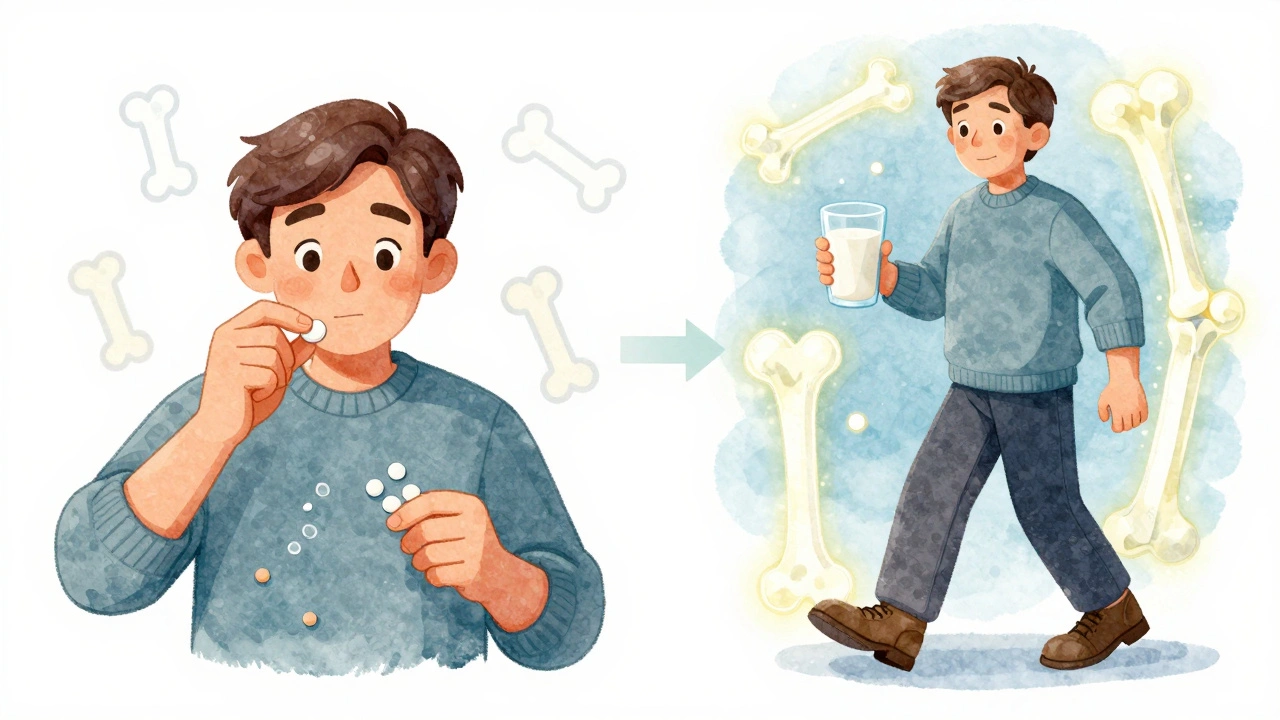
- Consider calcium citrate, not carbonate. Calcium citrate doesn’t need stomach acid to absorb. It’s the better choice if you’re on PPIs. Aim for 1,200 mg daily from food and supplements combined.
- Get enough vitamin D. At least 800-1,000 IU daily. Many older adults are deficient. A simple blood test can check your levels.
- Move your body. Weight-bearing exercise-walking, lifting weights, stair climbing-strengthens bones. Aim for 30 minutes most days.
- Don’t smoke. Limit alcohol. Both damage bone density.
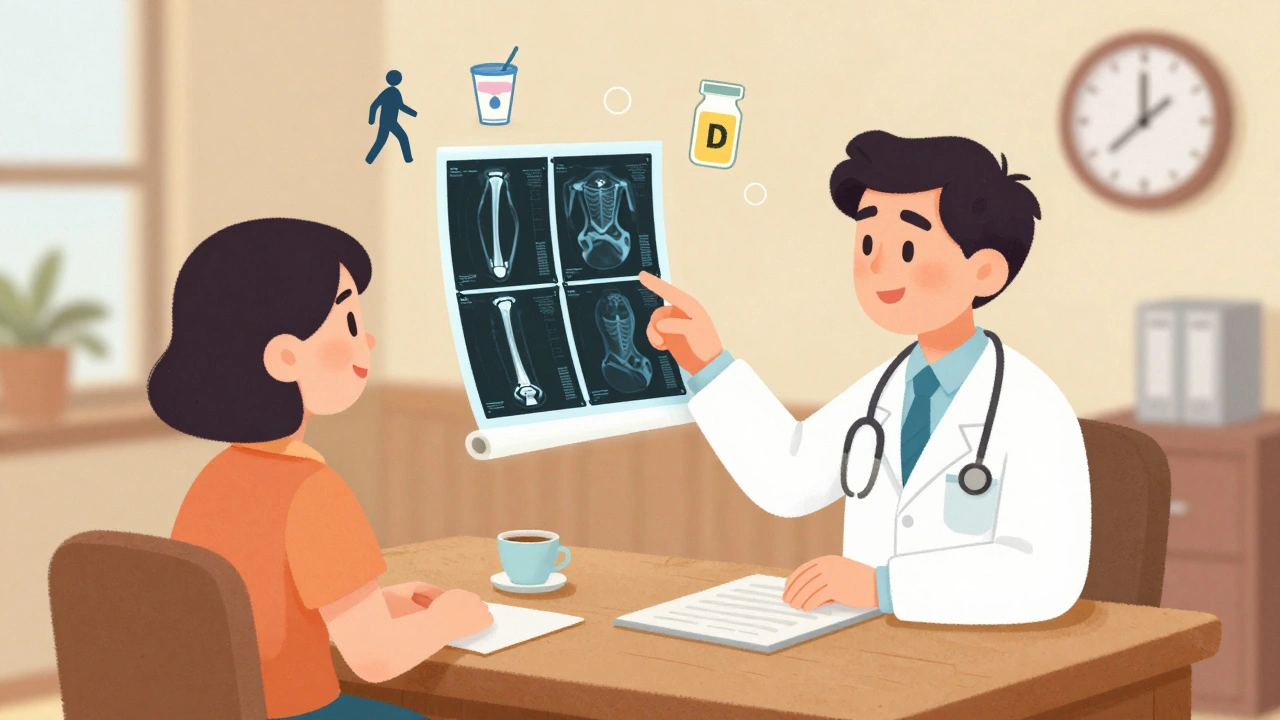
- Get a bone density scan if you’re high-risk. If you’re over 65, female, have a history of fracture, or take steroids, ask your doctor about a DEXA scan. It’s quick, painless, and tells you if your bones are thinning.
The National Osteoporosis Foundation recommends calcium citrate for PPI users. It’s slightly more expensive than carbonate, but worth it. And don’t just take supplements-get calcium from food: yogurt, cheese, leafy greens, fortified plant milks, sardines with bones.
The Bigger Picture: Are PPIs Still Worth It?
Let’s be clear: PPIs save lives. They prevent bleeding ulcers. They heal esophagitis. They stop deadly complications from acid reflux. For someone with Barrett’s esophagus or a history of GI bleeding, the benefits far outweigh the risks.
The problem isn’t PPIs themselves-it’s overuse. Studies show 60-70% of long-term PPI prescriptions are unnecessary. People take them for mild heartburn, for years, without ever reevaluating. That’s where the danger lies.
The good news? Prescribing patterns are changing. Between 2015 and 2021, long-term PPI prescriptions among Medicare patients dropped by nearly 20%. More doctors are now asking: “Do you still need this?”
If you’re one of the millions on PPIs, don’t stop cold turkey. Acid rebound can be brutal. But do talk to your doctor. Together, you can find the right balance-enough relief, without unnecessary risk.
What’s Next?
A major NIH-funded study called PPI-BONE, tracking 15,000 people over five years, is expected to release final results in mid-2025. It’s designed to cut through the noise-controlling for diet, activity, other meds, and lifestyle factors. That study could finally give us a clearer picture of how much risk is real, and for whom.
In the meantime, the message is simple: use PPIs only as long as needed, at the lowest dose possible. Protect your bones with calcium, vitamin D, and movement. And never assume a medication is harmless just because it’s common or available over the counter.
Can proton pump inhibitors cause osteoporosis?
PPIs don’t directly cause osteoporosis, but long-term use can contribute to bone weakening by reducing calcium absorption. This increases the risk of fractures, especially in older adults and those with other risk factors. The effect is modest but real, and it’s dose- and duration-dependent.
How long can you safely take PPIs?
Most guidelines recommend short-term use-4 to 8 weeks-for conditions like GERD or ulcers. If you need longer treatment, your doctor should reassess every 3-6 months. For chronic conditions like Barrett’s esophagus, long-term use may be necessary, but the lowest effective dose should always be used.
Should I stop taking PPIs if I’m worried about bone loss?
Don’t stop suddenly. Stopping PPIs abruptly can cause rebound acid hypersecretion, making symptoms worse. Talk to your doctor first. They may suggest tapering off, switching to an H2 blocker, or using on-demand dosing. If you’re high-risk for fractures, they may also recommend a bone density test.
Is calcium citrate better than calcium carbonate if I take PPIs?
Yes. Calcium carbonate needs stomach acid to be absorbed, which PPIs reduce. Calcium citrate doesn’t require acid, so it’s absorbed just as well even with low stomach acid. For PPI users, calcium citrate is the preferred form.
Do all PPIs carry the same fracture risk?
Current evidence suggests all PPIs carry similar risks when used long-term at high doses. The issue is the class effect-reducing stomach acid-not the specific drug. Omeprazole, pantoprazole, esomeprazole, and others all appear to carry comparable fracture risks in studies.
Can I take PPIs and still keep my bones strong?
Absolutely. Many people take PPIs safely for years without bone problems. The key is using the lowest dose for the shortest time possible, getting enough calcium (preferably citrate) and vitamin D, exercising regularly, avoiding smoking, and limiting alcohol. Regular check-ups with your doctor can catch bone loss early.

Iris Carmen
December 9, 2025 AT 18:14Rich Paul
December 10, 2025 AT 23:20Delaine Kiara
December 11, 2025 AT 06:48Ruth Witte
December 11, 2025 AT 21:05Noah Raines
December 12, 2025 AT 08:57Katherine Rodgers
December 14, 2025 AT 02:49Mona Schmidt
December 14, 2025 AT 08:41Guylaine Lapointe
December 15, 2025 AT 19:57Andrea Petrov
December 17, 2025 AT 19:26Suzanne Johnston
December 18, 2025 AT 13:41Graham Abbas
December 18, 2025 AT 22:01Haley P Law
December 20, 2025 AT 13:30Andrea DeWinter
December 21, 2025 AT 08:01