

When a pharmacist swaps one blood pressure pill for another, or switches an antidepressant to a different brand within the same group, it’s not a mistake. It’s therapeutic interchange-a deliberate, evidence-based move made by healthcare teams to save money without sacrificing care. But here’s the thing: it doesn’t mean swapping a statin for a beta-blocker. That’s not therapeutic interchange. That’s a completely different decision, and it’s not allowed under the rules.
Therapeutic Interchange Isn’t Across Classes-It’s Within Them
Many people think therapeutic interchange means swapping drugs from different classes-like switching from lisinopril (an ACE inhibitor) to amlodipine (a calcium channel blocker). That’s not it. Not even close. Therapeutic interchange happens only within the same therapeutic class. So, if a doctor prescribes losartan (an ARB), a pharmacist might swap it for valsartan, another ARB. Both lower blood pressure the same way. Both are in the same family. Both have similar side effect profiles. The difference? One might cost $15 a month instead of $85.
The American College of Clinical Pharmacy (ACCP) has been clear since 2004: therapeutic interchange is about substituting a prescribed drug with another that’s chemically different but therapeutically equivalent. It’s not about mixing classes. It’s not about guessing. It’s about having a pre-approved list of options-called a formulary-that a hospital or long-term care facility has vetted through a Pharmacy and Therapeutics (P&T) committee. That committee includes pharmacists, doctors, nurses, and sometimes patients. They look at clinical studies, cost data, and real-world outcomes before deciding which drugs make the cut.
How It Actually Works in Hospitals and Nursing Homes
Picture a skilled nursing facility with 120 residents. Half of them are on a brand-name statin that costs $120 a month. The formulary says they can switch to a generic version that’s just as effective-and costs $18. The pharmacist doesn’t just swap it without asking. They check the resident’s chart. They look for red flags: kidney issues, muscle pain, drug interactions. Then they send a notice to the prescriber. If the doctor agrees-or if they signed a blanket “therapeutic interchange letter” earlier-they approve the switch.
That’s how it works in institutional settings. Hospitals and nursing homes have formularies. They have P&T committees. They have systems in place. According to research from 2018, over 80% of U.S. hospitals had formal therapeutic interchange programs by then. And the savings? Real. One skilled nursing facility reported saving tens of thousands of dollars each month just by switching to lower-cost alternatives within the same class. That money doesn’t disappear-it goes back into staffing, therapy programs, or better nutrition for residents.
Why Community Pharmacies Rarely Do This
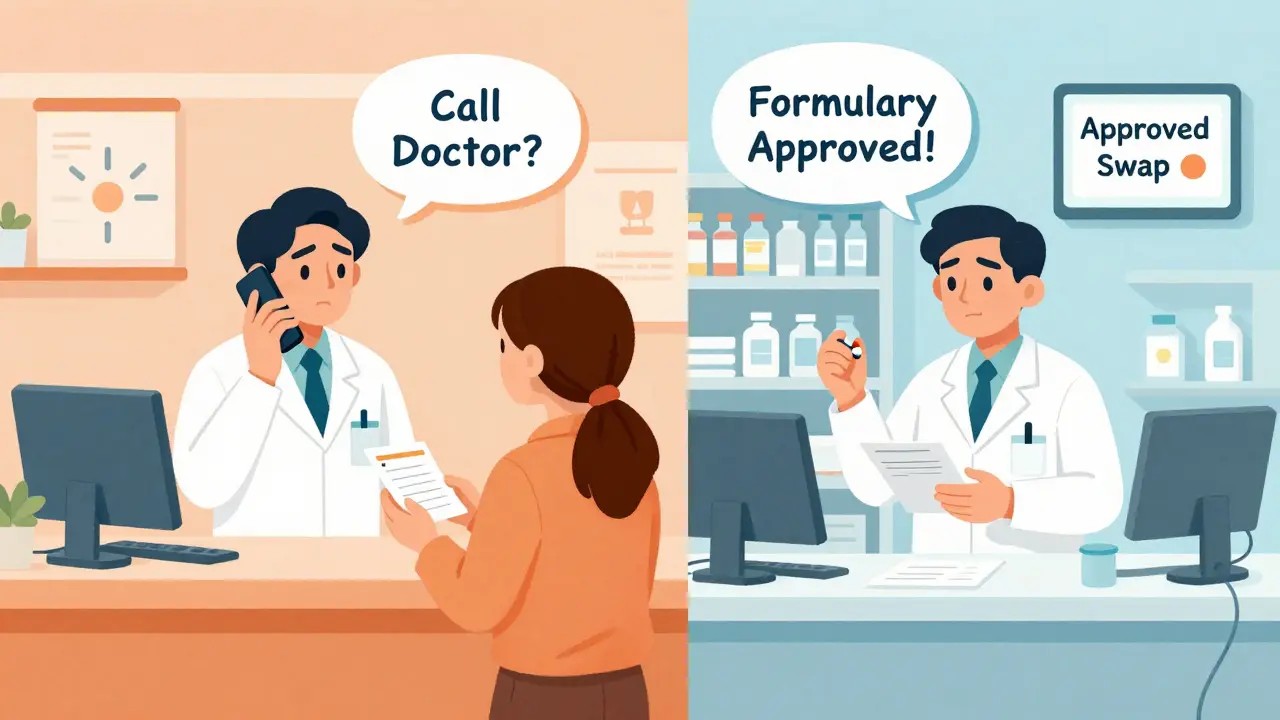
Now, go to your local pharmacy. You get a prescription for gabapentin. The pharmacist says, “We’re going to give you pregabalin instead.” That’s not therapeutic interchange. That’s not allowed. In community settings, pharmacists don’t have the same authority. Most states require them to call the prescriber and get a new prescription before swapping anything-even if the drugs are in the same class.
Why? Because community pharmacies aren’t set up like hospitals. No formulary. No P&T committee. No pre-approved list. The system is built around individual prescriptions, not population-level cost control. So when a pharmacist sees a cheaper alternative, they can’t just swap it. They have to call the doctor. That’s a hassle. It takes time. And often, the doctor says no-either because they’re not familiar with the alternative, or because they think their original choice is best for that specific patient.

What Makes Therapeutic Interchange Work-And What Breaks It
Successful therapeutic interchange has three pillars: a solid formulary, prescriber buy-in, and clear documentation.
The formulary isn’t just a list. It’s a living document. It’s reviewed every six months. New drugs come in. Old ones get pulled. Evidence changes. A drug that was once considered top-tier might now have a safety alert. The formulary reflects that.
Prescriber buy-in is just as important. A 2021 health policy analysis found that if the prescriber hasn’t signed off on a therapeutic interchange agreement, the swap won’t happen-even if the pharmacy has the perfect alternative. That’s why many long-term care facilities use “TI letters.” These are signed documents from doctors that say, “I’m okay with switching from Drug A to Drug B for any of my patients, as long as it’s on the approved list.” It cuts down on phone calls. It speeds things up. But it only works if the doctor trusts the process.
Documentation is the third piece. Every swap needs to be recorded. Why? Because if a patient has a bad reaction, someone has to trace it back. Was it the drug? The dose? The interaction? Without clear notes, you’re flying blind.
The Big Misconception: Different Classes Don’t Belong Here
Let’s clear this up once and for all: therapeutic interchange does not mean switching between different drug classes. That’s called clinical therapeutic substitution-and it’s a whole different ballgame. If a patient can’t tolerate a beta-blocker, switching them to a calcium channel blocker isn’t therapeutic interchange. It’s a new treatment decision. That’s the prescriber’s call. It’s not something a pharmacist can do on their own, even with a formulary.
Why does this matter? Because mixing classes without proper evaluation can lead to harm. One drug might lower blood pressure by relaxing arteries. Another might slow the heart rate. They work differently. They have different side effects. One might be better for someone with asthma. The other might not. Therapeutic interchange avoids that risk by staying within a class where the mechanism of action is known to be similar.
State Laws Vary-And That Changes Everything
Therapeutic interchange isn’t the same everywhere. In some states, pharmacists can make swaps under a blanket prescriber authorization. In others, they need a new prescription for every single change-even if it’s within the same class. Vanderholm’s 2018 research showed that interchange laws vary state by state, and pharmacists have to know their local rules inside and out.
In Queensland, Australia, pharmacists have more flexibility under certain conditions, but even there, they can’t switch across classes. The rules are strict because patient safety comes first. What works in a hospital in Texas might not fly in a nursing home in California. That’s why training matters. Pharmacists in institutional settings spend hours learning formulary guidelines, state laws, and documentation protocols.
Who Benefits-and Who Doesn’t
Patients benefit when they get the same clinical outcome at a lower cost. No one wants to pay $200 a month for a pill that’s just as good as a $20 one. Providers benefit too. Hospitals can reinvest savings into better care. Pharmacies reduce waste and streamline inventory.
But not everyone wins. Some doctors feel like their autonomy is being undermined. “I prescribed this for a reason,” they say. And sometimes, they’re right. A patient might have a unique reaction to one drug in a class. Or they’ve been stable on a brand-name version for years. That’s why exceptions are built into the system. The ACCP guidelines say formularies must allow for exceptions. That’s not a loophole-it’s a safety net.
Patients with complex conditions-like those with heart failure, epilepsy, or psychiatric disorders-are often excluded from therapeutic interchange programs. Why? Because the margin for error is too small. A tiny change in blood levels can trigger a seizure or a relapse. In those cases, sticking with the original prescription isn’t about preference. It’s about safety.
The Future: Smarter Formularies, Not Broader Swaps
The future of therapeutic interchange isn’t about expanding to different classes. It’s about making within-class swaps smarter. New tools are being developed to predict which patients are most likely to respond well to a substitution. AI models are being trained to flag high-risk patients before a swap even happens. Electronic health records are getting better at auto-flagging drug interactions.
But the core principle won’t change: therapeutic interchange is about equivalence-not experimentation. It’s not about trying new combinations. It’s about using proven alternatives that have already been vetted by experts. It’s about doing the right thing for the patient, while being smart about resources.
And that’s why, in 2026, therapeutic interchange still matters. Not because it’s trendy. Not because it saves money. But because it’s a quiet, thoughtful way to make sure more people get the care they need-without being priced out of it.
Can a pharmacist switch my medication to a different drug class without my doctor’s approval?
No. Pharmacists cannot switch a medication to a different drug class without explicit approval from the prescriber. Therapeutic interchange only applies to drugs within the same therapeutic class. Switching between classes-like from an ACE inhibitor to a diuretic-is a clinical decision that requires a new prescription. Any pharmacist who attempts this without authorization is acting outside legal and professional guidelines.
Why do hospitals use therapeutic interchange but pharmacies don’t?
Hospitals and long-term care facilities use therapeutic interchange because they have formal formularies and Pharmacy and Therapeutics (P&T) committees that approve which drugs can be swapped. These institutions manage medications for large groups of patients, so standardizing treatments helps control costs and improve consistency. Community pharmacies don’t have formularies or the same level of oversight. They’re designed to fill individual prescriptions as written, so swapping drugs requires direct communication with the prescriber-which many don’t have time for.
Is therapeutic interchange the same as generic substitution?
No. Generic substitution means swapping a brand-name drug for its exact chemical copy-like switching from Lipitor to atorvastatin. Therapeutic interchange means swapping one drug for another that’s chemically different but works the same way-like switching from lisinopril to valsartan, both of which lower blood pressure but through slightly different mechanisms. Generics are identical in active ingredient; therapeutic interchange uses different drugs in the same class.
What if I’m on a medication and my pharmacy switches it without telling me?
In institutional settings like nursing homes, you should receive notice before any therapeutic interchange happens. In community pharmacies, switches within the same class are usually allowed under state generic substitution laws, but only if the drug is on the approved list and the prescriber hasn’t written “dispense as written.” If you’re unsure, always ask your pharmacist: “Was this a generic swap or a therapeutic interchange?” If you feel something changed and it affected how you feel, contact your doctor right away.
Are there risks with therapeutic interchange?
Yes-if it’s done without proper evaluation. The main risk is assuming all drugs in a class work the same for every patient. For example, one person might tolerate a certain statin well but have muscle pain with another, even if they’re in the same class. That’s why therapeutic interchange programs include exceptions. Patients with complex conditions, narrow therapeutic windows, or a history of adverse reactions are often excluded. The process only works when it’s guided by clinical evidence and patient-specific factors-not just cost.





TONY ADAMS
January 27, 2026 AT 19:27So you're telling me my $200 blood pressure pill got swapped for a $15 one and I'm supposed to be happy? My grandma took that 'interchange' and started stumbling. They didn't even tell her.
Now she's in rehab. Thanks, cost-cutting heroes.
Ashley Karanja
January 29, 2026 AT 08:19What fascinates me is how therapeutic interchange reveals the tension between systemic efficiency and individualized care-two paradigms that are often framed as mutually exclusive, but aren’t necessarily.
The P&T committee model, while bureaucratic, is actually a brilliant example of collective wisdom: pharmacists, clinicians, and even patients co-designing safety nets based on real-world pharmacokinetics, not just formulary economics.
It’s not about reducing cost-it’s about redistributing value. The $100 saved on a statin doesn’t vanish-it funds a clinical pharmacist to monitor anticoagulants, or a dietitian to reduce readmissions.
And yet… the emotional weight of ‘my doctor prescribed this’ is real. For many, medication isn’t just chemistry-it’s identity. A ritual. A symbol of control in a chaotic health journey.
So yes, let’s expand formularies. But let’s also expand the language we use to explain *why* the swap happened. Not as a transaction. As a collaboration.
And maybe… just maybe… we stop calling it ‘interchange’ and start calling it ‘therapeutic alignment.’ Less cold. More human.
🙏
Napoleon Huere
January 29, 2026 AT 23:43Let’s be real-this whole system is a beautiful paradox.
We say we want affordable meds, but we freak out when the pill in the bottle looks different.
We want doctors to be autonomous, but we also want them to be cost-conscious.
We praise pharmacists for catching errors… but scream when they try to prevent an overpriced error.
Therapeutic interchange isn’t the problem. The problem is we’ve turned healthcare into a Netflix subscription-everyone wants the premium plan but refuses to pay for it.
And yet… the fact that this system works at all in institutional settings? That’s a quiet miracle.
It’s not sexy. No one’s making a documentary about it. But thousands of elderly people are eating better, walking more, and living longer because someone in a lab coat ran the numbers and said, ‘This works just as well, and we can afford it.’
So yeah. Let’s fix the communication. Let’s fix the laws.
But don’t kill the idea. It’s one of the few things in healthcare that actually makes sense.
Simran Kaur
January 31, 2026 AT 00:03As someone from India where generics are the norm and brand names are a luxury, I’ve seen this play out in real life.
My uncle was on a $150/month antihypertensive. They switched him to a generic ARB-same class, same results, 90% cheaper.
He didn’t know the difference until his granddaughter explained it to him.
Now he says, ‘Why did they make me pay so much before?’
Here’s the thing: in places like ours, this isn’t policy-it’s survival.
But I’ve also seen the fear. When a patient’s heart failure med gets swapped without explanation, panic sets in.
So yes-formularies are good. But communication? That’s the real medicine.
And if we can teach doctors to say, ‘This is the same as your old one, just cheaper and just as safe,’ we could save so much more than money.
We could save trust.
❤️
Neil Thorogood
January 31, 2026 AT 19:21Oh wow. So the pharmacist is now the CEO of your treatment plan? 🤡
Let me guess-next they’ll be deciding which chemotherapy you get based on insurance tiers.
‘Don’t worry, Mr. Smith, your cancer drug got swapped for a cheaper one. It’s in the same class!’
Yeah, right. Like I’m gonna trust a guy in a white coat who’s got a spreadsheet and zero knowledge of my anxiety, my sleep schedule, or the fact that I’ve been on this med for 12 years and it’s the only thing keeping me from crying in the shower.
They don’t get to decide what’s ‘equivalent.’ I do.
And if my doctor didn’t sign off? Then it’s not interchange.
It’s medical malpractice with a PowerPoint.
🚫💊
Jessica Knuteson
February 1, 2026 AT 18:15Therapeutic interchange is just cost-shifting dressed up as innovation
Doctors don't care
Patients don't know
Pharmacists are stuck in the middle
Formularies are corporate tools
Same class doesn't mean same outcome
End of story
rasna saha
February 2, 2026 AT 15:56I love how this post explains the difference between generic substitution and therapeutic interchange-it’s such a small detail that causes so much confusion.
My mom was switched from one ARB to another last year and she didn’t even notice until I checked the bottle.
She felt better after, honestly.
But I know people panic when the pill changes color or shape.
Maybe we need a simple card that says: ‘This is a therapeutic interchange. Same effect. Lower cost. Approved by your care team.’
Small thing. Big peace of mind.
❤️
Skye Kooyman
February 4, 2026 AT 15:08So if a pharmacist swaps my sertraline for escitalopram and I start feeling weird, is that on them or my doctor?
Just asking because I’ve had that happen.
Didn’t know what was going on until I googled it.
Not cool.
James Nicoll
February 5, 2026 AT 11:50Therapeutic interchange sounds like corporate jargon for ‘we’re not paying for your brand-name habit.’
Look, I get it. The system is broken.
But here’s the thing-when you treat people like line items in a spreadsheet, you’re not saving money.
You’re just making people feel disposable.
And guess what? That’s not healthcare.
That’s retail.
And I’m not buying it.
🫠
Uche Okoro
February 5, 2026 AT 17:22It is imperative to clarify that therapeutic interchange is not synonymous with generic substitution, as the former involves pharmacologically distinct compounds within the same therapeutic class, whereas the latter entails bioequivalent formulations of identical active pharmaceutical ingredients.
Moreover, the absence of standardized interprofessional protocols across state jurisdictions introduces significant variability in clinical outcomes, thereby undermining the purported efficacy of formulary-driven interventions.
The regulatory lacunae in community pharmacy settings remain a critical impediment to equitable access.
Further, the conflation of therapeutic interchange with clinical substitution constitutes a fundamental misrepresentation of pharmacotherapeutic principles.
Recommendation: Institute uniform national guidelines under the auspices of the FDA and ACCP.
Ashley Porter
February 6, 2026 AT 23:15Formularies are great in theory.
But the real issue? The P&T committee never talks to the patients.
They look at trials. They look at cost.
They don’t look at whether the patient can swallow the pill.
Or if they’re allergic to the dye.
Or if they’ve been on the old one since 2008 and it’s the only thing that keeps their depression from crushing them.
It’s not about the drug.
It’s about the person.
And no spreadsheet sees that.
Peter Sharplin
February 8, 2026 AT 03:47I’ve worked in long-term care for 18 years. I’ve seen therapeutic interchange save lives-not just money.
One resident had been on a $90/month antihypertensive that gave her chronic cough. We switched her to a different ARB on the formulary. The cough vanished. Her BP stabilized. She started eating again.
That’s the win.
But it only works because we had a P&T committee that included nurses who knew the residents. We had prescribers who trusted the process. We had documentation that tracked every change.
Community pharmacies? They’re running on fumes. No time. No support. No backup.
So yes-this system works in institutional settings.
But it needs to be scaled with *support*, not just mandates.
Because saving money is easy.
Keeping people safe? That’s the hard part.
And it’s worth it.