
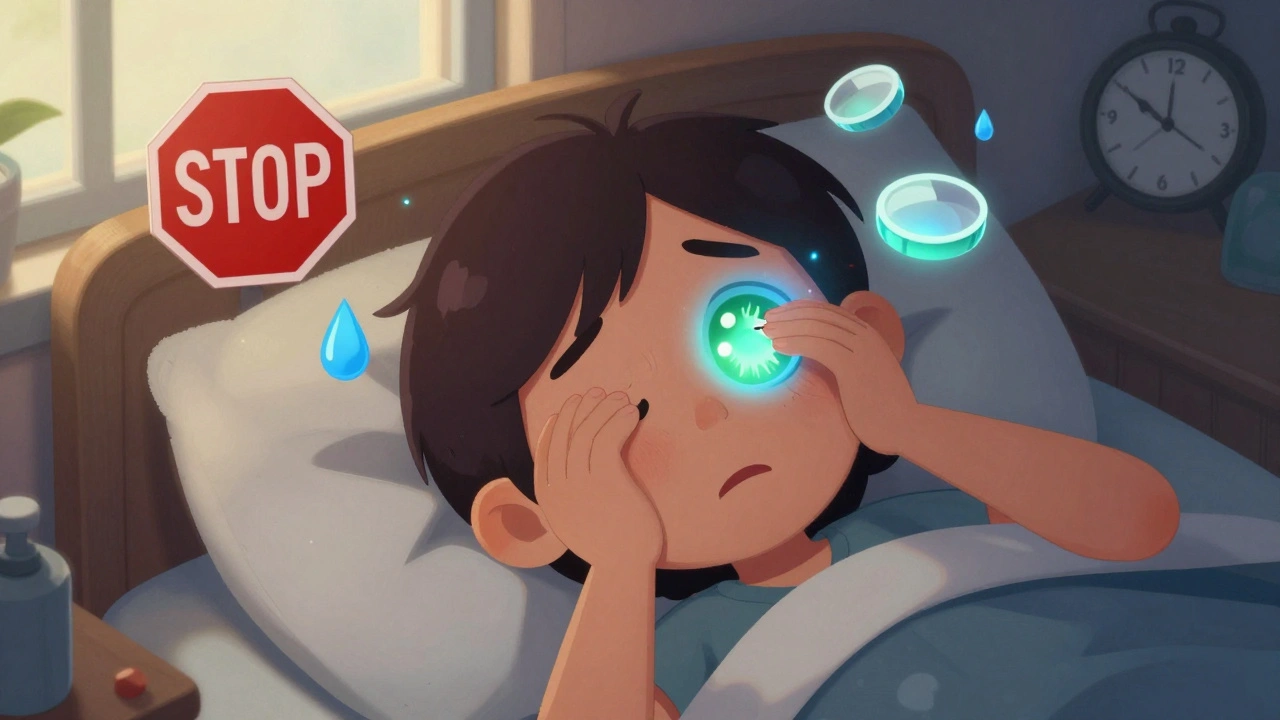
Imagine waking up with your eye burning like it’s full of sand, light feels like a knife, and your vision is suddenly blurry. You reach for your phone to Google it - and find out you might have a corneal ulcer. This isn’t just a bad day. It’s a medical emergency. If you wear contact lenses, this is a risk you can’t ignore.
What Exactly Is a Corneal Ulcer?
A corneal ulcer is an open sore on the clear front surface of your eye - the cornea. It’s not a scratch. It’s not a red eye that goes away in a day. It’s tissue loss caused by infection, often from bacteria, fungi, or viruses that get trapped under your contact lens. Left untreated, it can scar your cornea, permanently blur your vision, or even lead to blindness. The difference between a corneal abrasion and a corneal ulcer is simple: abrasions are surface-level scrapes that heal on their own. Ulcers are deeper, infected wounds that need immediate treatment. The FDA calls them “open sores” and warns they can cause blindness. That’s not a scare tactic - it’s a fact backed by decades of clinical data.Why Contact Lenses Are the Top Cause
Over 85 million people worldwide wear contact lenses. Most do it safely. But even one mistake can tip the balance. Contact lenses reduce oxygen flow to the cornea. That’s normal. But when you wear them too long - especially while sleeping - your eye becomes a breeding ground for germs. Here’s the hard truth: if you wear contact lenses, you’re about 10 times more likely to get a corneal ulcer than someone who doesn’t. If you sleep in them? That risk jumps to 100 times higher. That’s not a typo. Extended-wear soft lenses are the biggest culprit. The CDC and FDA both list overnight wear as the #1 preventable cause. It’s not just the lens. It’s what you do with it. Dirty hands. Tap water. Homemade cleaning solutions. Even a tiny scratch on the lens can create a doorway for bacteria. Acanthamoeba - a nasty germ found in water - can cling to lenses and cause a fungal-like infection that’s nearly impossible to treat without early detection.Signs You’re Not Just Having a Bad Eye Day
You might think your eye is just tired. Or dry. Or irritated from allergies. But if you’re wearing contacts and notice any of these, stop. Right now.- Severe eye pain - not a dull ache, but a sharp, constant burn
- Redness that doesn’t fade, even after removing your lenses
- Blurry or hazy vision that gets worse
- Sensitivity to light - even turning on a lamp hurts
- White or gray spot on the clear part of your eye (visible in the mirror)
- Excessive tearing or thick, yellow/green discharge

How Doctors Diagnose It
If you show up with these symptoms, your eye doctor won’t just look at you. They’ll use tools you’ve never seen. First, they’ll put a drop of yellow dye - fluorescein - in your eye. Under blue light, any damaged tissue glows bright green. That’s how they see the ulcer’s size and depth. Then comes the slit-lamp exam. It’s like a microscope with a bright light. They zoom in on your cornea, checking for swelling, pus, or signs of infection spreading. In serious cases, they’ll scrape a tiny bit of tissue from the ulcer and send it to a lab. This culture test tells them exactly what’s causing the infection - bacteria, fungus, or virus. That’s critical because the treatment changes completely based on the culprit. Newer tools are helping too. Some clinics now use high-resolution imaging to capture photos of the ulcer and track changes day by day. This lets them spot worsening early - before it’s too late.Treatment: No Guesswork, No Delay
Treatment starts the moment you walk in - not after test results. That’s because every hour counts. For bacterial ulcers - which make up 80% of cases - doctors start with strong antibiotic eye drops, usually fluoroquinolones like moxifloxacin or gatifloxacin. You’ll be told to use them every hour while awake, then taper off as it heals. If it’s viral - often from herpes simplex - they’ll prescribe antiviral drops like acyclovir. Fungal ulcers? Those need antifungal meds like natamycin, which are harder to get and take weeks to work. Here’s what you must never do: use steroid eye drops unless your doctor specifically orders them. Steroids reduce swelling, but they also weaken your eye’s defenses. Used without knowing the cause, they can make a bacterial or fungal infection explode. If the ulcer is bigger than 2 mm, or it’s close to the center of your vision, or it’s getting worse after 48 hours of treatment - it’s classified as “sight-threatening.” That means you’re in the hospital system now. You might need daily visits, stronger meds, or even surgery. In the worst cases, when the cornea is badly scarred or perforated, a corneal transplant is the only option. That’s major surgery. Recovery takes months. And even then, vision may never fully return.How to Prevent This From Ever Happening
The good news? Almost all corneal ulcers from contacts are preventable. You don’t need magic solutions. Just discipline.- Never sleep in your lenses. Even “extended-wear” ones aren’t risk-free. The 100x risk increase is real.
- Wash your hands before touching your lenses - soap and water, dry with a lint-free towel.
- Use only the solution your doctor recommends. Never use tap water, saliva, or homemade saline. Ever.
- Replace your lenses on schedule. Daily disposables are safest. If you use monthly lenses, toss them after 30 days - no extensions.
- Avoid water. No swimming, showering, or hot tubs with contacts in. Water carries germs that stick to lenses.
- Give your eyes a break. Wear glasses at least one day a week. Let your corneas breathe.
- Replace your case every 3 months. Bacteria grow in old cases. Rinse it daily with solution, never water, and let it air-dry upside down.

When to Go to the Emergency Eye Clinic
This isn’t a “call your doctor tomorrow” situation. If you have pain, vision changes, or light sensitivity - go today. Not tomorrow. Today. Most hospitals have urgent eye care clinics. If you can’t get in within 24 hours, go to the ER. Delaying care increases your risk of permanent damage by 50% or more, according to a 2024 study in the Journal of Ophthalmology. Don’t rely on over-the-counter redness drops. They mask symptoms, not treat the cause. And don’t try to “tough it out.” Corneal ulcers don’t heal on their own. They get worse.What Happens After You Heal?
Even if your ulcer clears up, you’re not back to normal. Your eye is more vulnerable now. Your doctor will likely recommend switching to daily disposable lenses, reducing wear time, and having check-ups every 3-6 months. Some people never wear contacts again. That’s not a failure. It’s wisdom. The goal isn’t to scare you off contacts. It’s to make you respect them. They’re medical devices - not fashion accessories. When used right, they’re safe. When used carelessly, they can steal your vision.Final Reality Check
You can’t control everything. But you can control your habits. Wash your hands. Don’t sleep in lenses. Replace your case. Get help fast. The science is clear. The risks are real. But so is the solution. Your eyes don’t need fancy tech. They need you to be consistent. One mistake can cost you your sight. One habit can save it.Can a corneal ulcer heal on its own?
No. A corneal ulcer is an infected open sore that requires medical treatment. Left untreated, it will worsen and can cause permanent scarring or blindness. Even if symptoms seem to improve, the infection may still be active beneath the surface.
How long does it take to recover from a corneal ulcer?
Mild ulcers treated early may heal in 1-2 weeks. Severe cases, especially those requiring surgery or long-term antifungal treatment, can take weeks to months. Recovery depends on the cause, size, how fast treatment started, and your overall eye health.
Are daily disposable contacts safer than monthly ones?
Yes. Daily disposables reduce the risk of infection because you’re not reusing the same lens for weeks. Each day starts with a fresh, sterile lens, cutting down on bacteria buildup, protein deposits, and contamination from cases or solutions.
Can I wear contacts again after having a corneal ulcer?
Maybe - but only under your eye doctor’s supervision. You’ll likely need to switch to daily lenses, avoid overnight wear, and get frequent check-ups. Some people choose not to wear contacts again because the risk isn’t worth it.
Is it safe to swim with contact lenses?
No. Water - even pool, lake, or tap water - contains germs like Acanthamoeba that can cling to lenses and cause rare but devastating infections. Always remove lenses before swimming or use waterproof goggles. If you must wear lenses in water, use daily disposables and throw them out immediately after.
What’s the difference between keratitis and a corneal ulcer?
Keratitis is inflammation of the cornea, which can be caused by irritation, injury, or infection. A corneal ulcer is a specific type of keratitis where the inflammation has caused an open sore or tissue loss. All ulcers are keratitis, but not all keratitis is an ulcer.
Can steroid eye drops help a corneal ulcer?
Only under strict medical supervision. Steroids reduce inflammation, but they also suppress the immune response in your eye. If used before the infection is controlled, they can make the ulcer worse - especially with fungal or viral causes. Never use them without a doctor’s order.



Jade Hovet
December 14, 2025 AT 01:47OMG I thought my eye was just tired after a late night… turns out I had a tiny ulcer 🥲 I took my contacts out immediately and went to urgent care. Thank you for this post - I’m now a total contact lens evangelist for safety 🙏✨
Constantine Vigderman
December 14, 2025 AT 08:40Y’all need to hear this: I used to sleep in my lenses like it was a badge of honor. Then I got a corneal ulcer that made me cry in the ER at 3am. Now I wear glasses on weekends like a responsible adult. No regrets. Your eyes aren’t replaceable 💪👁️
Cole Newman
December 16, 2025 AT 06:31LMAO people still don’t get it. You think your ‘extended wear’ lenses are magic? Nah. That’s just the lens company’s way of making you think you’re cool while your eye slowly turns into a science experiment. Tap water? Saliva? Bro. That’s not hygiene, that’s a horror movie plot.
Tom Zerkoff
December 17, 2025 AT 15:20It is imperative to underscore that corneal ulceration represents a sight-threatening ocular emergency, the etiology of which is predominantly iatrogenic in contact lens wearers. Adherence to sterile handling protocols, avoidance of overnight wear, and immediate consultation with an ophthalmologist upon onset of pain or visual disturbance are non-negotiable components of ocular health maintenance.
Yatendra S
December 18, 2025 AT 18:25Life is a lens, and we’re all just trying to see clearly. But sometimes… the clearest vision comes from stepping back. Your eyes don’t need to be perfect. They just need to be respected. 🌌👁️
kevin moranga
December 18, 2025 AT 20:02I used to be the guy who’d wear his contacts for 18 hours straight, rinse them with water when he was out of solution, and sleep in them because ‘I’m just gonna nap for 20 minutes.’ Spoiler: 20 minutes turned into 8 hours. I ended up in a clinic with a 3mm ulcer and a new life philosophy. Now I have glasses on my nightstand, a fresh case every month, and I actually wash my hands. It’s not glamorous. But my vision? It’s still sharp. And that’s worth more than any trendy lens.
Alvin Montanez
December 18, 2025 AT 20:19People treat contact lenses like they’re a hairstyle. You don’t see someone wearing a wig for 30 days straight and then blaming the wig when their scalp gets infected. Why is your eye any different? This isn’t a ‘personal choice’ - it’s negligence dressed up as convenience. Stop normalizing the risk. Your vision isn’t disposable.
Lara Tobin
December 20, 2025 AT 14:39I just read this and started crying… I had a corneal ulcer last year and didn’t realize it until I couldn’t open my eye. I felt so stupid. But you’re right - it’s not stupid. It’s just easy to ignore. Thank you for saying this so clearly. I’m going to send this to all my lens-wearing friends.
Jamie Clark
December 20, 2025 AT 20:04Here’s the truth no one wants to admit: contact lenses are a luxury, not a necessity. If you need them to feel ‘normal,’ maybe the problem isn’t your vision - it’s your identity. Stop pretending they’re harmless. They’re not. Your cornea doesn’t care how ‘fashionable’ you look.
Keasha Trawick
December 22, 2025 AT 09:32Corneal ulcers? More like corneal *catastrophes* wrapped in a glossy lens ad. I saw a guy with a fungal ulcer last year - his eye looked like a Rorschach test gone wrong. Fluorescein dye glowing green under blue light? That’s not science. That’s a horror movie trailer. And Acanthamoeba? That’s not a germ - it’s a nightmare with a PhD in persistence.
Bruno Janssen
December 22, 2025 AT 18:54I used to think I was the only one who got weird eye infections. Then I read this and realized I’m not special - I’m just unlucky. I didn’t even know tap water could do this. Now I’m scared to blink. Thanks for that.
Sheldon Bird
December 23, 2025 AT 22:33Hey, I’m a former contact lens addict turned glasses lover - and I’m not here to shame anyone. But if you’re reading this and you’re still sleeping in your lenses… just pause. Breathe. Take them out. Your future self will thank you. I did. And I’ve got 20/20 vision at 42 because I listened. You can too. 🙌👁️