
When your kidneys fail, you need a way to clean your blood. Two main options exist: hemodialysis and peritoneal dialysis. Both do the same job-remove waste and extra fluid-but they work in completely different ways. Choosing between them isn’t just about medical facts. It’s about your lifestyle, your body, and what you can manage day to day.
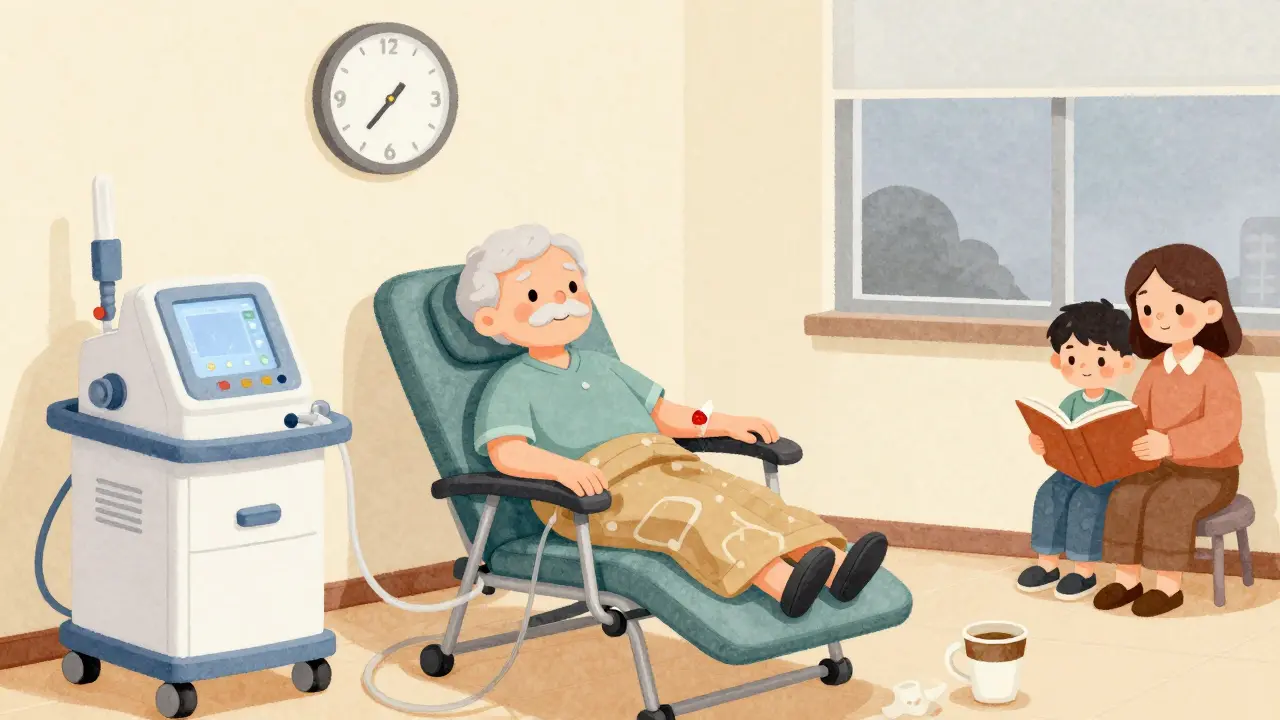
Most people in the U.S. get hemodialysis. About 70% of dialysis patients use it. It happens in a clinic, three times a week, for 3 to 5 hours each time. A machine filters your blood through tubes outside your body. You need a surgically created access point-usually an arteriovenous (AV) fistula in your arm. That fistula takes 6 to 8 weeks to heal before it can be used. Some people get a graft or a catheter instead, but those come with higher infection risks.
During hemodialysis, blood is pulled out at 300 to 500 milliliters per minute. That’s fast. It clears toxins quickly, which is great if you’re in crisis. But it also puts stress on your heart and blood pressure. Many patients feel exhausted for hours after treatment. Some say they’re too wiped out to work or spend time with family. It’s effective, but it’s also demanding on your body.
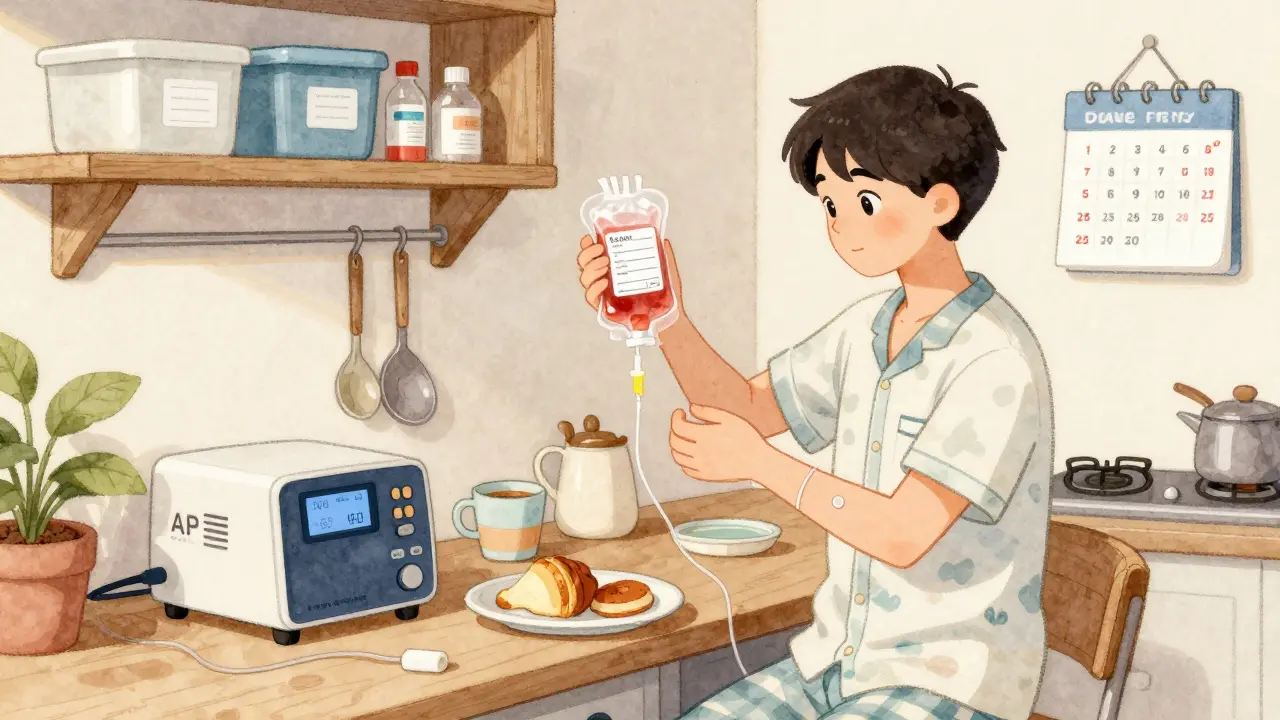
Peritoneal dialysis (PD) works differently. Instead of a machine, it uses the lining of your belly-the peritoneum-as a natural filter. A soft tube called a Tenckhoff catheter is placed in your abdomen. You fill your belly with dialysis fluid, let it sit for 4 to 6 hours, then drain it out. This happens 3 to 5 times a day in Continuous Ambulatory Peritoneal Dialysis (CAPD). Or, if you use a machine at night while you sleep, it’s called Automated Peritoneal Dialysis (APD).
PD doesn’t need a machine during the day. You can do it at home, at work, or while traveling. No need to schedule three trips to a clinic every week. That’s why 68% of PD users report higher satisfaction with flexibility, according to the National Kidney Foundation. You control the timing. You avoid the long car rides, the waiting rooms, the rigid schedule.
Which one is better for your heart and blood pressure?
One of the biggest differences between the two is how they affect your cardiovascular system. Hemodialysis causes big, sudden shifts in fluid and salt levels. That can lead to low blood pressure during treatment, cramping, and heart strain. A 2023 study from the National Center for Biotechnology Information tracked 74 hemodialysis patients and 77 peritoneal dialysis patients. The results were clear: PD patients had significantly better blood pressure control. Their heart rates stayed steadier. Their systolic and diastolic numbers were lower after treatment.
Why? Because PD works slowly and continuously. Instead of one big cleanse three times a week, you’re doing small ones every day. That means less buildup of potassium, sodium, and fluid between treatments. Less shock to your system. Less stress on your heart. That’s why doctors often recommend PD for patients with heart disease or unstable blood pressure.
But here’s the catch: PD isn’t always the right choice. If you’ve had multiple abdominal surgeries, you might have scar tissue that blocks the fluid flow. If you’re morbidly obese (BMI over 35), the catheter placement and fluid distribution become harder. And if your hands shake from arthritis or nerve damage, handling the dialysis bags and tubing every day might be impossible.
What about infections and complications?
Both types of dialysis carry infection risks-but they’re different kinds.
With hemodialysis, the biggest danger is your access point. If the fistula or catheter gets infected, it can lead to sepsis. Catheters are especially risky. About 1 in 5 catheter-related infections lead to hospitalization. AV fistulas are safer, but they can clot or narrow over time. You need regular checks to keep them working.
With PD, the main threat is peritonitis-an infection in the belly cavity. It happens when bacteria get into the dialysis fluid during exchanges. The rate is about 0.3 to 0.7 episodes per patient per year. That sounds low, but each episode means antibiotics, hospital visits, and sometimes switching to hemodialysis. Patients report this as their biggest fear. Reddit users on r/kidneydisease say 65% of PD users worry about peritonitis. And yes, you have to be extra careful about handwashing, sterile technique, and keeping the area clean.
But here’s something surprising: overall, PD has fewer total complications than hemodialysis. That same 2023 study showed PD patients had a significantly lower rate of all complications combined. Fewer hospitalizations. Fewer emergency visits. Fewer problems with blood pressure crashes.
Cost, convenience, and your daily life
Let’s talk money. Peritoneal dialysis is cheaper in the long run. The Journal of Peritoneal Therapy and Clinical Practice found PD offers better value for money. Why? Fewer clinic visits. Less staff time. Less equipment. The machine for APD is small and fits in a closet. You don’t need a water treatment system like home hemodialysis does.
But PD demands more from you. You need to learn how to do exchanges properly. Training takes 10 to 14 days. You have to be motivated. You have to remember to do it every day, even when you’re tired. If you’re not comfortable with self-care, hemodialysis might be easier. Someone else is doing the work for you.
And space? PD needs room for storing dialysis bags-usually 30 to 40 bags per week. That’s about a shelf in your closet. Hemodialysis needs a whole machine, a water purifier, and a dedicated area. Home hemodialysis isn’t practical for most apartments.
There’s also the emotional side. People on hemodialysis often feel like prisoners to their schedule. One Reddit user wrote: “I miss weekends. I miss sleeping in. I miss not thinking about dialysis every single day.” PD users say they feel more in control. But they also live with the catheter-always there, always a reminder. Some hate the feeling of fluid sloshing in their belly.
Who gets which treatment-and why?
It’s not just about what’s medically right. It’s about what fits your life.
PD is often recommended for:
- Patients who want independence and flexibility
- Those with stable heart function
- People with good manual dexterity
- Those who live far from a dialysis center
- Younger patients who want to keep working or traveling
Hemodialysis is often chosen for:
- Patients with severe heart disease or unstable blood pressure
- Those with abdominal scarring or obesity
- People who can’t manage daily treatments
- Older adults with cognitive challenges
- Those who prefer professional care over self-care
And here’s something most people don’t know: PD isn’t less effective. It just works differently. Hemodialysis clears toxins faster in one session. But PD clears them more evenly over 24 hours. Studies show the total weekly toxin removal is similar. One YouTube medical video put it simply: “PD isn’t as strong in one go-but it’s on all the time.”

What’s changing in 2026?
Things are shifting. The U.S. has been slow to adopt PD. Only 12% of patients use it. But that’s changing. The Centers for Medicare & Medicaid Services now pushes for 80% of new dialysis patients to get education on home dialysis or transplant by 2025. More nephrologists are being trained in PD. New dialysis fluids with icodextrin help protect the belly lining and reduce glucose damage.
By 2027, experts predict PD will jump to 18-22% of U.S. dialysis patients. Countries like Hong Kong and the UK already have much higher PD rates. Why? Because they prioritize patient choice and home care. The U.S. is catching up.
But the biggest change isn’t technology. It’s mindset. Doctors are starting to say: “Don’t just give people the most common treatment. Give them the one that fits their life.”
What should you do next?
If you’re considering dialysis, talk to your nephrologist-but not just about medical numbers. Ask:
- What are my options based on my heart health?
- Can I manage daily exchanges at home?
- What does my insurance cover for home dialysis?
- Can I try PD for a few months and switch if needed?
There’s no single best choice. Hemodialysis saved lives for decades. PD is now proving it can do the same-with less stress on the body and more freedom for the patient. The right one isn’t the one everyone else uses. It’s the one that lets you live.





Donna Macaranas
January 31, 2026 AT 21:16Aditya Gupta
February 2, 2026 AT 03:33Lisa Rodriguez
February 4, 2026 AT 02:29Nidhi Rajpara
February 6, 2026 AT 01:44Naomi Walsh
February 7, 2026 AT 22:15Bob Cohen
February 9, 2026 AT 02:08Lisa Rodriguez
February 10, 2026 AT 01:57Jaden Green
February 11, 2026 AT 15:25Angel Fitzpatrick
February 12, 2026 AT 16:01Nicki Aries
February 13, 2026 AT 19:31Nancy Nino
February 14, 2026 AT 01:36Ed Di Cristofaro
February 15, 2026 AT 23:48