
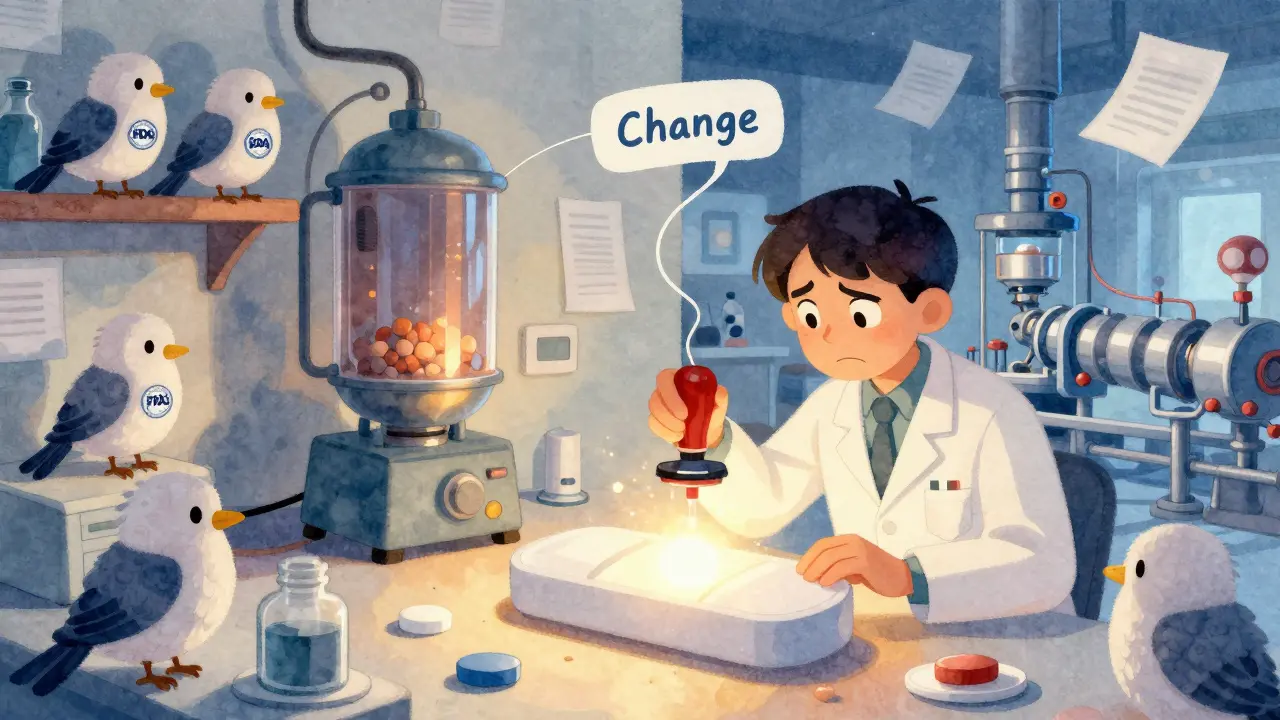
When a pharmaceutical company changes even a small part of how a drug is made, the stakes are high. A new mixer, a different supplier for raw materials, or moving a step to another room in the same facility - these aren’t just internal tweaks. They’re regulatory events. The FDA, EMA, Health Canada, and other agencies don’t just want to be informed. They require approval before the change goes live - or at least, before the next batch hits the market. Getting this wrong can mean a warning letter, a product recall, or worse: a patient getting a medicine that doesn’t work the way it should.
Why Manufacturing Changes Matter
Every drug approved by regulators has a specific recipe and process behind it. That recipe includes the exact chemical structure of the active ingredient, the type of equipment used, the temperature during mixing, the humidity in the packaging room, even the brand of gloves worn by technicians. All of these are tied to the drug’s safety, strength, purity, and effectiveness. Change one thing, and you risk changing the whole product. The FDA’s 21 CFR 314.70 and 21 CFR 601.12 are the rulebooks. They say: if you alter anything that could affect the drug’s quality, you must tell them - and often, you must wait for their green light before shipping. This isn’t bureaucracy for the sake of it. In 2022, 22% of all FDA warning letters were tied to improper handling of manufacturing changes. Of those, nearly 4 out of 10 involved equipment swaps that weren’t properly classified.The Three Tiers of Change: PAS, CBE-30, and Annual Reports
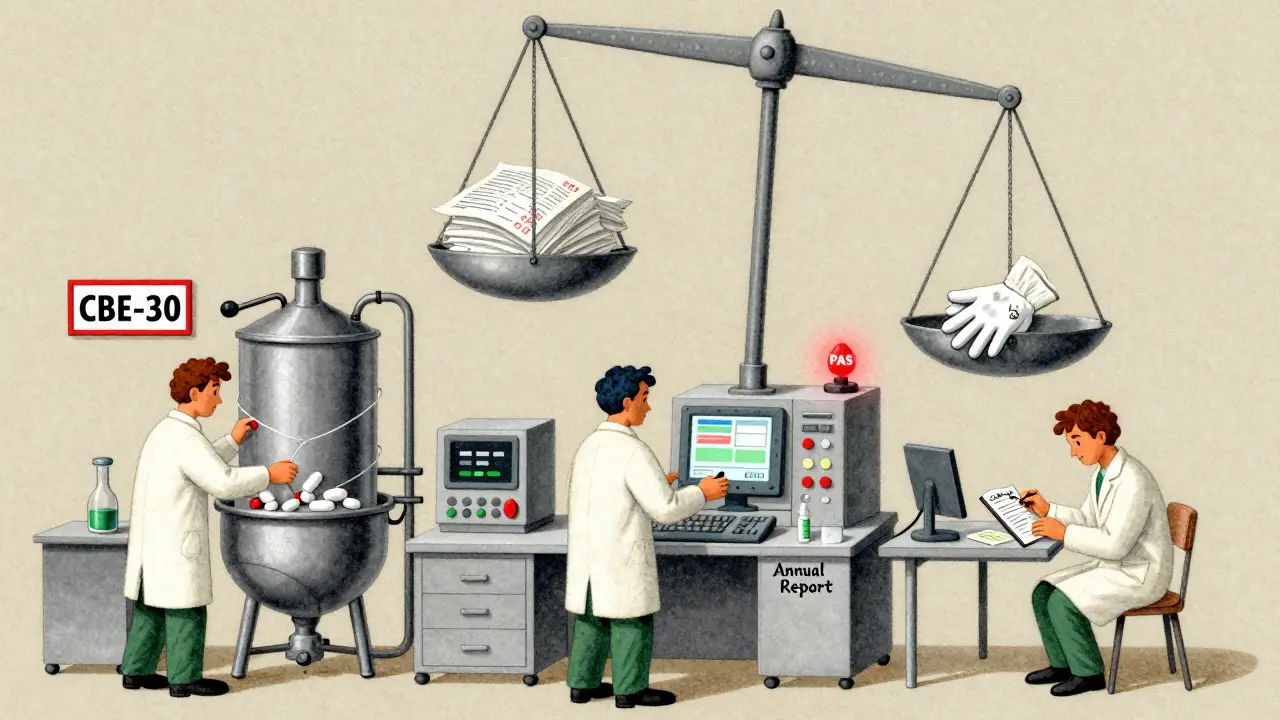
The FDA uses a three-tier system to sort changes by risk. It’s simple in theory, messy in practice.- Prior Approval Supplement (PAS) - This is for major changes. Think: switching the synthetic route for the active ingredient, moving production to a new country, or replacing a critical piece of equipment that affects how the drug dissolves or absorbs. You cannot ship any product made with this change until the FDA approves your submission. The review can take 6 to 12 months. If you start without approval, you’re breaking the law.
- Changes Being Effected in 30 Days (CBE-30) - These are moderate changes. Examples: swapping a tablet press for an identical model from the same manufacturer, changing the filter in a purification step, or updating software on a machine that doesn’t alter process parameters. You can implement the change after submitting the CBE-30 - but not before. You must wait 30 days. If the FDA objects during that window, you must stop distribution and recall any product made under the change.
- Annual Report - Minor changes. This includes moving a non-critical step within the same facility, changing the supplier of a non-critical excipient (like a filler), or updating documentation. You don’t need approval. You just need to log it in your next annual report, submitted within 60 days of your application’s anniversary date.
What Counts as a Major Change?
Not all equipment swaps are equal. The FDA’s 2022 guidance clarifies what “equivalent” means: same principle of operation, same critical dimensions, same material of construction. If you replace a high-shear mixer with a different model that has the same blade design, speed range, and stainless steel construction, it’s likely CBE-30. But if you switch from a batch mixer to a continuous one? That’s PAS territory. Other major changes include:- Changing the particle size distribution of an active ingredient - this affects how fast the drug dissolves in the body.
- Introducing a new sterilization method - like switching from autoclaving to irradiation.
- Modifying the final packaging material if it interacts with the drug - think plastic that leaches chemicals into liquid formulations.
- Changing the source of a biologic’s cell line - even if the protein looks the same, the immune response in patients can differ.
How Other Regulators Compare
The U.S. isn’t alone. The European Medicines Agency (EMA) uses Type IA, IB, and II changes:- Type IA: Minor, notify within 12 months (no approval needed before implementation).
- Type IB: Moderate, must get approval before implementing.
- Type II: Major, full review required - similar to FDA’s PAS.
Real-World Pitfalls
In 2023, Lupin Pharmaceuticals got a warning letter for replacing a lyophilizer (freeze-dryer) without a PAS. The new machine had the same capacity and temperature range - but different pressure controls. The FDA determined that altered drying time could affect moisture content, which impacts shelf life. They didn’t care that the machine was “better.” They cared about risk. Another common mistake: assuming a change is minor because it’s “just a software update.” But if that update changes how a filling machine measures dose volume? That’s a CBE-30 or PAS. Software controls critical process parameters. That’s not a footnote - it’s a regulatory trigger. A senior regulatory affairs manager at a mid-sized generic company told a Reddit thread in 2023 that classifying a tablet press replacement took 37 hours of team time. Why? Because the API’s particle size specification was vague. Was the new press going to crush particles more? No one knew. That uncertainty meant they had to run extra tests, consult engineers, and review historical batch data - just to decide if they needed to wait 30 days or 12 months.
How to Get It Right
There’s no magic formula. But there are best practices:- Use risk assessment - The Parenteral Drug Association’s TR60 recommends Failure Modes and Effects Analysis (FMEA). Ask: What if this change fails? How would it affect the drug? What’s the likelihood? What’s the severity? Score each risk. High score = PAS.
- Document everything - Don’t just say “we replaced the mixer.” Show the old and new specs. Include validation data. Show three consecutive batches made with the new setup. Compare dissolution profiles. If the new batch dissolves 5% slower? That’s a red flag.
- Consult early - If you’re unsure, ask the FDA. Their 2021 biologics guidance says: if you’re uncertain, submit a request for a pre-submission meeting. It’s free. It saves you from a costly mistake.
- Train your team - ASQ data shows regulatory specialists need 18 months of focused training to classify changes correctly. Don’t assume your QA lead knows the difference between CBE-30 and PAS. Test them. Audit their decisions.
The Future: Harmonization and Continuous Manufacturing
The industry is pushing for less confusion. ICH Q12, adopted in 2020, aims to standardize change management across the U.S., EU, Canada, and Japan. It encourages tools like risk-based classification and lifecycle management. But legal differences between countries mean full alignment is years away. Meanwhile, continuous manufacturing - where drugs are made in a single, flowing line instead of batch by batch - is changing the game. In these systems, changing one machine affects the whole line. The FDA now says: if you change equipment in a continuous process, assume PAS unless you can prove otherwise. By 2025, experts predict 40% of change submissions will include real-time data from sensors - not just lab tests. If a machine’s vibration levels stay within limits during production, and the drug’s quality stays consistent, regulators may accept that as proof the change is safe. That could reduce the need for PAS in some cases.What Happens If You Skip Approval?
The consequences are real. In 2022, 22% of FDA warning letters were about unapproved manufacturing changes. Penalties include:- Product recalls - costly, damaging to reputation.
- Import alerts - your drugs get blocked at the border.
- Consent decrees - court orders forcing you to overhaul your entire quality system.
- Loss of approval - the FDA can withdraw your drug’s license.
What’s the difference between a CBE-30 and a PAS?
A PAS (Prior Approval Supplement) requires FDA approval before you can make the change or ship any product made with it. It’s for major changes that could seriously affect safety or effectiveness. A CBE-30 lets you implement the change after submitting the notice - but you must wait 30 days before shipping. If the FDA objects during that window, you must recall any product made under the change. CBE-30 is for moderate changes; PAS is for major ones.
Can I make a manufacturing change and notify the FDA later?
Only for minor changes reported in your annual report. For CBE-30 and PAS changes, you must notify the FDA before or during implementation. The FDA does not allow “do-and-tell” for moderate or major changes. The EMA allows this for Type IA changes, but the FDA does not. Violating this rule can trigger enforcement actions.
What if I’m not sure whether a change is major or minor?
Don’t guess. Submit a pre-submission request to the FDA. They offer free meetings to help you classify changes correctly. Use risk assessment tools like FMEA to support your decision. If you misclassify a major change as minor, you risk a warning letter, recall, or loss of approval. It’s better to be cautious and consult than to assume.
Do equipment replacements always need FDA approval?
Not always. If you replace equipment with an identical model from the same manufacturer - same materials, same dimensions, same operating principles - it’s typically a CBE-30. But if the new equipment changes critical process parameters (like mixing speed, temperature control, or pressure), it’s a PAS. The FDA’s 2022 guidance defines “equivalent” strictly. If in doubt, treat it as a PAS until proven otherwise.
How long does a PAS take to get approved?
PAS reviews typically take 6 to 12 months. The timeline depends on complexity, completeness of the submission, and whether the FDA requests additional data. For biologics or advanced therapies, it can take longer. Plan ahead - don’t wait until you need to replace a broken machine. Start the PAS process early, even if you’re still evaluating options.



Matt Beck
January 6, 2026 AT 16:06So basically, if I swap a mixer and it hums a little differently, I’m risking a federal warning letter? 😅 I mean… I get it, but also… is this regulation or performance art? 🤔🧪 #PharmaLife
Kelly Beck
January 6, 2026 AT 23:35Y’all are making this sound like a horror movie, but honestly? This is why I love working in pharma-every detail matters. 🌟 I’ve seen a 0.5% change in humidity ruin a whole batch of insulin. It’s not bureaucracy, it’s protection. We’re not just making pills-we’re keeping people alive. 💙 And yes, I cried when my team got a PAS approved after 9 months. Worth every second. 🙌
Molly McLane
January 8, 2026 AT 09:45As someone who trains new QA folks, I can’t stress this enough: don’t assume. Ever. I had a junior analyst classify a software update as ‘annual report’ because ‘it was just a patch.’ Spoiler: it changed the dosing calibration. 🚨 We had to recall 12,000 vials. The lesson? When in doubt, escalate. And yes, I still send them coffee after these moments. We’re all learning. ☕️
Katie Schoen
January 9, 2026 AT 08:56So the FDA’s got a 3-tier system… but the EMA’s got a 3-tier system… and Health Canada’s got a 3-tier system… and WHO’s got a whole damn *protocol*? 😴 I’m just here for the drugs, not the paperwork Olympics. But hey-if it keeps me from getting a faulty batch of metformin, I guess I’ll file the 47th Excel sheet. 🤷♀️ #PharmaLife
Beth Templeton
January 9, 2026 AT 11:17PAS = 6-12 months. CBE-30 = 30 days. Annual = just log it. Done. Stop overcomplicating.
Tiffany Adjei - Opong
January 9, 2026 AT 21:25Actually, the FDA’s system is outdated. Why should a company wait a year to improve a process that’s clearly safer? The EMA’s Type IA is smarter-let innovation happen, then audit. We’re not in the 1980s. Also, ‘equivalent equipment’ is a joke. Two mixers with the same specs can behave differently in real life. The FDA doesn’t care about real life. They care about paperwork. 🤷♂️
Ryan Barr
January 10, 2026 AT 00:19Regulatory compliance is not a suggestion. It’s the baseline. If you need a Reddit post to understand why you can’t swap a lyophilizer without approval, you shouldn’t be in this industry.
Cam Jane
January 11, 2026 AT 06:45Biggest tip I’ve learned? Run a mock PAS before you even start. Get your validation data ready, map out your risk assessment, and draft the whole thing like you’re writing a novel. Then-when you submit-it’s smooth. Also, if you’re unsure? Email the FDA’s Q&A portal. They reply within 5 days. Free advice. No shame. I’ve done it 3 times. Saved my company $2M in recalls. You’re welcome. 🙏