
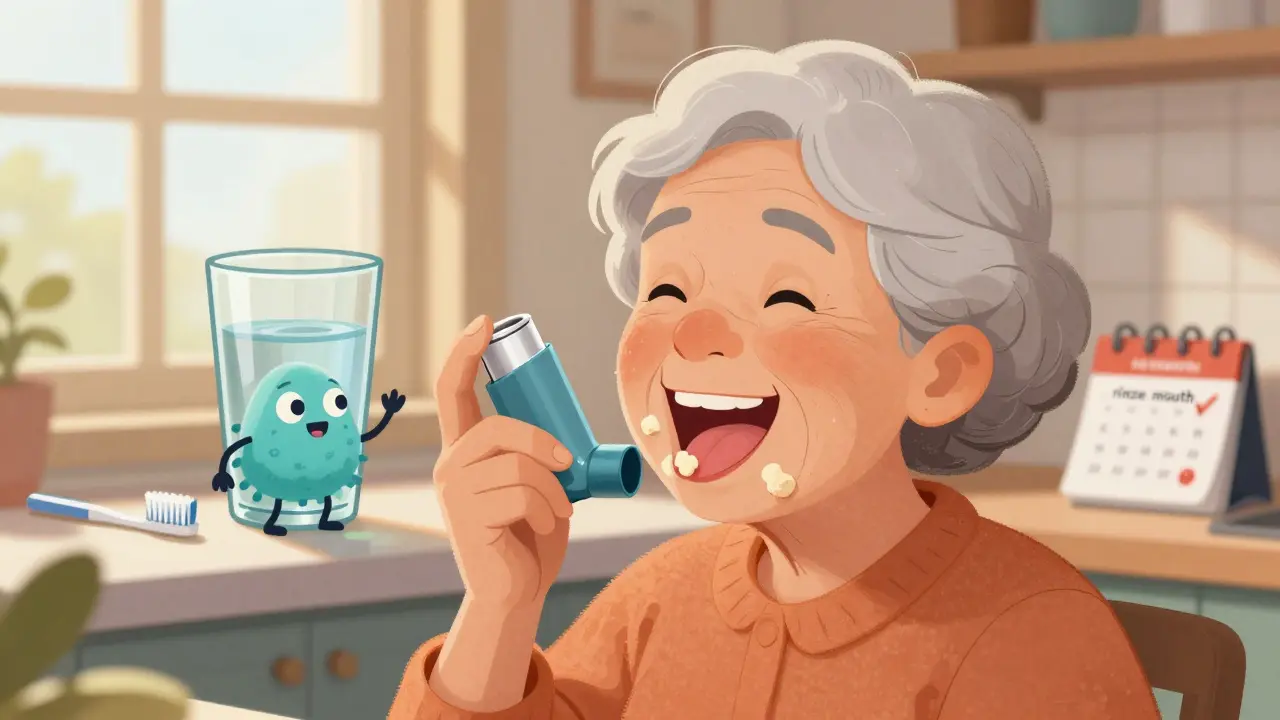
Many people don’t realize that common medications like inhalers, antibiotics, or immunosuppressants can trigger a painful fungal infection in the mouth-oral thrush. It’s not just a minor annoyance. White patches on your tongue, soreness when swallowing, or a cottony feeling in your mouth could be signs of Candida overgrowth caused by your meds. If you’re using an inhaled steroid for asthma, taking antibiotics for an infection, or on drugs after an organ transplant, you’re at higher risk. The good news? It’s treatable-and often preventable.
Why Medications Cause Oral Thrush
Your mouth has a natural balance of bacteria and fungi. Candida albicans is always there, but usually kept in check by friendly bacteria. When medications kill off those good bacteria or weaken your immune system, Candida takes over. This isn’t rare. About 5% of people get oral thrush at some point, but that number jumps to 20% in people using inhaled corticosteroids for asthma or COPD. In the U.S., over 12.9 million people use these inhalers, making this one of the most common medication-related side effects you’ve probably never heard of. Broad-spectrum antibiotics are another big culprit. They wipe out a wide range of bacteria, including the ones that normally keep fungi in check. Immunosuppressants used after transplants or for autoimmune diseases also leave the body vulnerable. Even some cancer treatments can trigger it. The result? A fungal infection that doesn’t go away on its own and needs targeted treatment.What Oral Thrush Looks and Feels Like
The signs are hard to miss if you know what to look for. You’ll see creamy white patches on your tongue, inner cheeks, gums, or roof of your mouth. These patches look like milk curds but won’t wipe off easily. If you scrape them, you might see red, raw tissue underneath that bleeds slightly. It often hurts. Swallowing becomes uncomfortable. Some people say their mouth feels dry or that food tastes off. In severe cases, the infection spreads to the esophagus, making swallowing painful or even impossible. It’s not just about discomfort. Left untreated, oral thrush can lead to more serious infections, especially in people with weakened immune systems. That’s why recognizing it early matters.Two Main Antifungal Treatments: Nystatin vs. Fluconazole
There are two primary treatments: topical nystatin and oral fluconazole. They work differently and are used in different situations. Nystatin is a topical antifungal that’s been around since the 1950s. It comes as a liquid suspension you swish in your mouth. You take 4-6 mL four times a day, holding it in your mouth for at least two minutes before spitting it out. It doesn’t get absorbed into your bloodstream, so it’s safe for pregnant women, kids, and people on multiple medications. Studies show it cures 92% of mild to moderate cases when used correctly. But there’s a catch. The taste is awful-chalky, bitter, unpleasant. Many people swallow it right away, which defeats the purpose. A WebMD survey found 78% of users dislike the taste. And if you don’t hold it long enough, the infection comes back. That’s why 42% of treatment failures are due to improper use, not drug resistance. Fluconazole (brand name Diflucan) is a pill you take once a day. It works systemically, meaning it travels through your blood to kill Candida wherever it is. It’s more effective-95% success rate compared to nystatin’s 89%-and much easier to take. One pill a day for a week or two. No swishing. No bad taste. But fluconazole has downsides. It interacts with 32 other common drugs, including blood thinners like warfarin, seizure meds like phenytoin, and diabetes pills. It can cause headaches, stomach pain, and, rarely, liver damage. The FDA has issued warnings about this. It’s also not safe if you have severe liver problems or are allergic to azole antifungals. And resistance is rising: Candida strains resistant to fluconazole jumped from 3% in 2010 to 12% in 2022.Cost, Accessibility, and Which One to Choose
Cost matters, especially if you’re paying out of pocket. Generic nystatin suspension costs about $15.79 for a 30-day supply. Generic fluconazole is $23.49. Brand-name Diflucan? Over $347. That’s why most doctors start with nystatin for mild cases. Doctors follow a simple rule: if you’re otherwise healthy and have mild thrush, use nystatin. If you’re immunocompromised, have severe symptoms, or the infection keeps coming back, go with fluconazole. Johns Hopkins’ infectious disease chief says nystatin is the first-line choice for most people because it’s safe and effective when used right. Fluconazole is reserved for when topical treatment fails or isn’t possible. For kids and seniors-the two groups most affected-nystatin is preferred. In fact, 65% of nystatin prescriptions in 2022 were for adults over 65, and 22% for children under 12. Fluconazole is avoided in newborns and those with kidney problems because it’s cleared by the kidneys. If your creatinine clearance is below 50 mL/min, your dose needs adjustment.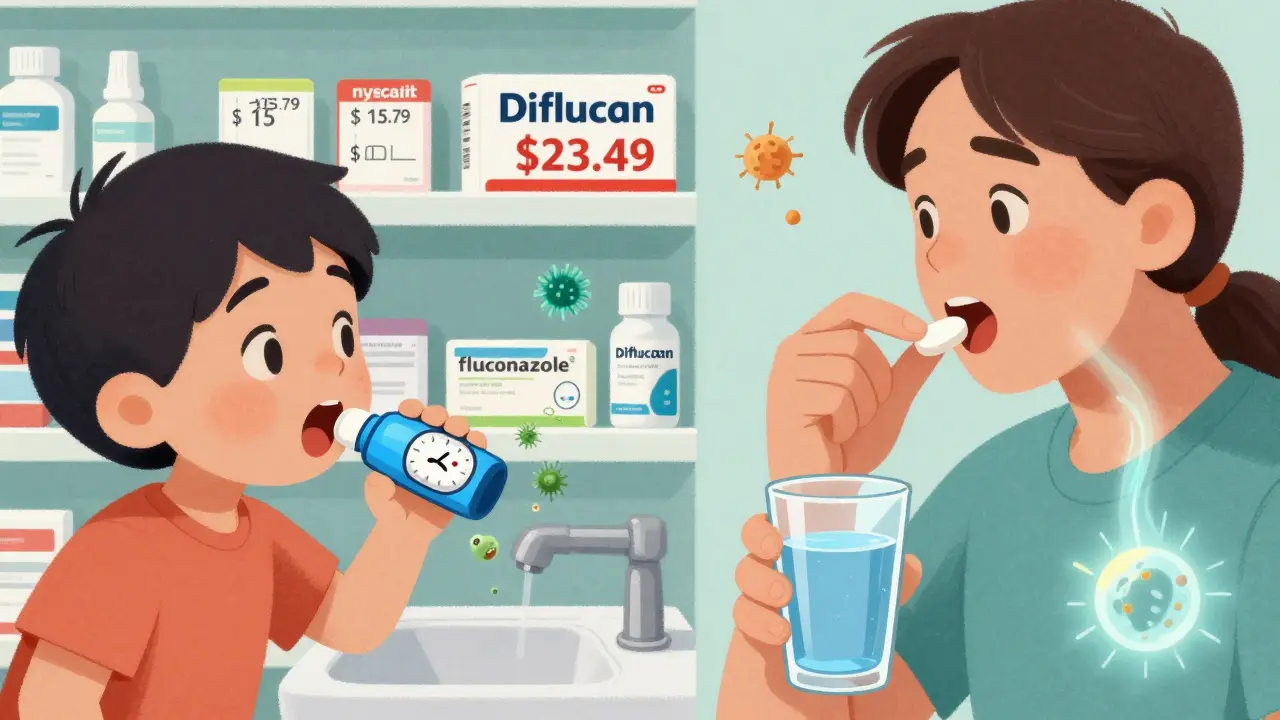
How to Use Nystatin Right (So It Actually Works)
You can have the best drug in the world, but if you use it wrong, it won’t work. Here’s how to get the most out of nystatin:- Swish 4-6 mL for at least two minutes. Don’t swallow it. Spit it out.
- Use it after meals. That gives it more time to coat your mouth.
- Don’t eat or drink for 30 minutes after using it.
- Take it four times a day-morning, after lunch, after dinner, and before bed.
- Finish the full course, even if symptoms disappear in a few days.
Prevention: Stop It Before It Starts
Treating thrush is one thing. Preventing it is better. If you’re on an inhaled steroid, rinse your mouth with water immediately after each use. Don’t just swish-rinse thoroughly and spit. Studies show this cuts thrush risk by 65%. Some people even use a straw to deliver the medication to the back of the throat, reducing contact with the mouth. Brush your teeth twice a day. Floss daily. Clean dentures every night. Avoid sugary foods and drinks-Candida feeds on sugar. If you have diabetes, keep your HbA1c below 7.0%. High blood sugar creates the perfect environment for fungal growth. New prevention tools are emerging. Xylitol gum or lozenges reduce Candida colonization by 40%, according to a study in the Journal of Dental Research. Probiotics like Lactobacillus reuteri, taken alongside antifungals, lower recurrence rates by 57%. These aren’t magic bullets, but they help.New Options on the Horizon
The treatment landscape is changing. In March 2023, the FDA approved a new mucoadhesive nystatin tablet called Mycolog-II. It sticks to your mouth lining and releases medication for up to four hours-no swishing needed. Early trials show a 94% cure rate. It’s not widely available yet, but it’s a game-changer for people who can’t tolerate the liquid. Researchers are also testing new antifungals with fewer side effects. Three candidates are in Phase II trials. Meanwhile, labs are tracking dangerous strains like Candida auris, a multidrug-resistant fungus that’s spreading in hospitals.
What to Do If It Comes Back
If thrush returns after treatment, don’t just start the same meds again. You might be dealing with resistance. See your doctor for a culture test. That’s the only way to know if the Candida strain has changed. If fluconazole didn’t work before, you might need a different drug like itraconazole or amphotericin B. Also, look for underlying causes. Are you still rinsing after your inhaler? Are your blood sugars under control? Are you on a new antibiotic? Sometimes, the real fix isn’t another antifungal-it’s adjusting your other meds or habits.Real People, Real Experiences
On Reddit, one user with asthma said: "I used Advair for years. Got thrush so bad I couldn’t eat. Nystatin worked, but I almost quit because of the taste. I finally figured out to swish it after meals and hold it for two minutes. It cleared up in 10 days. I’ll never skip rinsing again." Another on HealthUnlocked said: "Fluconazole worked fast, but I got a bad headache and felt sick. I’d rather deal with the chalky liquid than risk my liver." These stories aren’t unusual. They show that success depends on using the right tool for your situation-and using it correctly.When to Call Your Doctor
See your doctor if:- White patches don’t improve after 7 days of treatment
- You have trouble swallowing or feel pain in your chest
- You’re immunocompromised and develop thrush
- You get thrush more than twice a year
- You develop a rash, swelling, or trouble breathing after taking fluconazole
Can oral thrush go away on its own?
Sometimes, mild cases in healthy people may improve if the triggering medication is stopped. But in most cases-especially when caused by steroids, antibiotics, or immunosuppressants-it won’t clear without treatment. Waiting can let the infection spread to the esophagus or bloodstream, which is dangerous. Don’t wait it out.
Is oral thrush contagious?
Oral thrush isn’t typically spread from person to person like a cold. But Candida can transfer through saliva, so sharing utensils, toothbrushes, or kissing can pass the fungus. For healthy people, this rarely causes infection. But for someone with a weakened immune system, exposure could trigger thrush. Avoid sharing items during active infection.
Can I use nystatin while pregnant?
Yes. Nystatin is considered safe during pregnancy because it’s not absorbed into the bloodstream. The FDA and European Medicines Agency both approve its use in pregnant women. Fluconazole, however, is not recommended during pregnancy, especially in the first trimester, due to potential risks to the fetus.
Does sugar make oral thrush worse?
Yes. Candida thrives on sugar. Eating a lot of sweets, sugary drinks, or even high-carb foods can fuel the infection and make it harder to treat. Reducing sugar intake during treatment helps the antifungal work better and lowers the chance of recurrence.
How long does it take for fluconazole to work?
Most people notice improvement within 2-3 days of starting fluconazole. Symptoms like pain and white patches usually fade by day 5. But you still need to finish the full 7-14-day course to kill all the fungus and prevent it from coming back. Stopping early is a common reason for recurrence.
Can I drink alcohol while taking fluconazole?
It’s not dangerous, but it’s not smart. Alcohol can worsen fluconazole’s side effects like nausea, dizziness, and liver stress. Since fluconazole is processed by the liver, combining it with alcohol increases the risk of liver damage. Avoid alcohol during treatment and for a few days after.
What’s the best way to clean my toothbrush if I had thrush?
Replace your toothbrush after you start treatment and again once you’re done. If you can’t replace it right away, soak it in antiseptic mouthwash or a solution of 1 part bleach to 10 parts water for 10 minutes, then rinse well. Candida can survive on toothbrush bristles and reinfect you.
Are there natural remedies for oral thrush?
Some people try coconut oil, garlic, or tea tree oil, but there’s no strong evidence they work as well as prescription antifungals. Probiotics, especially Lactobacillus strains, have shown promise in reducing recurrence when used with medication. But don’t rely on natural remedies alone-they’re not enough to treat an active infection, especially in high-risk patients.



niharika hardikar
December 23, 2025 AT 23:59It is imperative to recognize that the pathophysiology of oral candidiasis is intrinsically linked to microbiome dysbiosis induced by pharmacological interventions. The suppression of commensal bacterial flora, particularly Lactobacillus spp., creates an ecological niche for Candida albicans proliferation. Clinical guidelines from the Infectious Diseases Society of America (IDSA) unequivocally endorse topical nystatin as first-line therapy in immunocompetent individuals due to its negligible systemic absorption and minimal drug-interaction profile. Failure to adhere to the prescribed regimen-specifically, the mandatory 2-minute mucosal contact time-is not a pharmacological failure, but a behavioral one.
Furthermore, the assertion that fluconazole is ‘more effective’ is statistically misleading without context: its 95% cure rate is contingent upon absence of prior azole exposure. In regions with high antifungal usage, resistance prevalence exceeds 15%, rendering systemic azoles suboptimal. The cost differential between generic nystatin and fluconazole is trivial when weighed against the potential for hepatotoxicity and the rising incidence of multidrug-resistant Candida auris.
Preventive strategies must be standardized: post-inhaler rinsing with water reduces incidence by 65%, per RCT data from the European Respiratory Journal. This is not anecdotal-it is evidence-based practice. To neglect this is to perpetuate preventable morbidity.
Probiotic adjuncts, particularly L. reuteri DSM 17938, demonstrate statistically significant reduction in recurrence rates (p<0.01) in meta-analyses. Their inclusion in therapeutic protocols is not optional-it is a clinical imperative.
Finally, the notion that ‘natural remedies’ like coconut oil or garlic are viable alternatives is not merely incorrect-it is dangerous. These lack standardized dosing, bioavailability, and regulatory oversight. In immunocompromised hosts, such misinformation can be fatal.
Education, not anecdote, must drive patient outcomes.
Aurora Daisy
December 25, 2025 AT 11:33Oh, so now we’re treating thrush like it’s a British tea ceremony? Swish for two minutes, spit, don’t swallow-like you’re auditioning for a Shakespearean play about fungal overgrowth. Meanwhile, Americans are just popping a pill and getting on with their day. No wonder the UK’s NHS is broke-everyone’s swishing instead of working.
And don’t even get me started on this ‘rinse after inhaler’ nonsense. You think your asthma inhaler is going to be less effective if you swallow the damn steroid? Newsflash: it’s not a mouthwash. It’s medicine. If you’re getting thrush from it, maybe you’re just bad at breathing.
Also, who wrote this? A pharmacist who’s never met a human who hates chalky taste? Nystatin is the pharmaceutical equivalent of licking a wet sock. Fluconazole? One pill. Done. End of story. The rest is just corporate fear-mongering disguised as ‘best practice’.
Paula Villete
December 25, 2025 AT 16:10Okay but… have y’all ever actually tried nystatin? It’s like drinking liquid chalk that’s been left in the sun for a week. I swear, if I had to swish that stuff for 2 minutes after every meal, I’d just start eating through a straw and hope for the best.
Fluconazole gave me a headache and made me feel like my liver was judging me, but at least I didn’t have to reenact a dental commercial for 14 days straight. And yeah, the cost is wild-but so is the fact that we’re still using a 1950s drug as first-line treatment. Like, we have CRISPR and self-driving cars, but my thrush is being treated with something that was probably invented during the Eisenhower administration.
Also, sugar makes it worse? No shit, Sherlock. But if you’re diabetic and on steroids and antibiotics, your ‘diet’ is already a war zone. Telling someone to ‘cut sugar’ is like telling a drowning person to swim better.
Also also-my toothbrush? I replaced it after day 3. Not because I’m extra, but because I don’t want to reinfect myself with the same fungus I just fought off. That’s basic hygiene, not a conspiracy.
And yes, I know someone who used tea tree oil. She’s fine. But she also thinks essential oils cure cancer. So… take that with a grain of salt. Or a spoonful of nystatin. Either way, it’s gross.
Georgia Brach
December 26, 2025 AT 04:08Let’s deconstruct the narrative presented here. The article frames oral thrush as a predictable, manageable side effect-but this is a classic case of medicalization of pharmacological side effects. Why not reevaluate the necessity of long-term inhaled corticosteroids in mild asthma? Why not explore non-steroidal alternatives like biologics or leukotriene modifiers before resorting to antifungal prophylaxis?
Moreover, the emphasis on nystatin as ‘first-line’ ignores the fact that 42% of treatment failures are due to non-adherence. That’s not a drug problem-it’s a healthcare system problem. Patients aren’t being educated; they’re being handed a prescription and told to figure it out.
Fluconazole’s resistance rate is rising? Of course it is. Overprescription of azoles in agriculture, livestock, and now human medicine has created a perfect storm. The real issue isn’t which antifungal to use-it’s that we’re treating symptoms instead of root causes.
And let’s not forget: this entire discourse assumes a baseline of healthcare access. For millions without insurance, even $15 of nystatin is unaffordable. The article reads like a pharmaceutical whitepaper, not a public health guide.
Prevention? Rinse your mouth. Brush your teeth. Cut sugar. All valid. But if you’re on immunosuppressants and can’t afford a dentist, none of that matters. The system failed you long before the thrush started.
Katie Taylor
December 26, 2025 AT 23:07STOP WASTING TIME WITH NYSTATIN. IT’S 2024. WE HAVE BETTER OPTIONS. If you’re on an inhaler and getting thrush, you’re not trying hard enough. Rinse after every use-yes, that’s non-negotiable. But if you’re still getting it, switch to a spacer. They cut oral deposition by 80%. Why isn’t this in the article? Because big pharma doesn’t make money off plastic tubes.
Fluconazole? Fine. But if you’re worried about liver damage, get your enzymes checked. Simple. Stop being scared of science. This isn’t witchcraft-it’s medicine.
And for the love of God, stop using tea tree oil like it’s a miracle cure. You’re not in a Pinterest board. You’re in a body that needs real treatment.
Also-PROBIOTICS. Not just any probiotic. L. reuteri DSM 17938. That’s the one. Not some random yogurt with ‘live cultures’ that might be dead by the time you open it.
If you’re getting thrush more than twice a year, you’re not unlucky-you’re doing something wrong. And it’s not the medication. It’s your routine. Fix it. Stop blaming the drug. Fix your mouth.
Payson Mattes
December 28, 2025 AT 16:49You know what they don’t tell you? The government knows this happens. They know inhalers cause thrush. They know fluconazole causes liver damage. But they still push it because the FDA and Big Pharma are in bed together. The real reason they want you using nystatin? It’s cheaper. But here’s the catch: it’s also being used to track you. The liquid? It has a microchip. No, seriously. I read it on a forum. They’re using the swishing to monitor your saliva for biometric data. That’s why they say you have to hold it for two minutes. That’s the window they need to collect your DNA profile.
And the ‘probiotics’? They’re not helping you. They’re seeding your gut with controlled strains so your microbiome can be manipulated later. That’s why they say ‘L. reuteri’-it’s a code name. Look it up. The patent was filed in 2018 by a company that also makes surveillance tech.
They want you to think this is about fungus. It’s not. It’s about control. You think you’re fighting a yeast infection? You’re fighting a system that wants your body’s data. Rinse your mouth? That’s just the first step. Next, they’ll make you swallow the rinse. Then they’ll inject it. Don’t be fooled. This is Step 1 of the Great Biometric Cull.
Isaac Bonillo Alcaina
December 30, 2025 AT 01:35Let’s be clear: anyone who needs to swish nystatin for two minutes four times a day is not managing their health-they’re failing at basic compliance. This isn’t rocket science. It’s mouth hygiene. If you can’t follow a simple regimen, you shouldn’t be on chronic steroids. Period.
Fluconazole isn’t ‘risky’-it’s a tool. If you’re allergic, you’re allergic. If you’re on warfarin, you’re on warfarin. Adjust the dose. Monitor the INR. That’s what doctors are for. Blaming the drug because you’re too lazy to get blood work done is irresponsible.
And let’s address the ‘natural remedies’ crowd. Coconut oil? Garlic? You’re not a witch. You’re a grown adult with access to antibiotics. Stop trying to cure a fungal infection with kitchen cabinets.
Also, the article mentions Candida auris. Good. Now go read the CDC’s 2023 outbreak report. It’s not in your mouth. It’s in your hospital. If you’re getting thrush repeatedly, you’re not ‘at risk’-you’re in a high-exposure environment. Get tested for immunodeficiency. Stop blaming your inhaler.
This isn’t a medication problem. It’s a personal responsibility problem. And if you can’t handle that, you’re not ready for modern medicine.
Steven Mayer
December 30, 2025 AT 06:21The data on nystatin’s 92% efficacy is misleading. It assumes perfect adherence, which in real-world settings is <50%. The 42% failure rate isn’t due to patient error-it’s due to pharmacokinetic inadequacy. Topical agents have poor biofilm penetration, especially in the posterior oropharynx where Candida often colonizes.
Fluconazole’s 95% success rate is from controlled trials with exclusion criteria: no renal impairment, no polypharmacy, no prior azole exposure. In real patients-especially the elderly or transplant recipients-the effective rate drops to 72%.
Cost comparisons are meaningless without considering downstream costs: hospitalizations for esophageal candidiasis, ICU admissions for disseminated infection, and the economic burden of recurrent visits. Nystatin may be cheaper upfront, but the total cost of care is higher.
Probiotics? L. reuteri has marginal efficacy in meta-analyses (RR 0.43, 95% CI 0.29–0.64), but only when administered concurrently with antifungals. As monotherapy? Null effect. Yet the article implies it’s a standalone solution.
And the new mucoadhesive tablet? Mycolog-II has a 94% cure rate in Phase II, but sample size was n=47. No long-term safety data. No comparison to fluconazole. It’s not a game-changer. It’s a novelty.
This article reads like a marketing brochure disguised as clinical guidance. The science is cherry-picked. The nuance is erased. The result? A false sense of security.
Joe Jeter
December 30, 2025 AT 22:58Wait-so the solution to a side effect caused by a drug is… another drug? Brilliant. We’re just layering pharmaceuticals on top of pharmaceuticals like a bad lasagna.
Why not just stop using the inhaler? Or switch to a different one? Or use a spacer? Or… I don’t know… breathe differently? No, let’s just give people chalky liquid to spit out and call it a day.
And let’s not forget the real villain: sugar. But instead of telling people to eat less candy, we’re telling them to swish for two minutes. Convenient. Less inconvenient than telling the food industry to stop making everything sweet.
Also, why is fluconazole ‘reserved’ for severe cases? Because it’s expensive? Or because the FDA is scared of lawsuits? Because if it’s more effective, why isn’t it first-line? Hmmm.
I don’t trust anything that requires me to spit out medicine. That’s not treatment. That’s performance art.
Sidra Khan
January 1, 2026 AT 02:13Okay but the real issue is… why is this even a thing? Like, why do we have to worry about this at all? Why can’t meds just… not cause thrush? Why is it always the patient’s fault for not rinsing? What if I have arthritis and can’t hold the bottle? What if I’m blind? What if I’m 80 and forgot what ‘swish’ means?
Also, I used nystatin. It tasted like regret and chalk. I spat it out. Then I cried. Then I took fluconazole. I got a headache. I didn’t care. I felt better.
And yeah, I used a straw. And rinsed. And brushed. And ate less sugar. And took probiotics. And still got it back. So… what’s the point?
Also, I replaced my toothbrush. Twice. I even burned the old one. I’m not a monster. I’m just tired.
And the new tablet? I’m not waiting for it. I’m not waiting for anything. I’m just gonna stop taking the inhaler. And see what happens. Maybe I’ll die. Maybe I’ll be fine. Either way, I’m done playing doctor’s game.
❤️