

Every year, millions of patients receive generic drugs instead of the brand-name medications their doctors prescribed. But did you know you have the right to refuse this substitution? Depending on where you live, you might need to take specific steps to ensure you get the medication your doctor intended. Generic substitution is a practice where pharmacists replace prescribed brand-name medications with chemically equivalent generics to reduce costs. This process is governed by state laws that originated from the Drug Price Competition and Patent Term Restoration Act of 1984 (Hatch-Waxman Act), which balanced incentives for brand-name drug innovation with generic drug availability.
How State Laws Impact Your Medication Choices
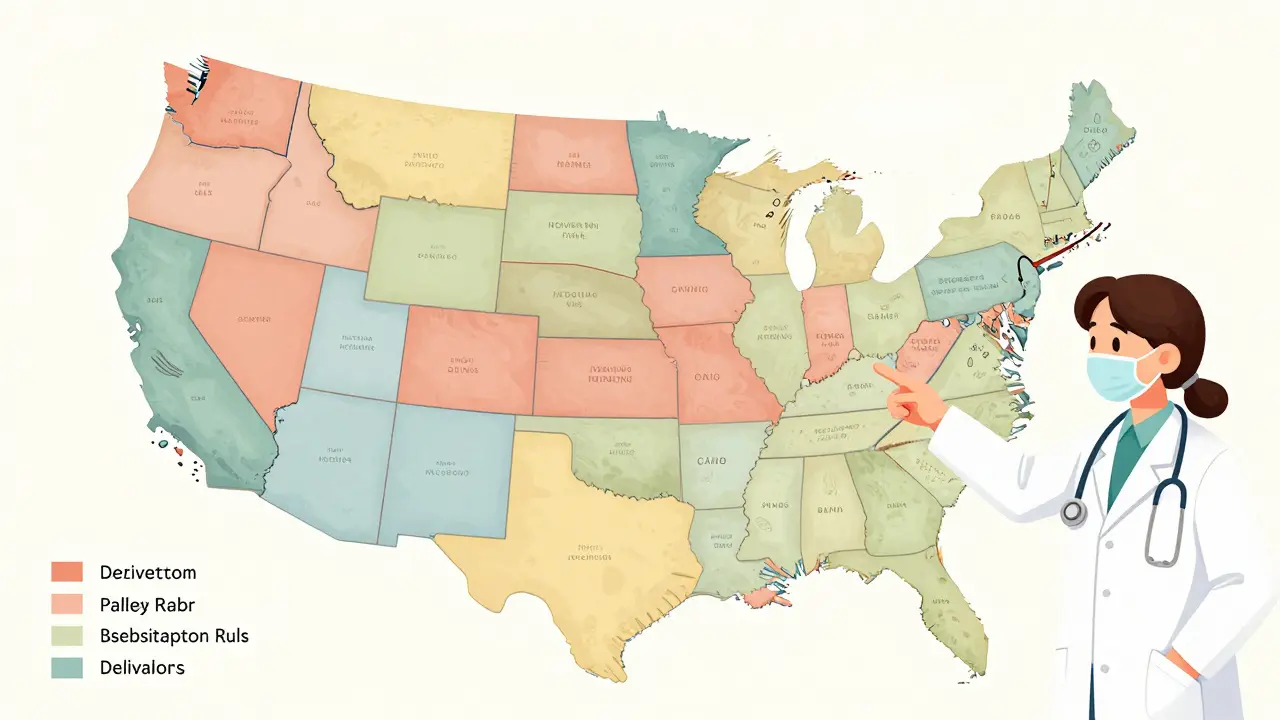
State laws vary significantly on how pharmacists handle generic substitution. Here's a breakdown of common categories:
| Category | States and DC | Patient Action Required |
|---|---|---|
| Mandates substitution | California, Texas, New York, and 16 others | Must explicitly refuse at pharmacy counter |
| Requires explicit consent | Alaska, Connecticut, Hawaii, Maine, Massachusetts, New Hampshire, Vermont, and DC | Pharmacist must get your approval before substituting |
| Requires notification | 31 states plus DC | Pharmacist must inform you of substitution; you can request brand-name |
The Hatch-Waxman Act is a 1984 federal law that established the modern framework for generic drug approval. It created the system where generic drugs can be approved after brand-name patents expire, leading to significant cost savings. However, the law also allowed states to set specific rules for when substitutions can occur. For example, in 2023, Colorado and Nevada strengthened patient notification requirements for biologic substitutions, bringing the total of states with biologic-specific safeguards to 47.
The FDA Orange Book is the official reference for therapeutic equivalence evaluations. Pharmacists use this to determine if a generic can safely replace a brand-name drug. Drugs listed with an "A" rating are considered therapeutically equivalent and generally substitutable. Those with a "B" rating require additional considerations due to potential differences in effectiveness.
When You Need to Request a Brand-Name Drug
Narrow therapeutic index drugs are medications where small changes in dose can lead to serious side effects or treatment failure. Examples include levothyroxine for thyroid conditions, antiepileptic drugs like phenytoin, and digoxin for heart problems. For these drugs, even minor differences in generic versions can cause health issues. Kentucky's Board of Pharmacy maintains a specific list of non-substitutable drugs, including digitalis glycosides and antiepileptic drugs. Hawaii's law explicitly prohibits substitution of antiepileptic drugs without both practitioner and patient consent.
Biosimilars are biologic drugs that are highly similar to brand-name biologics but not identical due to complex manufacturing processes. Unlike small-molecule generics, biosimilars require additional safeguards. The World Medical Association emphasizes that biosimilars are "not generic versions of biologics" and need heightened protections. A 2021 Consumer Reports survey found 28% of patients who attempted to refuse biosimilar substitution encountered difficulties, with some pharmacists claiming they "had to" substitute.
Step-by-Step Guide to Refusing Generic Substitution
Here's how to protect your right to the correct medication:
- State your refusal clearly: At the pharmacy counter, say "I decline substitution" or "I want the brand-name drug as prescribed." This is legally sufficient in 43 states. For example, a Massachusetts patient successfully refused substitution for levothyroxine by simply stating "I decline substitution per state law" and received brand-name Synthroid without additional cost due to insurance coverage.
- Ask for documentation: Request a written note from your doctor stating "brand medically necessary" if applicable. This is recognized in 48 states. The American Academy of Family Physicians recommends this for narrow therapeutic index drugs or if you've had adverse reactions to generics.
- Verify the prescription: Check the prescription label for "Dispense As Written" (DAW) code. If not present, ask your doctor to add it. South Dakota law specifically prohibits prescribers from making "dispense as written" a default on all prescriptions.
- Know your state law: Use resources like your state pharmacy board's website to confirm specific requirements. For instance, Oklahoma's law states it is unlawful for pharmacists to substitute without prescriber or purchaser authorization.
- Document everything: Keep records of all substitution attempts and refusals. In 2019, a Michigan patient experienced severe side effects after automatic substitution of an antiepileptic drug, leading to a successful lawsuit against the pharmacy.

Common Challenges and How to Overcome Them
Pharmacists sometimes claim substitution is mandatory when it's not. In states requiring consent (like Massachusetts), a pharmacist saying "I have to substitute" is illegal. If this happens, request to speak with the pharmacy manager and cite your state's specific law. For example, Maine's law requires explicit patient consent before substitution, so pharmacists cannot proceed without it.
Another challenge is "gag clauses," which previously prevented pharmacists from informing patients when paying cash for brand-name drugs would be cheaper than insurance co-pays. The 2018 Know the Lowest Price Act largely prohibited this practice. Know the Lowest Price Act is a federal law that allows pharmacists to inform patients about cash prices for medications. For instance, a GoodRx survey in 2022 showed 83% of respondents were satisfied with generic substitutions that included proper notification, with average out-of-pocket savings of $27.50 per prescription.
Pharmacy Benefit Managers (PBMs) like Express Scripts and CVS Caremark often mandate substitution to reduce costs. However, the Congressional Budget Office reported in 2022 that non-medical switching costs the healthcare system $2.1 billion annually due to increased adverse events and monitoring requirements. Pharmacy benefit managers are organizations that manage prescription drug benefits for health plans. They frequently incentivize substitution, but patients can push back by citing their rights.
Key Resources for Patient Advocacy
State pharmacy boards maintain complaint procedures for issues with substitutions. For example, the Iowa Legislature's 2021 Nonmedical Switching publication specifies that substituted drugs must cost less than the prescribed drug product. If a pharmacy violates this, you can file a complaint with your state board.
The FDA's medication error reporting system allows patients to report substitution errors. Additionally, patient advocacy organizations like the National Organization for Rare Disorders provide support for specialty medications. AARP's 2023 study found patients typically require 1-2 prescription fills to understand their state's specific requirements. Keep a printed copy of your state's substitution laws in your wallet for quick reference.
Can a pharmacist substitute my brand-name drug without my knowledge?
No. In 31 states plus DC, pharmacists must inform you of substitutions. In 7 states plus DC, they must get your explicit consent. Only in 19 states can pharmacists substitute without notifying you, but even then, you can refuse by saying "I decline substitution." Always check your prescription label for substitution details and ask the pharmacist to explain any changes.
What should I do if a pharmacist refuses my request for a brand-name drug?
Request to speak with the pharmacy manager and cite your state's specific law. For example, in Massachusetts, pharmacists cannot substitute without consent, so they must honor your request. If they still refuse, file a complaint with your state pharmacy board. The National Consumers League's 2022 Medication Guide states that patients have the right to refuse substitution in all 50 states, and pharmacists must comply with your instructions.
Are there specific drugs where substitution is never allowed?
Yes. Narrow therapeutic index drugs like levothyroxine, antiepileptic drugs, and digoxin often require brand-name versions due to small differences in effectiveness. Kentucky's Board of Pharmacy maintains a specific list of non-substitutable drugs. Additionally, biosimilars require extra safeguards, and some states prohibit substitution without physician and patient consent. Always verify with your doctor if your medication falls into this category.
How do I know if my state requires patient consent for substitution?
Check your state pharmacy board's website or use the FDA's online resources. States requiring explicit consent include Alaska, Connecticut, Hawaii, Maine, Massachusetts, New Hampshire, Vermont, and DC. In these states, pharmacists cannot substitute without your approval. For example, in Hawaii, pharmacists must get both practitioner and patient consent for antiepileptic drug substitutions. If unsure, ask the pharmacist directly about your state's requirements.
What if my insurance won't cover the brand-name drug?
You can still request the brand-name drug, but you may need to pay the difference. The Know the Lowest Price Act allows pharmacists to inform you when paying cash for the brand-name drug would be cheaper than insurance co-pays. For example, GoodRx reported in 2022 that 83% of patients were satisfied with generic substitutions that included proper notification, with average savings of $27.50 per prescription. If the brand-name drug is medically necessary, ask your doctor to submit an appeal to your insurance company. Many insurers will cover the brand-name drug with proper documentation.


Savannah Edwards
February 6, 2026 AT 14:12I've been through the wringer with generic substitutions in California, where the law mandates that pharmacists can substitute unless you explicitly say no. A few years back, my doctor prescribed me a brand-name drug for my thyroid condition, but when I went to pick it up, the pharmacist handed me the generic without even asking. I was confused and didn't realize I had to refuse. After that incident, I started doing my homework on state laws. Turns out, in California, you have to state "I decline substitution" at the counter-otherwise, they'll just give you the generic. I also learned about the importance of the "Dispense As Written" (DAW) code on prescriptions. If it's not there, I now ask my doctor to add it. It's crazy how often pharmacists assume you're okay with substitution, but you have to be proactive. I've also discovered that states like Massachusetts require explicit consent before substituting, which is a huge relief. For narrow therapeutic index drugs like levothyroxine, even small differences can cause serious issues. I've read about cases where patients had adverse reactions after automatic substitution of antiepileptic drugs. It's really important to know your state's specific rules. The FDA Orange Book is a great resource for checking therapeutic equivalence ratings. I always keep a printed copy of my state's substitution laws in my wallet. It's frustrating that so many people don't know their rights, but education is key. If you're unsure, just ask the pharmacist to explain the process. Your health is worth the extra effort.
Mayank Dobhal
February 7, 2026 AT 06:35Always ask for brand name-no compromises on health.
Marcus Jackson
February 8, 2026 AT 15:16The FDA Orange Book lists therapeutic equivalence. A-rated generics are safe to substitute; B-rated ones aren't. Simple as that. Stop overcomplicating it.
Natasha Bhala
February 9, 2026 AT 12:16just say i decline substitution and they have to listen. you got this 🙌
Gouris Patnaik
February 10, 2026 AT 10:34India has a robust generic system. We don't have the same issues as the US. Americans overthink everything. It's not rocket science. Trust the science.
Jesse Lord
February 11, 2026 AT 20:15always check for DAW code on your prescription. if not there, ask your doc to add it. its your right. simple.
AMIT JINDAL
February 12, 2026 AT 21:45Jesse, you're absolutely right about the DAW code, but I've personally witnessed pharmacies ignoring it despite patients requesting brand-name drugs. It's infuriating how often they try to substitute without consent. I always check the prescription label and ask the pharmacist to verify the DAW code. Additionally, the Know the Lowest Price Act means you can ask for cash prices, which are often cheaper than insurance copays-GoodRx is a lifesaver for that. However, the real problem lies with Pharmacy Benefit Managers (PBMs) like Express Scripts and CVS Caremark. They prioritize profits over patient health, mandating substitutions even when medically unnecessary. The Congressional Budget Office reported $2.1 billion in annual costs from non-medical switching, which is insane. We need stricter regulations to protect patients. Always stand your ground and demand your rights-your health shouldn't be a bargaining chip. 😎
Catherine Wybourne
February 13, 2026 AT 06:18Ah, the never-ending debate between brand and generic. So much fuss over something that's usually straightforward. Just say 'no' and move on. Though I do wonder why we need all these laws when a simple 'I decline' should suffice. Oh well, keep fighting the good fight. 😏