
Every year, over 1,000 generic drugs hit the U.S. market. They’re cheaper, just as safe, and prescribed in 9 out of 10 pharmacy fills. But behind every one of those pills, patches, or inhalers is a long, strict, and highly technical journey through the FDA generic drug approval system. It’s not just about copying a brand-name drug. It’s about proving, with hard data, that it works the exact same way in your body. Here’s how it actually happens.
What Is an ANDA? The Foundation of Generic Approval
The entire process revolves around the Abbreviated New Drug Application, or ANDA. This isn’t a shortcut-it’s a smart, science-based system created by the Hatch-Waxman Act of 1984. Before this law, generic drug makers had to repeat all the expensive clinical trials done by the original brand-name company. That made generics nearly impossible to develop. Hatch-Waxman changed that. It said: if you can prove your drug is identical in active ingredient, strength, dosage form, and route of administration-and that your body absorbs it at the same rate and amount-you don’t need to re-prove safety or effectiveness. You’re building on the FDA’s existing approval of the brand-name drug, called the Reference Listed Drug (RLD).
The ANDA doesn’t ask, “Is this drug safe?” It asks, “Is this generic the same as the approved brand?” That’s the core difference between an ANDA and a New Drug Application (NDA). An NDA for a new brand drug can cost over $2 billion and take 10-15 years. An ANDA? Typically $1-5 million and 3-4 years.
Step 1: Identify the Reference Listed Drug (RLD)
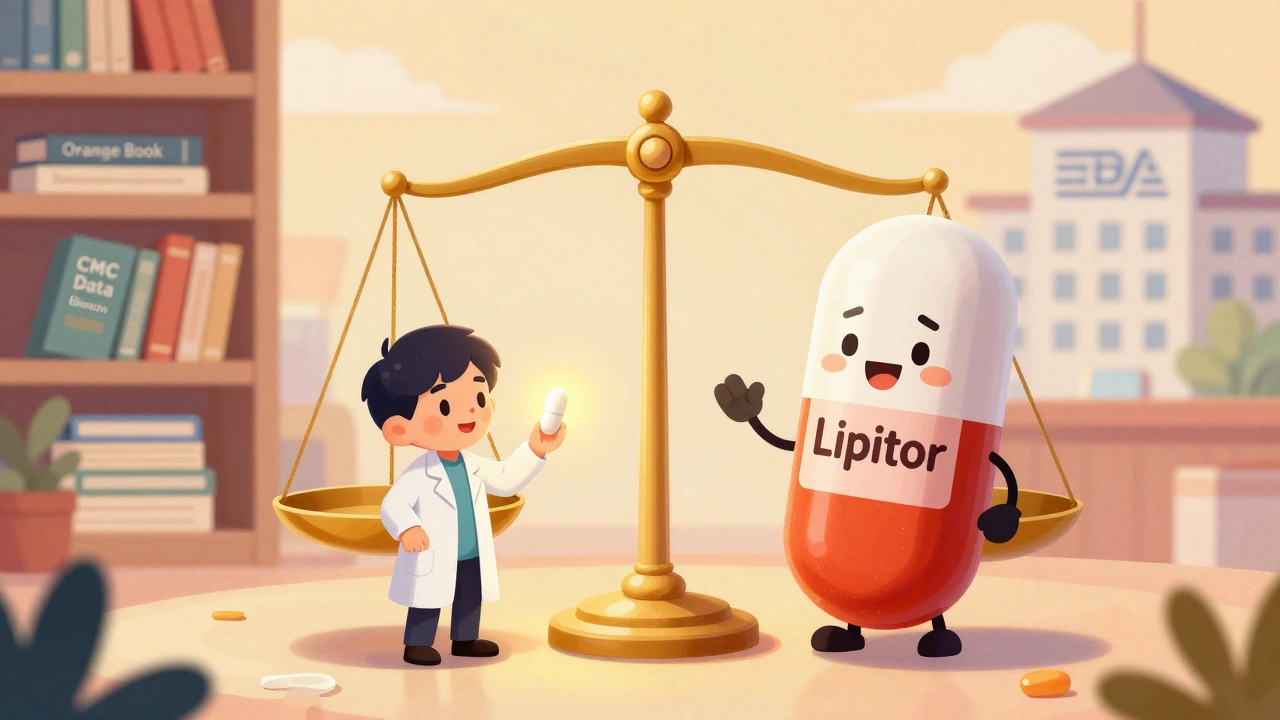
You can’t start an ANDA without picking the right brand-name drug to copy. The FDA maintains the Orange Book, a public list of all approved drug products with their therapeutic equivalence ratings. You need to choose an RLD that’s still under patent or exclusivity protection, or one that’s already expired. If you pick the wrong RLD, your application gets rejected before it’s even reviewed.
For example, if you want to make a generic version of Lipitor (atorvastatin), you must use the exact version approved by the FDA as the RLD-not a different formulation, not a different strength, not a different manufacturer’s version. Even small differences matter. The RLD becomes your gold standard.
Step 2: Prove Pharmaceutical Equivalence
Pharmaceutical equivalence means your generic matches the RLD in four key areas:
- Active ingredient: Same chemical compound, same amount.
- Strength: Same dosage per unit (e.g., 10 mg tablet).
- Dosage form: Same physical form-tablet, capsule, injection, etc.
- Route of administration: Same way it enters the body-oral, IV, topical, etc.
This part seems simple, but it’s where many applications fail. The FDA requires detailed chemistry, manufacturing, and controls (CMC) data. That includes:
- Complete description of the manufacturing process
- Specifications for raw materials and finished product
- Stability testing data showing the drug won’t degrade over time
- Validation of testing methods used to ensure consistency
The FDA expects you to follow Current Good Manufacturing Practices (cGMP). Facilities are inspected-sometimes before approval, sometimes after. If your factory doesn’t meet the same standards as Pfizer’s or Merck’s, your ANDA won’t pass.
Step 3: Demonstrate Bioequivalence
This is the make-or-break part. Bioequivalence means your generic delivers the same amount of active ingredient into the bloodstream at the same rate as the brand-name drug. The FDA defines this as the 90% confidence interval for the ratio of your drug’s AUC (area under the curve) and Cmax (peak concentration) falling within 80-125% of the RLD’s values.
To prove this, you run a clinical study-usually with 24 to 36 healthy adult volunteers. Each person takes your generic and the brand-name drug on separate occasions, with a washout period in between. Blood samples are taken at frequent intervals over 24-72 hours. Then, the data is analyzed statistically.
It’s not just about the numbers. The study design must be approved by the FDA in advance. If your protocol doesn’t meet their guidelines-for example, if you use the wrong fasting state or wrong sampling times-you’ll get a Complete Response Letter (CRL) asking for a redo. That can cost months and hundreds of thousands of dollars.
Step 4: Match the Labeling Exactly
Your generic’s label-the package insert-must be identical to the RLD’s in terms of warnings, dosing instructions, contraindications, and clinical pharmacology. You can change the inactive ingredients (like dyes or fillers), but you can’t change the language about how the drug works or what risks it carries.
Why? Because if a doctor prescribes a drug based on its label, and your generic says something different, it could lead to dangerous misunderstandings. The FDA checks every word. A single typo in the dosage section can trigger a CRL.
Step 5: Submit in eCTD Format
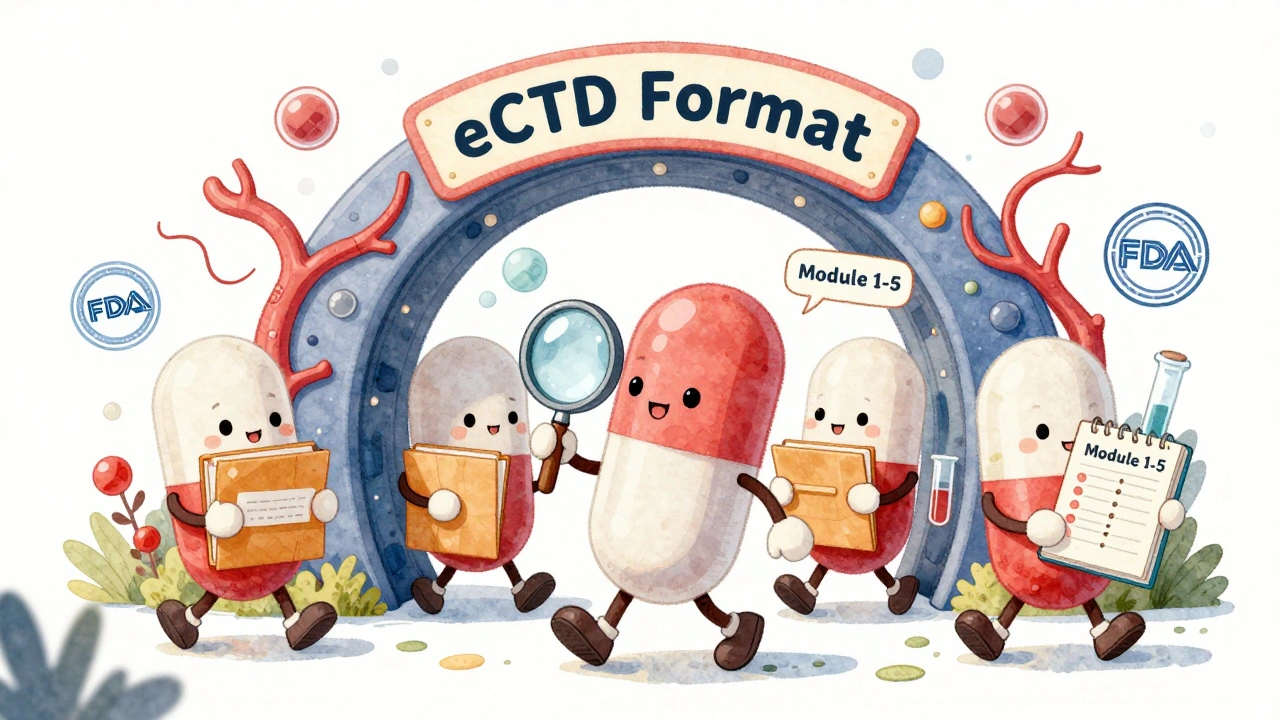
There’s no paper ANDA anymore. All submissions must be in the electronic Common Technical Document (eCTD) format. This is a standardized digital structure with five modules:
- Module 1: Administrative and prescribing information (country-specific)
- Module 2: Summaries of quality, nonclinical, and clinical data
- Module 3: Chemistry, manufacturing, and controls (CMC)
- Module 4: Nonclinical study reports
- Module 5: Clinical study reports and labeling
The eCTD isn’t just a file upload-it’s a complex, organized system. If your file structure is wrong, the FDA won’t even begin reviewing your application. They’ll send back a “filing deficiency” notice within 60 days. You’ll have to fix it and resubmit, losing valuable time.
Step 6: FDA Review and Inspection
Once the FDA accepts your ANDA for review, the clock starts. Under the Generic Drug User Fee Amendments (GDUFA IV), the goal is to review 90% of original ANDAs within 10 months. But that’s the target-not the guarantee.
The review team includes scientists from pharmacology, chemistry, microbiology, and labeling. They dig into every page of your submission. Around 75% of ANDAs get approved on the first try. The other 25% get a Complete Response Letter (CRL). Common reasons for rejection:
- 32%: Incomplete or unclear CMC data
- 28%: Bioequivalence study flaws
- 22%: Manufacturing site issues
- 18%: Labeling mismatches
During or after review, the FDA may inspect your manufacturing facility. These inspections can happen before approval (pre-approval inspection) or after. If the facility fails, your approval is delayed-even if your science is perfect.
Step 7: Approval and Market Entry
If you pass, the FDA sends an approval letter. Now you can start selling. But here’s the catch: you can’t always launch immediately.
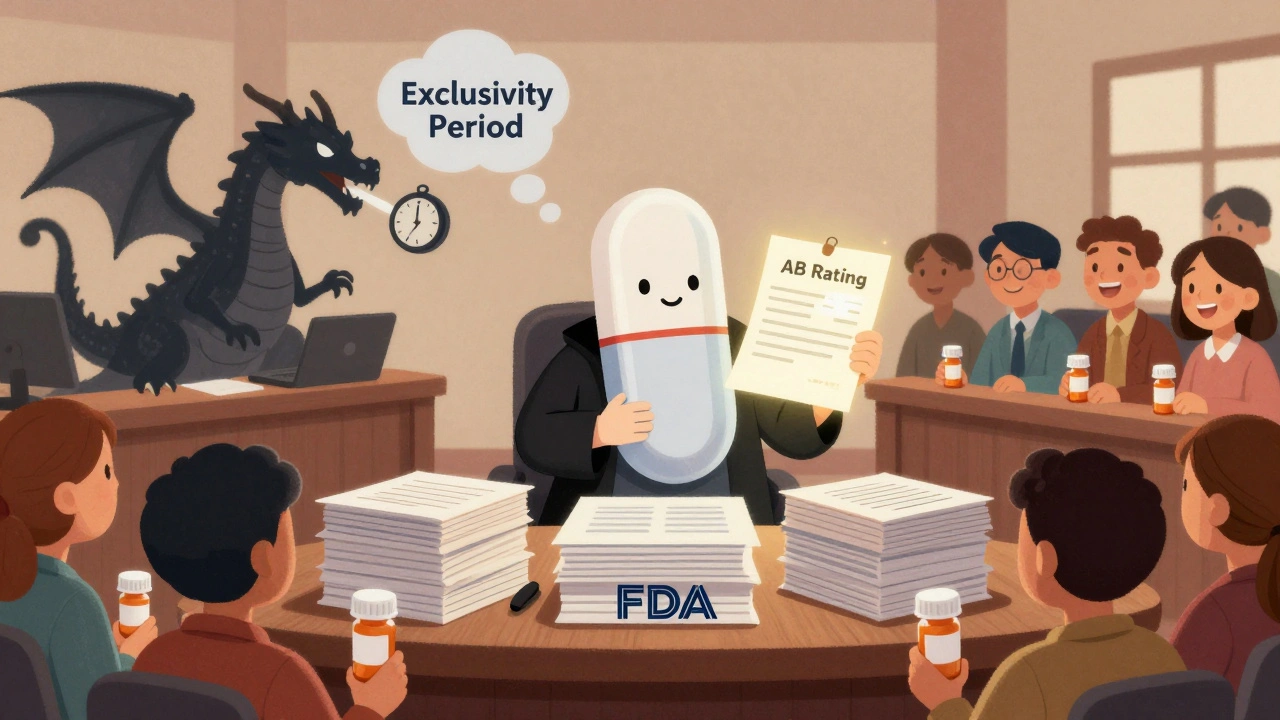
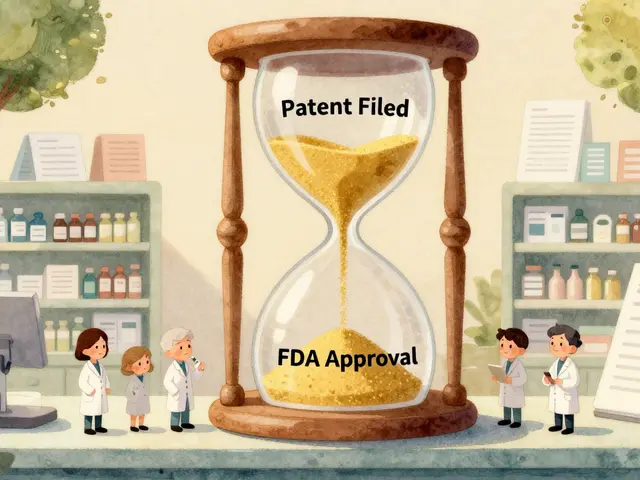
Patents and exclusivity periods can block you. The brand-name company might still have legal protection. That’s where Paragraph IV certifications come in. If you challenge a patent and win, you get 180 days of market exclusivity as the first generic. That’s why companies like Teva and Mylan invest millions in patent litigation-it’s worth it if you’re the only one selling the generic for half a year.
Once approved, your drug appears in the Orange Book with an “AB” rating, meaning it’s therapeutically equivalent to the brand. Pharmacists can substitute it without a doctor’s permission.
Challenges and Real-World Hurdles
Not every ANDA goes smoothly. Complex products like inhalers, injectables, or topical creams are harder to copy. The FDA calls these “complex generics.” For these, bioequivalence isn’t as simple as measuring blood levels. You might need to test lung deposition, skin absorption, or particle size distribution. The FDA has a special initiative for these-and the approval times are longer.
One company spent 28 months and over $2.3 million on a nasal spray ANDA that got three CRLs because the FDA questioned their bioequivalence method. Another got approved in 11 months for a generic metformin ER-but only after responding to two information requests.
And while most generics are safe and effective, experts have raised concerns about narrow therapeutic index drugs-like warfarin or levothyroxine-where tiny differences in absorption can cause serious side effects. The FDA says it monitors these closely and has never pulled a generic off the market for lack of equivalence. But the scrutiny is higher.
Why This Matters
Generic drugs save the U.S. healthcare system $373 billion every year. Without the ANDA process, most people couldn’t afford their prescriptions. The system works because it’s rigorous, not because it’s easy. It’s designed to protect patients while enabling competition.
By 2025, the FDA aims to reduce its ANDA backlog to fewer than 300 applications-down from 1,200 in 2020. They’re using AI to sort documents faster and improving guidance for complex products. The goal isn’t just speed-it’s reliability. Every pill you take that’s cheaper than the brand? It went through this entire process. And it had to earn every step.
How long does FDA generic drug approval take?
The FDA aims to complete its review of an ANDA within 10 months under GDUFA IV. However, the total time from start to approval is usually 3-4 years, including time to develop the drug, run bioequivalence studies, and prepare the application. If the application gets a Complete Response Letter (CRL), the timeline can extend by another 6-12 months.
Can a generic drug be different from the brand-name version?
Yes-but only in ways that don’t affect safety or effectiveness. Generics can have different inactive ingredients (like fillers or dyes), different packaging, and different branding. But the active ingredient, strength, dosage form, route of administration, and bioequivalence must match the brand-name drug exactly. The FDA requires this to ensure therapeutic equivalence.
What is a Complete Response Letter (CRL)?
A Complete Response Letter (CRL) is the FDA’s official notice that an ANDA cannot be approved in its current form. It lists all deficiencies-such as missing data, flawed studies, or labeling errors. The applicant must respond with additional information or revised data. A CRL doesn’t mean rejection-it means more work is needed before approval.
Do generic drugs work as well as brand-name drugs?
Yes, for the vast majority of drugs. The FDA requires generics to meet the same strict standards for quality, strength, purity, and stability as brand-name drugs. Bioequivalence studies prove they deliver the same amount of medicine into the bloodstream at the same rate. Over 90% of prescriptions in the U.S. are filled with generics because they’re proven safe and effective.
Why do some generic drugs cost more than others?
Price differences come from market competition, not quality. The first generic to enter the market after patent expiry often charges a higher price during its 180-day exclusivity period. Once more generics enter, prices drop sharply-sometimes by over 90%. Manufacturing costs, scale, and supply chain efficiency also affect pricing, but all approved generics must meet the same FDA standards.


Lucy Kavanagh
December 6, 2025 AT 02:25Michael Dioso
December 7, 2025 AT 09:07Laura Saye
December 8, 2025 AT 20:34aditya dixit
December 10, 2025 AT 02:45Krishan Patel
December 10, 2025 AT 07:28sean whitfield
December 10, 2025 AT 15:11Stephanie Fiero
December 10, 2025 AT 21:59Chris Brown
December 11, 2025 AT 06:46