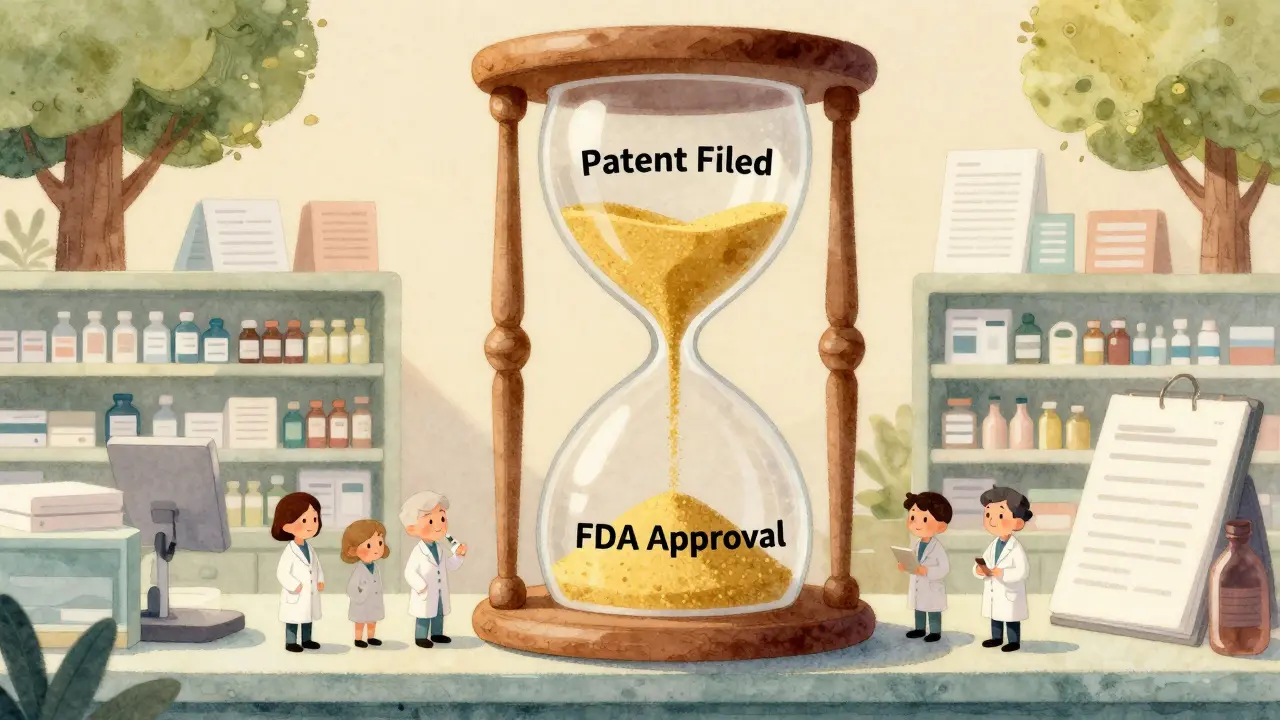
Most people think a drug patent lasts 20 years - and that’s technically true. But if you’re waiting for a brand-name medication to drop in price because the patent ran out, you might be waiting a lot longer than expected. Or worse, you might be surprised when it drops sooner than you thought. The truth is, the 20-year clock starts ticking long before the drug even hits the pharmacy shelf.
The 20-Year Clock Starts at Filing - Not Approval
Under U.S. law, drug patents are granted for 20 years from the date the application is first filed. That’s not when the drug is tested in humans. Not when it’s approved by the FDA. Not even when it’s sold to patients. It’s when the patent paperwork is submitted to the USPTO - often during early-stage research, sometimes before animal trials even begin.
That means if a company files a patent in 2010 and the drug doesn’t get FDA approval until 2020, they’ve already used up 10 years of their patent life just waiting for regulators. The actual time they have to sell the drug without competition? Maybe 7 to 10 years. For many drugs, it’s less.
This is why the patent cliff isn’t just a buzzword - it’s a financial earthquake. When a blockbuster drug loses patent protection, its price can drop 60% or more within a year. Generic versions flood the market, and insurance plans switch to cheaper alternatives. In 2022, when Eliquis lost its patent, generics captured 35% of the market in just six months. By the end of the first year, prices fell 62%.
Patent Term Extension: Getting Back Lost Time
Here’s where things get complicated - and why some drugs stay expensive for way longer than 20 years.
The Hatch-Waxman Act of 1984 lets drugmakers apply for Patent Term Extension (PTE) to make up for the time lost during FDA review. They can get up to five extra years of protection. But there’s a catch: the total time a drug has market exclusivity - patent plus regulatory delay - can’t exceed 14 years from the date it’s approved by the FDA.
Let’s say a drug was approved in 2018. Even if the original patent expired in 2025, the company could extend it to 2032 - as long as they filed the extension request within 60 days of approval. Miss that deadline? You lose the extension. No second chances.
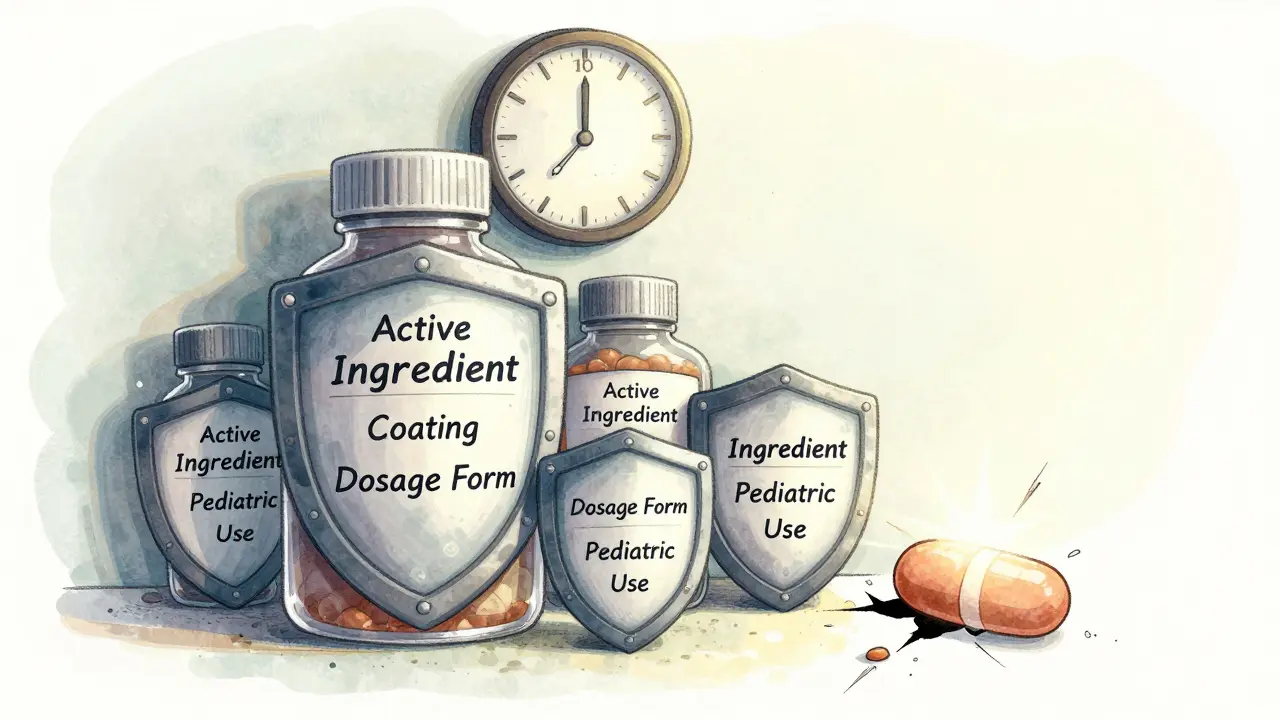
And it’s not just one patent. Most drugs have a whole family of patents: one for the active ingredient, another for the pill coating, another for how it’s made, another for how it’s used to treat a specific condition. These are called secondary patents. They’re filed years after the original - sometimes even after the drug is on the market. Each has its own 20-year clock. That’s how a drug like Spinraza (nusinersen) stays protected until 2030, even though its core patent was filed in the early 2010s.
Regulatory Exclusivity: The Hidden Timer
Even if a patent expires, that doesn’t mean generics can jump in right away. The FDA gives extra protection called regulatory exclusivity, and it’s separate from patents.
- New Chemical Entity (NCE) exclusivity: 5 years. During this time, the FDA can’t even look at a generic application.
- Orphan Drug Exclusivity: 7 years for drugs treating rare diseases (fewer than 200,000 U.S. patients).
- New Clinical Investigation Exclusivity: 3 years if the company did new studies for a new use or dosage.
- Pediatric Exclusivity: 6 months added to any existing patent or exclusivity period if the company tests the drug in children.
These aren’t optional. They’re automatic. And they stack. A drug could have 5 years of NCE exclusivity, plus 6 months of pediatric exclusivity, plus a patent extended by 4 years - meaning no generic can enter for 9.5 years after approval, even if the patent itself expired earlier.
One patient on Reddit shared how their insurance covered a brand-name drug at a $50 copay - until the pediatric exclusivity kicked in. Then, they were forced onto a generic version… with a $200 copay. Why? Because the generic wasn’t approved yet. The insurance plan had to pay for the brand - but the patient still paid more.
Patent Litigation Delays: The Legal Clock
When a generic company files an application to sell a cheaper version, they have to say whether they believe the brand’s patents are invalid or won’t be infringed. That’s called a Paragraph IV certification.
If the brand company sues within 45 days, the FDA is legally required to delay approving the generic for 30 months - unless the court rules faster. That’s called a 30-month stay.
Here’s the kicker: lawsuits take an average of 37 months to resolve. That means even if the patent expires in 2025, the generic might not be allowed on the market until 2028 - because the lawsuit is still going.
And it gets worse. The first generic company to file a Paragraph IV challenge gets 180 days of exclusive rights to sell their version before any other generic can enter. That’s why you often see one generic appear first - then a flood of others months later.
What About Biosimilars? It’s Different
Biologic drugs - like Humira, Enbrel, or Humalog - are made from living cells, not chemicals. They’re harder to copy. So instead of generics, you get biosimilars.
They don’t get the same 5-year exclusivity as small-molecule drugs. Instead, they face a 12-year exclusivity period from the date of FDA approval. That’s longer than most small-molecule drugs. But even then, companies pile on patents. Humira had 137 patents across seven patent families. Its patent cliff didn’t happen overnight - it took years for biosimilars to chip away at its market share.
And biosimilars move slower. While generics can capture 90% of the market for a small-molecule drug in 18 months, biosimilars usually hit 40-60%. Why? Because doctors and pharmacies are cautious. Insurance plans don’t always switch. And patients fear the unknown.
What’s Next? The Future of Drug Patents
There’s pressure to change the system. In 2024, a bill called the Restoring the America Invents Act was introduced to cut back on patent term adjustments. If passed, it could shorten exclusivity by 6-9 months for new drugs.
Meanwhile, the World Health Organization is pushing for global patent terms to be reduced to 15 years to improve access to medicines. The pharmaceutical industry pushes back, saying the $2.3 billion average cost to develop a drug needs that 20-year window to be recouped.
But the data shows something else: companies are already extending protection through clever tactics. Reformulations. New delivery methods. Companion diagnostics. Combination pills. AstraZeneca’s Tagrisso, for example, has its core patent expiring in 2026 - but its patent portfolio keeps protection alive until 2033.
And it’s working. In 2025, the pharmaceutical industry will lose $62 billion in revenue from patent expirations - the biggest drop in history. That’s why companies are investing heavily in patent strategy teams, legal departments, and global filing systems. The average big pharma company holds over 8,500 active patents worldwide.
What This Means for You
If you’re a patient: don’t assume your drug will become cheap when the patent expires. Check the FDA’s Orange Book - it lists every patent tied to a brand drug. Look for pediatric exclusivity or regulatory delays. Ask your pharmacist: “Is there a generic yet?”
If you’re a caregiver or insurance manager: understand that price drops don’t happen on the patent expiration date. They happen when the first generic is approved - which could be years later.
If you’re tracking drug costs: the real expiration date isn’t on the patent. It’s on the FDA’s approval date for the first generic. That’s when the real savings start.
And if you’re wondering why your prescription still costs $300 when the drug’s been on the market for 15 years - it’s not because the patent is still active. It’s because another one is.