
1
Dec
Drug Withdrawal Timeline Calculator
Enter details about a drug to calculate the time between FDA approval and withdrawal. Based on data showing the average withdrawal takes 46 months after evidence of ineffectiveness.
When a drug you’ve been taking suddenly disappears from the pharmacy shelf, it’s not just an inventory issue-it’s a safety decision. Every year, dozens of medications are pulled from the market, not because they’re outdated, but because new evidence shows they’re either unsafe or don’t work as promised. The process behind these removals is complex, slow, and sometimes dangerously delayed. In 2025, we’re still seeing the fallout from drugs approved years ago that were later proven ineffective, leaving patients exposed to harm while regulators played catch-up.
How Drugs Get Approved-And Why That’s Not the End of the Story
The FDA doesn’t approve drugs because they’re perfect. It approves them because, based on available data, their benefits outweigh their known risks. That’s a crucial distinction. For many life-threatening conditions-especially cancer, rare diseases, and neurological disorders-the FDA uses a fast-track system called accelerated approval. This lets drugs reach patients faster, based on early signs of effectiveness, like tumor shrinkage or a biomarker change, rather than waiting years to prove they actually extend life or improve quality of life. But here’s the catch: accelerated approval comes with a promise. The drugmaker must conduct a follow-up study to confirm the drug’s real-world benefit. If that study fails, the drug should be pulled. In theory, it’s a smart system. In practice, it’s been broken. Between 2010 and 2020, about 12.7% of drugs approved under this fast-track path were eventually withdrawn because they didn’t deliver on their promise. In some cases, like the small cell lung cancer drug lurbinectedin (later withdrawn), nearly 41% of eligible patients received it before the confirmatory trial proved it ineffective. That’s not a glitch-it’s a pattern.The Long Wait Between Proof and Removal
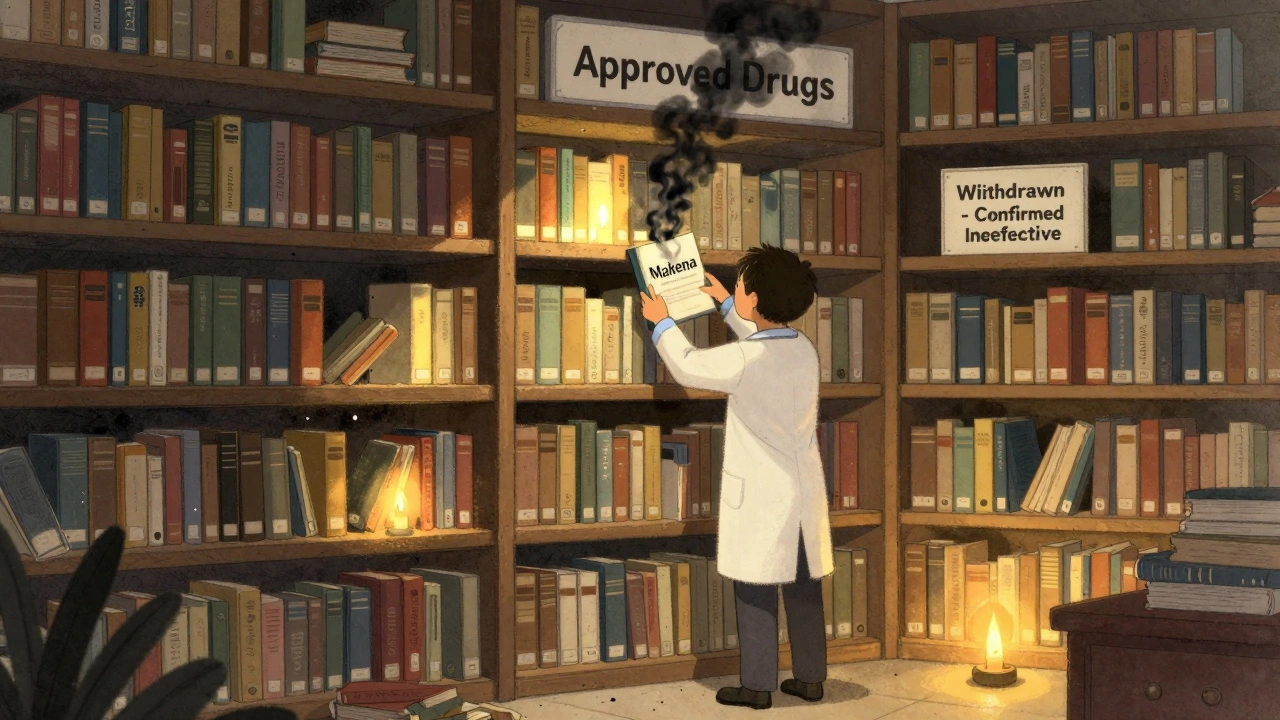
The most alarming fact about drug withdrawals isn’t that they happen-it’s how long they take. A 2023 study from the Penn LDI found that, on average, the FDA took 46 months-almost four years-to withdraw a drug after evidence showed it didn’t work. Compare that to the average approval time for these same drugs: just 207 days. That’s a 7.2-to-1 ratio. By the time the FDA acted, thousands of patients had already been treated with a drug that offered no real benefit. Take Makena, a drug approved in 2011 to prevent preterm birth in high-risk women. The approval was based on a small, flawed study. By 2020, a large, rigorous trial proved it didn’t work. But the FDA didn’t withdraw approval until 2022-over two years after the evidence was clear. During that time, an estimated 150,000 women received a treatment that did nothing but cost money and expose them to side effects. This delay isn’t just inefficient. It’s dangerous. Patients trust their doctors. Doctors trust the FDA. When a drug stays on the market after it’s been proven ineffective, that trust becomes a liability.What Changed in 2023? The New FDA Withdrawal Rules
In December 2023, Congress passed the Consolidated Appropriations Act, and with it, the FDA gained real power to act faster. For the first time, the agency has a clear, structured path to remove drugs that fail their post-approval studies. Under the new rules, the FDA can initiate withdrawal if:- The drugmaker doesn’t conduct required follow-up studies on time
- The follow-up study fails to confirm the drug’s benefit
- Independent research proves the drug is unsafe or ineffective
- The company promotes the drug with false or misleading claims
Who Gets Hurt When Drugs Stay Too Long?
The biggest victims aren’t the drug companies. They’re the patients and their families. In oncology, where accelerated approval is most common, about 30% of patients treated with fast-tracked drugs between 2015 and 2020 received therapies later withdrawn. One patient on a breast cancer forum wrote: “I was on [withdrawn drug] for 18 months before the trial failed. My oncologist said it was standard of care. Now I know it didn’t help.” That’s not an outlier-it’s a common story. Healthcare providers are caught in the middle. Pharmacists struggle to interpret the FDA’s Orange Book, which tracks which drugs are approved, withdrawn, or no longer eligible as reference products. A 2022 survey found 63% of pharmacists had trouble understanding whether a withdrawn drug could still be used as a benchmark for generics. Doctors, meanwhile, are often left guessing whether a drug they prescribed is still safe. And then there’s the emotional toll. Reddit threads like “How many of you have been on drugs later withdrawn?” have hundreds of comments, mostly from people scared they were given a treatment that didn’t work. The fear isn’t just about side effects-it’s about wasted time, false hope, and the feeling that the system failed you.How Withdrawals Work: Voluntary vs. Mandatory
Not all withdrawals are forced. Sometimes, a company decides to pull a drug on its own-usually because sales are low, or the cost of maintaining the drug outweighs the benefit. These are called voluntary withdrawals and are covered under 21 CFR 314.161. But when the FDA steps in, it’s a mandatory withdrawal, governed by 21 CFR 314.150. This happens when the agency determines the drug is unsafe or ineffective. The key difference? Voluntary withdrawals can be for business reasons. Mandatory withdrawals are about public health. The FDA’s guidance from 2018 clarifies that a temporary supply shortage doesn’t count as a withdrawal unless it’s due to safety or effectiveness concerns. That’s important-because in the past, companies would quietly stop shipping a drug, and the FDA wouldn’t act unless patients started reporting harm. Now, the agency is expected to act even if no one complains.



Carolyn Woodard
December 3, 2025 AT 03:58The accelerated approval pathway always felt like a Faustian bargain: speed at the cost of certainty. We trade longitudinal outcomes for early biomarkers, and then wonder why patients are left hanging. The 46-month lag between evidence and action isn’t bureaucratic inefficiency-it’s institutional betrayal. We’ve normalized this delay as ‘necessary risk,’ but when 30% of oncology patients receive withdrawn therapies, that’s not risk-it’s systemic negligence.
What’s more troubling is how little we interrogate the surrogate endpoints themselves. Tumor shrinkage isn’t survival. Biomarker modulation isn’t quality of life. And yet, we’ve built entire regulatory architectures on these proxies. The new 12-month target for withdrawal is a start, but we need to redesign the approval framework from the ground up-not just tighten the screws on the old one.
Real-world evidence from Flatiron Health is promising, but only if it’s integrated prospectively, not retrospectively. Otherwise, we’re just collecting post-mortems instead of preventing harm.
And let’s not pretend the industry’s motives are pure. Companies exploit accelerated approval not to save lives faster, but to lock in market exclusivity before the confirmatory data even begins to roll in. The financial incentives are misaligned, and until we restructure them, this cycle will repeat.
The emotional toll on patients? That’s the silent epidemic. No one talks about the guilt patients feel when they realize they spent 18 months on a treatment that did nothing. It’s not just physical-it’s existential. We’ve turned hope into a commodity, and then sold it with a FDA seal.
I don’t blame doctors. They’re working with flawed tools. But we’ve made them complicit by giving them incomplete information. The Orange Book is a labyrinth. Withdrawal notices lack transition timelines. How can we expect frontline providers to navigate this without drowning?
The real reform isn’t in the 180-day window. It’s in requiring companies to publish interim results from confirmatory trials publicly, in real time. Transparency isn’t optional. It’s the only thing that can restore trust.
And yes-I’m aware this sounds like a policy white paper. But when patients are the data points, you stop writing for regulators. You write for the people who trusted you to keep them safe.
Allan maniero
December 3, 2025 AT 07:23Look, I’ve been in this game for 25 years-pharma, academia, you name it-and the whole accelerated approval thing was always a band-aid on a bullet wound. The FDA’s got to approve something fast because people are dying, sure, but then we just… leave it out there? For years? Like a forgotten toaster in the garage? It’s not just the delays-it’s the silence after the trial fails. No public announcement, no ‘hey, this thing you’ve been taking? It doesn’t work.’ Just… nothing. Until someone finally digs up the data and the media picks it up.
And then what? The company quietly stops shipping. The pharmacy stops ordering. The doctor’s office gets a vague email. And the patient? They’re left wondering if their cancer came back because the drug failed… or because they gave up hope too soon.
The new rules are a step. A tiny one. But at least now there’s a clock. Before, it was like waiting for a reply from a ghost. Now, there’s a deadline. Even if it’s 180 days, that’s something. Still, I worry we’re fixing the paperwork and not the mindset. We still treat drug approval like a finish line, when it’s really just the starting gate.
Also, Makena? That whole saga still makes me sick. 150,000 women. All told it was ‘standard of care.’ Standard of care for what? A placebo with side effects? We’ve got to stop letting ‘tradition’ override evidence. Even if the tradition is 11 years long.
Zoe Bray
December 5, 2025 AT 01:37The regulatory framework governing accelerated approval and subsequent withdrawal represents a profound tension between therapeutic innovation and evidentiary rigor. The FDA’s invocation of 21 CFR 314.150 to initiate mandatory withdrawal upon failure of post-marketing confirmatory trials is a necessary corrective mechanism within the broader pharmacovigilance architecture. However, the temporal disjunction between the initiation of accelerated approval (mean: 207 days) and the execution of withdrawal (mean: 46 months) constitutes a critical vulnerability in the risk-benefit calculus, wherein patient exposure to non-beneficial therapeutics is prolonged beyond ethically defensible thresholds.
The introduction of a dedicated Accelerated Approval Withdrawal Team, operationalized under the Consolidated Appropriations Act of 2023, signals institutional recognition of this asymmetry. Nevertheless, the continued reliance on surrogate endpoints-such as tumor response rate or biomarker modulation-as primary bases for approval remains methodologically precarious. The integration of real-world evidence via Flatiron Health is a promising development, yet its scalability and methodological standardization remain unproven.
Furthermore, the absence of mandatory public disclosure of interim confirmatory trial data by sponsors undermines transparency and impedes clinician decision-making. The Orange Book’s opacity, as noted in the 2022 pharmacist survey, reflects a systemic failure in information architecture. Until regulatory communications are rendered machine-readable, standardized, and temporally synchronized with clinical practice workflows, provider compliance will remain fragmented and reactive.
The ethical imperative is clear: the presumption of efficacy must be replaced by the obligation of ongoing validation. Withdrawal is not punishment-it is epistemic responsibility.
Girish Padia
December 5, 2025 AT 23:00These drug companies are just playing the system. They get approval fast, make billions, then when the trial fails? They just shrug and say ‘oops.’ Meanwhile, regular people waste months, years, even their last hope on garbage medicine. And the FDA? Sitting on their hands for four years? That’s not oversight-that’s corruption with a badge.
They don’t care about patients. They care about stock prices. And we let them. We let them because we’re too lazy to ask questions. You think your doctor knows? Nah. He’s just reading the label like everyone else.
And now they’re gonna make it faster? Good. But they should shut the whole thing down until they can prove a drug works before they sell it. Not after. Not ‘maybe.’ Not ‘we’ll check later.’
It’s not innovation. It’s exploitation.
Sandi Allen
December 6, 2025 AT 23:03THIS IS A SCAM. A FULLY-ORGANIZED, MULTI-BILLION-DOLLAR SCAM. THE FDA ISN’T PROTECTING YOU-IT’S PROTECTING PHARMA. THEY’RE LETTING DRUGS ON THE MARKET ON PURPOSE-KNOWING THEY WON’T WORK-SO THEY CAN MAKE MONEY WHILE THEY WAIT FOR THE ‘CONFIRMATORY TRIAL’… WHICH THEY’LL DELAY ON PURPOSE WITH BUREAUCRATIC GARBAGE. AND THEN-WHEN THEY FINALLY GET AROUND TO WITHDRAWING IT-THEY ACT LIKE THEY’RE HEROES?!
THEY’RE USING ‘ACCELERATED APPROVAL’ AS A BACKDOOR TO SELL PLACEBOS. AND THE ‘REAL-WORLD EVIDENCE’ PILOT? THAT’S JUST A SMOKE SCREEN. THEY’RE STILL USING THE SAME BROKEN SYSTEM-JUST WITH A NEW NAME.
YOU THINK THE ‘WITHDRAWAL TEAM’ IS REALLY GOING TO ACT FAST? THEY’RE ALL PART OF THE SAME SYSTEM THAT LET MAKENA STAY ON THE SHELF FOR 11 YEARS. THEY’RE NOT REFORMERS-THEY’RE PART OF THE PROBLEM.
THEY’RE LYING TO YOU. AND THEY’RE LYING TO YOUR DOCTOR. AND THEY’RE LYING TO YOUR PHARMACIST.
AND IF YOU’RE STILL TAKING ANY DRUG APPROVED UNDER ‘ACCELERATED APPROVAL’… YOU’RE A LAB RAT.
DO YOUR OWN RESEARCH. OR DIE QUIETLY.
Shubham Pandey
December 8, 2025 AT 01:59So drugs get pulled after 4 years? That’s just… sad. And expensive. And pointless.
Why not just require the confirmatory trial before approval? Simple. Done.
But then pharma wouldn’t make money as fast.
There it is.
Elizabeth Farrell
December 9, 2025 AT 11:48I’ve been reading through this whole post, and honestly, it’s made me feel a lot less alone. I was on one of those withdrawn drugs for nearly two years-breast cancer, stage 3. My oncologist said it was ‘the best we had.’ I believed him. I didn’t know it hadn’t been confirmed. I didn’t know it was still under review. I thought I was doing everything right.
When I found out it didn’t work, I didn’t get angry at my doctor. I got angry at the system. Because he was just trusting the same system I was. And that’s the tragedy here: everyone’s trying to do the right thing, but the system is broken.
I’m so glad the FDA is finally moving faster. And I’m especially glad they’re using real-world data now. That’s huge. Because we’re not just numbers in a trial-we’re people with lives, families, fears.
To anyone reading this who’s on a fast-tracked drug: ask your doctor about the confirmatory trial status. It’s okay to ask. You deserve to know. And if they don’t know? That’s not your fault. That’s the system’s failure.
We’re not powerless. We just need to speak up. And now, maybe, someone’s finally listening.
Thank you for writing this. I needed to hear it.
ruiqing Jane
December 10, 2025 AT 12:23The 46-month delay in withdrawal is indefensible. The FDA’s new 180-day timeline is a moral baseline-not an achievement. Every day a known ineffective drug remains on the market is a day of preventable harm. The fact that 30% of patients on accelerated approvals received withdrawn therapies between 2015–2020 is not a statistical anomaly-it is a public health failure of epic proportions.
Pharmaceutical companies must be held to the same evidentiary standard as academic researchers: publish or perish. If they cannot complete confirmatory trials within 24 months of accelerated approval, their license should be suspended automatically. No exceptions. No extensions. No lobbying.
The Orange Book must be redesigned as a real-time, API-accessible public database with color-coded withdrawal status, transition guidance, and patient advisories. Pharmacists should not be forced to interpret regulatory legalese. This is not a documentation problem-it is a patient safety imperative.
Real-world evidence from Flatiron Health is promising, but only if it is mandated, standardized, and integrated into the approval lifecycle from Day One-not as an afterthought.
And to the patients: you were not foolish for trusting. The system betrayed you. But now, it has the tools to redeem itself. We must demand it uses them.