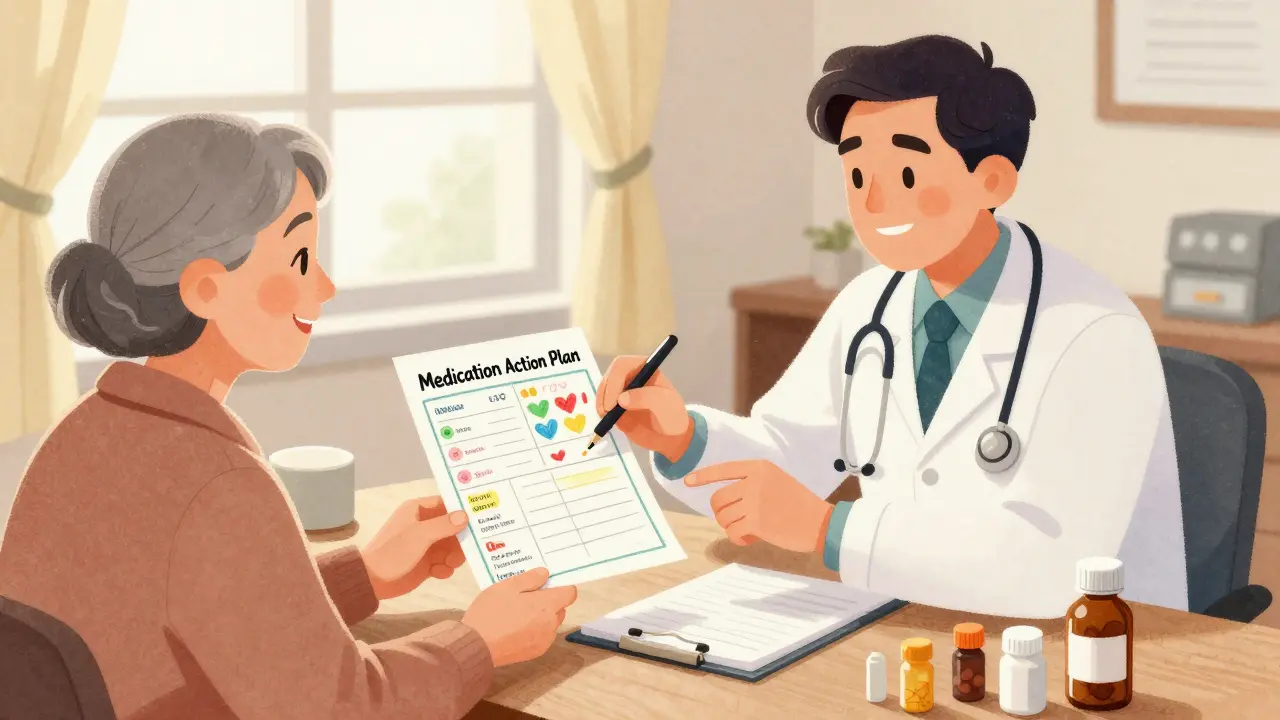
Bringing a medication action plan to your doctor’s visit isn’t just paperwork-it’s a lifeline. Too many people leave appointments confused about what pills to take, when, or why. Some even end up with dangerous drug overlaps or missed doses because no one took the time to line up the facts. A simple, filled-out Medication Action Plan (MAP) changes that. It turns vague memories into clear instructions, and silence into conversation.
What Exactly Is a Medication Action Plan?
A Medication Action Plan is a standardized form that tracks your medications, goals, side effects, and next steps. It’s not just a list of pills. It’s a living document designed for use during every visit-with space for your provider to write down changes, and for you to note what you actually did at home. It’s required in Medicare Part D Medication Therapy Management programs, and used across Germany since 2016 under national law. The template includes specific sections: What we talked about, What I need to do, What I did and when I did it, and My follow-up plan. It must be signed by both you and your provider to be valid. The goal? Reduce errors. Studies show that when patients use a MAP, they’re 87.5% more likely to find critical info on their first try. Adverse drug events drop by up to 23%. Medication discrepancies fall by over 40% during care transitions. This isn’t theory-it’s proven.What Belongs in the Template?
Not all templates are identical, but the best ones include these non-negotiable elements:- Your full name and date of birth
- Date the plan was last updated
- Provider name, phone, and clinic address
- Full list of all medications: prescription, over-the-counter, vitamins, supplements
- Each drug’s dose, frequency, and reason for taking it (e.g., "Lisinopril 10mg once daily for high blood pressure")
- Start and stop dates for every medication-exact dates, not just "last month"
- Side effects you’ve noticed
- Any symptoms that trigger as-needed meds (e.g., "Take ibuprofen if headache is moderate or worse, no more than twice a day")
- Clear action steps: "Take metformin with breakfast and dinner starting tomorrow"
- Questions you want to ask
- Follow-up date and who to contact
How to Prepare Before Your Visit
Don’t show up with a blank form or a crumpled list from your purse. Preparation makes the difference.- Get your current MAP from your pharmacist or provider. If you don’t have one, ask for the CMS1245776 template-it’s the official standard.
- Collect every pill bottle, patch, inhaler, or cream you’re using. Bring them all. Research shows this improves accuracy by 37.2% compared to relying on memory.
- Cross out any meds you stopped taking. Write the date and reason: "Stopped simvastatin on 12/15/2025 due to muscle pain."
- Write down any side effects you’ve had since your last visit-even if you think they’re unrelated.
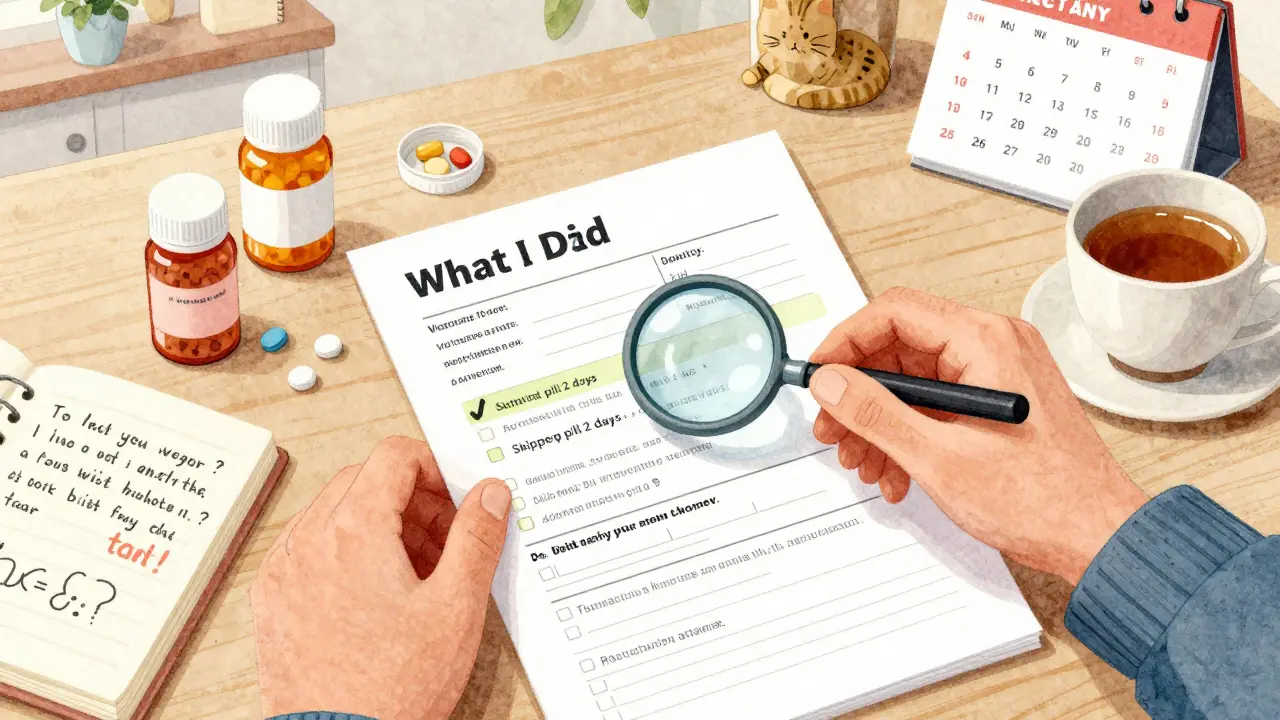
- Fill out the "What I did and when I did it" section honestly. Did you skip your blood pressure pill for two days because you ran out? Say so.
- Write down 2-3 questions you want answered. Use the "Questions I want to ask" box. Examples: "Why did you take me off the old heart pill?" or "Can I cut this tablet in half?"
What Happens During the Visit
The first 5-7 minutes of your appointment should be about your MAP. Don’t let your provider skip this.- Hand them your MAP and your pill bottles.
- Ask them to go through the "What we talked about" section with you. Make sure they write down what was discussed-like "Switched from furosemide to torsemide due to low potassium."
- Watch as they update your medication list. They should cross out discontinued drugs with a line and write the stop date. Add new ones with start dates.
- Review the "What I need to do" section together. If it says "Take insulin as directed," ask them to rewrite it: "Inject 10 units of Lantus at bedtime every night."
- Discuss high-risk meds. If you’re over 65, make sure they check for drugs that cause dizziness or confusion-like certain antihistamines or sleep aids.
- Ask them to sign and date the form. A signed plan is legally recognized in Medicare MTM programs.
After the Visit: Keep It Alive
Your MAP isn’t done when you leave the office. It’s only useful if you keep it current.- Take a photo of the updated form or ask for a printed copy. Keep it in your wallet, purse, or phone.
- Give a copy to a family member or caregiver. If you end up in the ER, they’ll have the full picture.
- Update it after every new prescription-even if it’s from a specialist or urgent care.
- If you refill a med and the label says something different than your MAP, call your pharmacist. Don’t assume it’s right.
- Check your MAP before every visit. Add new symptoms, side effects, or changes in routine.
Common Mistakes and How to Avoid Them
Even with good intentions, people mess up. Here’s what goes wrong-and how to fix it.- Mistake: Not writing stop dates. Fix: Always write the exact date you stopped a med. "Stopped in June" isn’t enough. "Stopped 6/15/2025" is.
- Mistake: Using brand names only. Fix: Write both: "Lisinopril (Zestril) 10mg daily." Pharmacists need the generic to avoid errors.
- Mistake: Keeping it in a drawer. Fix: Keep it where you can grab it fast-wallet, phone case, taped to the fridge.
- Mistake: Not updating after hospital stays. Fix: Every hospital discharge comes with a new med list. Update your MAP the same day you get home.
- Mistake: Ignoring health literacy. Fix: If the form is too complex, ask for a simplified version. Many clinics now offer pictorial or large-print templates.

Why This Matters More Than You Think
Medication errors are the leading cause of preventable harm in healthcare. In the U.S., they send over 700,000 people to the ER every year. A 2023 report from the Patient Safety Movement Foundation says consistent MAP use could prevent 150,000 of those annually. It’s not just about safety. It’s about control. When you know exactly what you’re taking and why, you stop feeling helpless. You become a partner in your care. Dr. Jerry Fahrni from the National Association of Chain Drug Stores says the MAP is "the single most effective intervention in reducing medication-related hospitalizations." And Dr. Sarah Spinler says plans with specific, time-bound actions lead to 2.3 times better adherence. This isn’t about filling out a form. It’s about speaking up, staying informed, and demanding clarity.What If Your Provider Doesn’t Use a MAP?
Some doctors still don’t use them. That doesn’t mean you shouldn’t. Bring your own printed MAP anyway. Say: "I use this to keep track of my meds. Can we update it together?" Most will be glad you did. If they resist, ask: "Is there a standard form you use for medication reviews?" If they say no, ask for one. You have the right to a clear plan. Many clinics are still struggling with EHR integration-28.6% can’t easily add MAPs to their systems. But your paper version still works. Keep it. Update it. Use it.Final Thought: Your Life, Your Plan
Your medications are part of your story. Not a list on a slip of paper. Not a note in a chart you never see. They’re what keep you walking, breathing, sleeping, living. A Medication Action Plan puts you in charge. It turns confusion into clarity. Silence into partnership. Risk into safety. Start today. Get your template. Fill it out. Bring it next time. And don’t let anyone tell you it’s "just paperwork." It’s your lifeline.What should I do if I lose my Medication Action Plan?
Contact your pharmacist or primary care provider and ask for a new copy. Most clinics keep digital records of your last updated plan. If you’re on Medicare Part D, your MTM pharmacist is required to provide a copy upon request. In the meantime, write down all your current meds, doses, and reasons on a piece of paper-bring it to your next appointment and ask them to turn it into a formal plan.
Can I use a digital app instead of a paper template?
Some apps can help track meds, but they’re not a replacement for the official Medication Action Plan. Most digital tools don’t include the required sections like provider signatures, exact stop dates, or structured action steps. For Medicare MTM programs and insurance purposes, the paper-based CMS1245776 template is still the standard. Use an app as a helper, but keep a printed, signed MAP as your official record.
Do I need to update my MAP if I get a new prescription from an urgent care clinic?
Yes. Every new medication, even if it’s short-term or from a different provider, should be added to your MAP. Write the name, dose, reason, start date, and how long you’re supposed to take it. If you’re unsure, call your main doctor or pharmacist within 24 hours to confirm. Many medication errors happen because new prescriptions aren’t added to the central plan.
Why do I need to bring my pill bottles to the appointment?
Because your memory-and even your pharmacy label-can be wrong. Bottles show the exact name, strength, and instructions as prescribed. Many patients think they’re taking one thing, but the bottle says another. Bringing bottles reduces errors by 37.2%. It also helps your provider spot expired meds, wrong doses, or pills that don’t match your list.
What if I can’t read or understand the MAP?
Ask for help. Many clinics offer simplified versions with larger fonts, pictures, or color-coded boxes. You can also ask a family member, friend, or pharmacist to go over it with you. The goal isn’t to fill out a form-it’s to understand your treatment. If you don’t understand it, you can’t use it safely. Providers are required to make accommodations for low health literacy under federal guidelines.