
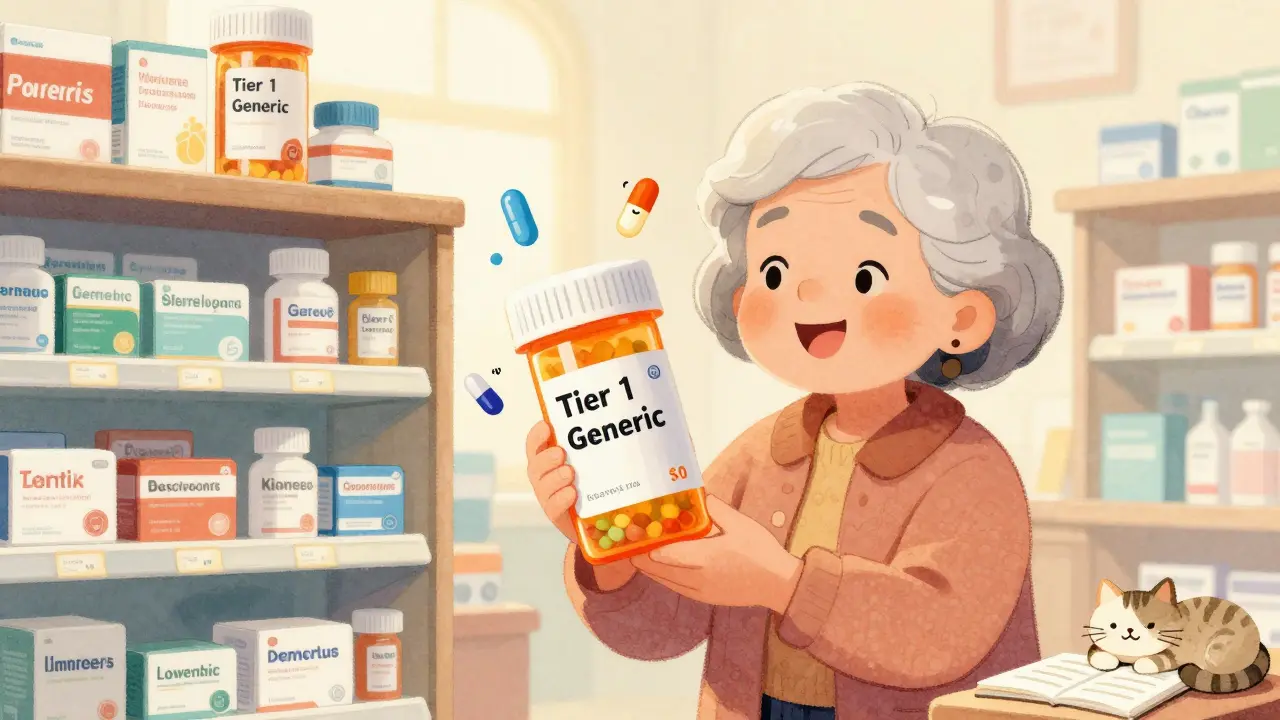
When you’re on Medicare and need prescription drugs, understanding how generic coverage works in Part D can save you hundreds - even thousands - of dollars each year. Most people don’t realize that nearly 92% of all prescriptions filled under Medicare Part D are for generic drugs. That’s not just a statistic; it’s your key to lower costs. But knowing generics are cheaper isn’t enough. You need to know how the system is built, where your drugs fall, and what changes in 2025 mean for your wallet.
How Medicare Part D Formularies Are Structured
Every Medicare Part D plan has a formulary - a list of drugs it covers. This isn’t random. It’s carefully organized into five tiers, and generics are placed where they make the most financial sense: the bottom two tiers.
Tier 1 is for preferred generics. These are the most commonly used, lowest-cost versions of brand-name drugs. Think of them as the go-to options your plan wants you to use. A 30-day supply here usually costs $0 to $15. Tier 2 is for non-preferred generics. These are still generics, but they might be newer, less commonly prescribed, or slightly more expensive. You’ll pay more here - anywhere from 25% to 35% of the drug’s cost, or a fixed copay up to $40.
By contrast, brand-name drugs start on Tier 3, and specialty drugs (even if they have generic versions) land on Tier 5, often costing over $100 per month. The system pushes you toward the cheapest effective option. And for most people, that’s a generic.
What Changed in 2025 - The $2,000 Cap
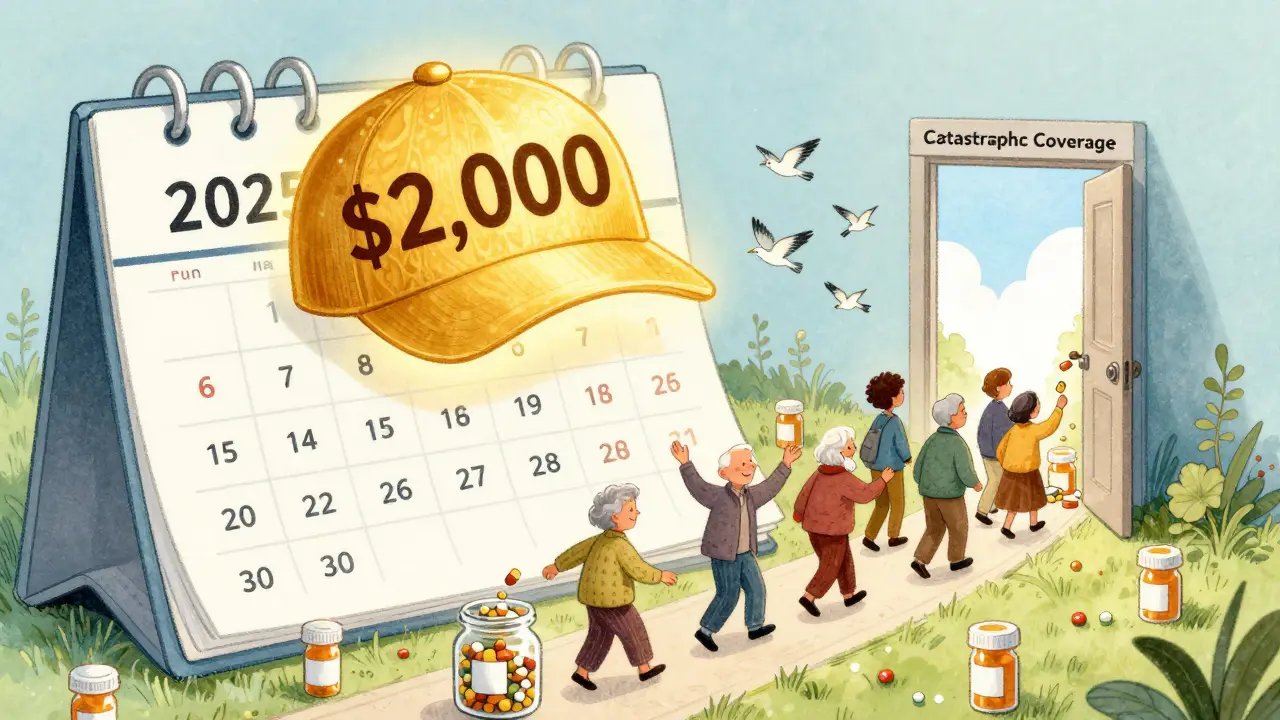
Before 2025, there was a big gap in coverage called the "donut hole." Once you spent a certain amount on drugs, you paid 100% out of pocket until you hit a higher threshold. That’s gone. Thanks to the Inflation Reduction Act, as of January 1, 2025, your total out-of-pocket spending on all drugs - including generics - is capped at $2,000 per year.
Here’s how it works: You pay 25% coinsurance on generics during the initial coverage phase. That means if a generic costs $100, you pay $25. Your plan pays the other $75. This continues until you’ve paid $2,000 in total out-of-pocket costs. Once you hit that number, you enter catastrophic coverage - and for the rest of the year, you pay nothing. Zero. Not even a copay.
This change is huge. Before, someone taking multiple generics could easily hit the donut hole and end up paying hundreds of dollars a month. Now, once you’ve paid $2,000, your drugs are free. That’s not just a policy tweak - it’s a financial reset for millions.
Why Generics Cost So Much Less
Generic drugs aren’t just cheaper because they’re "copycats." They’re cheaper because they don’t need to pay for research, marketing, or patent protection. Once a brand-name drug’s patent expires, other manufacturers can make the same medicine. The FDA requires them to prove they’re identical in strength, safety, and effectiveness.
That’s why 92% of prescriptions are generics - but they only account for 18% of total Part D spending. In 2024, Part D spent $185 billion on drugs. Generics made up $33.3 billion of that. The rest went to brand-name drugs, even though they were prescribed far less often.
And here’s the kicker: when you pay for a brand-name drug, 70% of the cost (including manufacturer discounts) counts toward your $2,000 out-of-pocket cap. But for generics, only your actual payment counts. That means generics help you reach the cap faster - and get to free drugs sooner.
What You Need to Do Every Year
Your plan’s formulary can change every year. A drug that was on Tier 1 last year might move to Tier 2. Or worse - it might be removed entirely. That’s why you can’t just enroll once and forget it.
Each fall, you’ll get an Annual Notice of Change (ANOC). Read it. If a drug you take is being moved to a higher tier or dropped, you have options. You can switch plans during the Annual Enrollment Period (October 15 to December 7). Or you can request a formulary exception - a formal appeal to keep your drug covered.
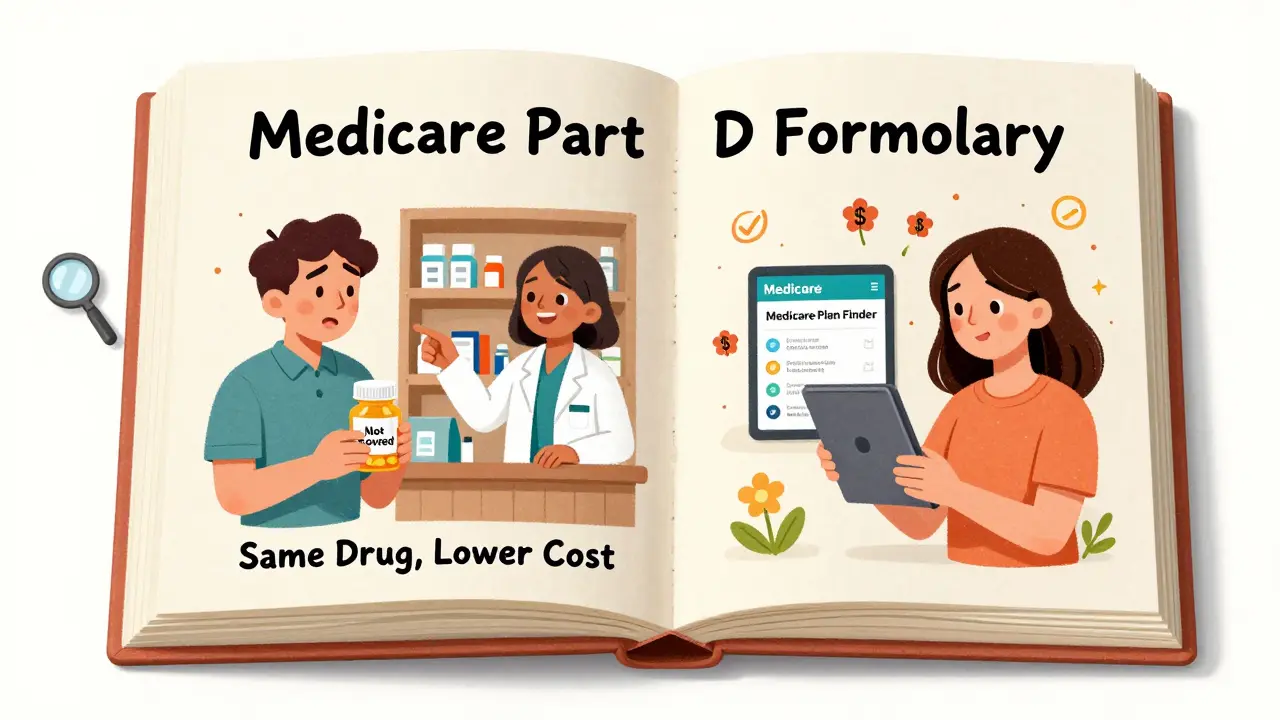
Use the Medicare Plan Finder tool. Type in your exact medications - not just the name, but the dose and form (tablet, capsule, etc.). Compare plans side by side. KFF found that 61% of people who do this save an average of $427 a year. That’s not a guess - that’s real money.
Common Problems and How to Fix Them
Not everything is smooth. Here are the top three issues people run into:
- Your pharmacist substituted a different generic. Just because two drugs are "therapeutically equivalent" doesn’t mean your plan covers both. If your plan covers only one generic for blood pressure, and your pharmacist gives you another, you might pay full price. Always ask: "Is this the version my plan covers?"
- Your plan doesn’t cover a generic you need. If your doctor prescribes a generic that’s not on your formulary, you can file a coverage determination. In 2023, 83% of these requests were approved. Don’t assume you’re stuck - ask.
- You’re confused about tiers. If you’re on multiple generics, you might be paying different amounts each month. Use your plan’s online portal. Most now have a "Drug Cost Estimator" tool. Plug in your meds and see exactly what you’ll pay.
One user on Reddit said they were charged $120 for a generic heart medication because their plan only covered a different version. Another said their three generics cost $0 thanks to Tier 1 coverage - saving them $300 a month. The difference? Knowing the system.
What’s Coming Next
The changes aren’t over. Starting in 2026, Part D plans must include a "generic price comparison tool" in their member portals. That means you’ll be able to see, right in your account, which generic version of your drug costs the least - even if it’s not the one your doctor prescribed.
In 2029, the government will start negotiating prices for certain generics. Insulin glargine (the generic version of Lantus) is already on the list. That could bring prices down even further.
And by 2027, experts predict 95% of Part D beneficiaries will have access to $0 copays for at least half of their commonly used generics. That’s not a dream - it’s the direction the system is heading.
Key Takeaways
- Generics make up 92% of Part D prescriptions - and only 18% of spending.
- Tier 1 generics usually cost $0-$15; Tier 2 can cost 25-35% coinsurance.
- The $2,000 out-of-pocket cap in 2025 means once you hit it, your drugs are free for the rest of the year.
- Only your actual payments count toward the cap for generics - not manufacturer discounts.
- Review your plan’s formulary every fall. Use the Medicare Plan Finder to compare.
- If a drug isn’t covered, request a coverage determination - 83% of requests are approved.
Are all generic drugs covered under Medicare Part D?
Almost all FDA-approved generics are covered, but not every single one. Plans must cover at least two generics in each therapeutic class, and they must include 100% of generics in six protected drug classes (like antidepressants and antiretrovirals). But plans can exclude generics for weight loss, fertility, or cosmetic use. Always check your plan’s formulary before enrolling.
Why does my plan cover one generic but not another for the same condition?
Plans choose which generics to cover based on cost and clinical effectiveness. Even if two generics are chemically identical, one might be cheaper to purchase. Your plan might cover only the lowest-cost option to keep premiums down. If you need a different generic, you can request a formulary exception - and you have a good chance of approval.
Do generic drugs work the same as brand-name drugs?
Yes. The FDA requires generics to have the same active ingredient, strength, dosage form, and route of administration as the brand-name drug. They must also meet the same quality and safety standards. The only differences are inactive ingredients (like fillers or dyes) and cost. For most people, generics work just as well - and often better, because they’re more affordable.
Can I switch plans if my generic drug is removed from the formulary?
Yes. If your plan removes a drug you’re taking, you’ll get an Annual Notice of Change. You can switch to another plan during the Annual Enrollment Period (October 15-December 7). In some cases, you may qualify for a Special Enrollment Period if your drug is removed mid-year - but you’ll need to act quickly.
How do I find out which tier my generic drug is on?
Log in to your plan’s website and use their formulary search tool. You can also call the customer service number on your card and ask for the tier placement. The Medicare Plan Finder tool also shows tier information when you enter your medications. Don’t guess - check it every year.
Philip Blankenship
February 17, 2026 AT 18:36Man, I’ve been on Medicare for five years now and I just figured out last month that generics are the secret weapon. I was paying $80 for my blood pressure med until I switched to the Tier 1 version - now it’s $3. No joke. My dog costs more than my meds. I didn’t even know my plan had a cost estimator tool until I stumbled on it. Why don’t they advertise this stuff? Everyone’s out there buying expensive brand-name drugs like they’re still in 2015.
James Lloyd
February 19, 2026 AT 18:34The $2,000 out-of-pocket cap is the most underappreciated policy change since the ACA. People still think the donut hole is a thing - it’s not. Once you hit $2k, you’re done. Zero coinsurance. Zero copays. And here’s the kicker: if you’re on multiple generics, you’ll hit that cap by August. I know a woman on four different generics - she hit the cap in June. Her entire drug bill for July and August? $0. This isn’t just savings - it’s financial liberation. The system works if you understand it. And most people don’t.
Linda Franchock
February 21, 2026 AT 03:30So let me get this straight - you’re telling me I can get my diabetes meds for free after paying $2,000? And the government’s gonna start negotiating generic prices in 2029? Sounds like socialism with a side of common sense. I don’t care what anyone says - this is how healthcare should work. No more ‘my drug isn’t covered’ nonsense. If it’s FDA-approved, it should be affordable. End of story.
Tony Shuman
February 23, 2026 AT 02:57Oh wow, another one of those ‘Medicare is great’ propaganda pieces. You know what’s really happening? Pharma companies are just shifting their profits to generics because they know the cap is coming. They’re not lowering prices - they’re just letting you pay less upfront so you don’t realize how much they’re still charging the system. And don’t get me started on how they game the formularies. They want you to think you’re saving money - you’re just being funneled into cheaper drugs that still cost the program a fortune. This isn’t reform - it’s redistribution with a smiley face.
Geoff Forbes
February 23, 2026 AT 21:45Yall are missing the point. I’ve been on 3 generics for 8 years. My plan dropped one last year. I filed a coverage exception. Got denied. Filed again. Got denied. Third time? They approved it - but only after 3 months without meds. That’s not a system. That’s a nightmare. And now they want us to believe this $2k cap is magic? What if you’re on 12 meds? What if you’re on chemo? What if your doctor prescribes a non-preferred generic because it’s better for your kidneys? You’re still screwed. This isn’t helping - it’s just making people feel better while the real problems stay buried.
Jonathan Ruth
February 24, 2026 AT 17:4092% of prescriptions are generics 18% of spending that’s the whole damn point. Why are we even talking about this like it’s a mystery? It’s math. If 92% of the pills are cheap and only 18% of the money is spent on them then the system is working. The problem isn’t the system - it’s people who think brand-name drugs are better. They’re not. They’re just more expensive. And the FDA doesn’t lie. If your generic doesn’t work - you’re imagining it. Or you’re one of those people who thinks aspirin from Walmart is poison because it’s not in a fancy bottle.
Agnes Miller
February 25, 2026 AT 04:30OMG I just realized I’ve been paying $40 for my thyroid med when it’s on Tier 1? I’ve been doing this for 6 years. I’m so mad at myself. I didn’t even know my plan had a cost tool. I just assumed the pharmacist knew what I was supposed to pay. I called them today - they said I could switch to the cheaper version anytime. I’m doing it tomorrow. This post saved me like $500 a year. Thank you. Seriously. I didn’t even know I was being overcharged.
Haley DeWitt
February 26, 2026 AT 03:04Yessssss!! I’ve been telling my mom this for years 😭 She was paying $110/month for a generic that’s now $0. She cried when I showed her the Medicare Plan Finder. I literally printed out the comparison and taped it to her fridge. She’s now a convert. Also - I used the emoticon tool to check my dad’s meds. He’s on 5 generics. Total monthly cost? $12. Before? $320. I’m not joking. This is the most important thing I’ve ever done for my family. ❤️🙏
guy greenfeld
February 26, 2026 AT 16:09Let’s be honest - this isn’t about savings. It’s about control. The government doesn’t care if you pay less. They care if you stop asking questions. Why are there only two generics covered per class? Why can’t you choose the one your doctor recommends? Why do they hide the cost estimator behind 3 logins and a password reset? This isn’t reform - it’s a distraction. They want you to think you’re winning while the real costs get shifted to premiums, deductibles, and provider networks. The $2,000 cap? It’s a trap. You think you’re free - but you’re just one step deeper into the machine.
Adam Short
February 28, 2026 AT 04:04They’re not talking about the real issue - the fact that American generic manufacturers are now outsourcing production to China and India. The FDA inspects 1% of facilities. One percent. That’s not oversight - that’s negligence. You think your $3 generic is safe? It was made in a factory with 300 people working in a room with no air filtration. I’ve seen the reports. This isn’t healthcare. It’s a global lottery. And we’re all playing.
Prateek Nalwaya
March 1, 2026 AT 12:00As someone from India where generics are the backbone of healthcare, I find this fascinating. Here, we’ve been using generics for decades - affordable, accessible, trusted. It’s not magic. It’s just smart policy. The U.S. system is finally catching up. The real win isn’t the $2,000 cap - it’s the cultural shift. People are starting to believe that cheap doesn’t mean bad. That’s huge. And the fact that 83% of exceptions get approved? That’s not bureaucracy - that’s compassion. We need more of this. Not less.
John Haberstroh
March 2, 2026 AT 01:12Here’s what nobody says: The real savings come from knowing which tier your drug is on - and switching to the exact same drug in a different form. Like, my asthma inhaler is $45 on Tier 2 - but the same exact drug in a different brand is $0 on Tier 1. Same active ingredient. Same dosage. Different packaging. My pharmacist didn’t even know. I had to dig into the formulary myself. It’s like a treasure hunt. And the best part? You don’t need a doctor’s note. Just ask. It’s legal. It’s safe. And it’s free. Why isn’t this on TV?
Logan Hawker
March 3, 2026 AT 12:31Let me break this down for you, because clearly, you’ve all missed the nuance. The formulary structure is a classic example of behavioral economics - nudge theory in action. By placing preferred generics on Tier 1, plans exploit loss aversion and default bias. You’re not choosing cheaper drugs - you’re being herded into them. And the $2,000 cap? It’s a psychological anchor. It makes you feel like you’re hitting a milestone - when in reality, it’s just a fiscal reset designed to reduce administrative friction. The real winners? The PBMs. They’re the ones negotiating the rebates. You? You’re just the bait.
Carrie Schluckbier
March 4, 2026 AT 00:19They’re lying. I know this. I’ve seen the documents. The $2,000 cap? It’s a lie. They’re counting manufacturer discounts as part of your out-of-pocket - but only for brand-name drugs. For generics? Only your payment counts. So if you’re on a brand-name drug, you get help reaching the cap faster. But if you’re on generics? You’re on your own. That’s not fairness. That’s discrimination. And they’re hiding it behind ‘transparency.’ Wake up. This isn’t healthcare reform - it’s a financial trap for the elderly.
Digital Raju Yadav
March 5, 2026 AT 17:04Why are you all so happy? This is a scam. The U.S. government is forcing Medicare to pay less for generics so they can redirect the savings to defense contractors. I’ve seen the budget reports. The $185 billion spent on Part D? $33 billion went to generics. The rest? Went to lobbyists, consultants, and private equity firms buying up pharmacies. You think you’re saving money? You’re just funding the same system that’s been stealing from you for 20 years. The cap isn’t freedom - it’s a distraction. They want you to stop asking why your insulin still costs $500.