Vaccination Readiness Checklist
Use this interactive checklist to prepare for your appointment. Select your medication type to customize your safety steps.
Quick Facts for Your Next Appointment
- It is safe: Anticoagulants are not a reason to skip vaccines.
- Tell your provider: Always mention your medication before the needle touches your skin.
- Pressure is key: Firm pressure for several minutes is the best way to prevent hematomas.
- Needle size matters: Smaller gauges generally lead to less bruising.
Understanding the Risk of Injection Site Bleeding
When you take Anticoagulants is a class of medications designed to prevent blood clots by slowing down the coagulation process, your blood takes longer to clot. Most vaccines, including the annual flu shot and COVID-19 boosters, are administered via intramuscular (IM) injection. This means the needle penetrates deep into the muscle tissue. Because muscles have a rich blood supply, a small blood vessel can be nicked during the process.
For most people, this is no big deal. For someone on a blood thinner, that small nick can lead to a Hematoma is a solid swelling of clotted blood within the tissues, typically resulting from a broken blood vessel. While a small bruise is common, a large hematoma can cause significant pain and swelling. According to data from the National Blood Clot Alliance, patients whose vaccinators didn't adjust their technique saw complication rates 63% higher than those who received proper care. This proves that the issue isn't the vaccine itself, but how the shot is given.
Comparing Warfarin and DOACs in Vaccination
Not all blood thinners behave the same way. If you are on an older medication like Warfarin is a vitamin K antagonist used to treat and prevent blood clots, requiring regular monitoring of the INR level, your preparation is a bit more involved than if you use a newer agent. Warfarin requires a check of your International Normalized Ratio (INR)-a measure of how fast your blood clots. Generally, experts suggest that vaccination should happen when your INR is below 4.0. If it's too high, the risk of a significant bleed increases substantially; in fact, the American Society of Hematology found that patients with an INR over 4.0 had a 37% higher chance of developing a major hematoma.
On the other hand, Direct Oral Anticoagulants (DOACs) is a group of newer blood thinners, including rivaroxaban and apixaban, that act on a specific clotting factor and do not require routine blood monitoring (like Xarelto or Eliquis) are more straightforward. You don't need a blood test before your appointment. However, you should still discuss the timing of your dose with your doctor to ensure the best outcome.
| Feature | Warfarin (Coumadin) | DOACs (e.g., Xarelto, Eliquis) |
|---|---|---|
| Pre-Shot Blood Test | Required (INR check) | Not typically required |
| Monitoring Complexity | High (Diet and drug interactions) | Low (Predictable dosing) |
| Bleeding Risk | Higher if INR > 4.0 | Moderate/Consistent |
| Dose Timing | Follow physician's plan | May require timing adjustments |
The Gold Standard for Vaccination Technique
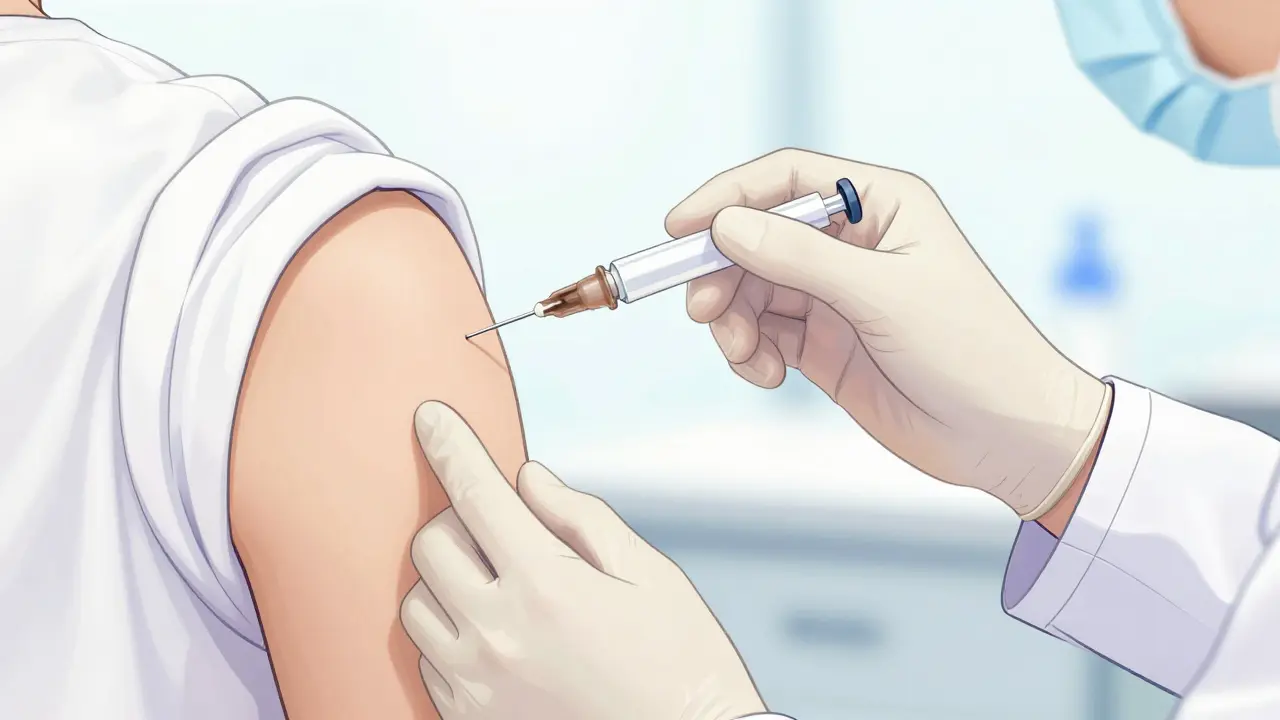
To get your shot without the subsequent purple arm, your healthcare provider needs to follow a few specific steps. If you notice your nurse is rushing, don't be afraid to speak up. The following protocol is based on guidelines from the CDC and the Anticoagulation Forum to minimize trauma to the tissue.
- Needle Gauge selection: Using a smaller needle, such as a 23-gauge or 25-gauge, reduces the size of the hole left in the skin and muscle. This naturally limits the amount of blood that can leak into the surrounding tissue.
- Precise Placement: The injection should be placed exactly in the thickest part of the deltoid muscle to ensure the vaccine is absorbed efficiently and the needle doesn't hit a larger vein.
- The "No-Rub" Rule: Once the needle is withdrawn, the most critical step is applying firm, direct pressure. You should not rub the area, as rubbing can actually damage the vessel further and encourage a larger bruise.
- Extended Pressure: While a standard patient might get a cotton ball and a quick bandage, you need a minimum of 2 to 5 minutes of steady pressure. For those with severe bleeding disorders or hemophilia, this can extend up to 10 minutes.
Applying these steps isn't just a suggestion-it's a game-changer. The Anticoagulation Forum reports that proper training and adherence to these protocols can reduce injection site complications by up to 78%.

What to Do if You Notice Excessive Bruising
Even with the best technique, a small bruise is normal. However, you need to know when a "normal" bruise becomes a medical concern. Keep an eye on the injection site for the first 48 hours. A small, flat, purple area is usually fine. But if you notice a lump that feels hard or is rapidly growing, you might be dealing with a hematoma.
Common red flags include:
- Pain that gets worse after three days instead of better.
- A visible lump that feels warm to the touch.
- Numbness or a "pins and needles" sensation radiating down your arm.
- Bleeding that doesn't stop even after 10 minutes of firm pressure.
If these happen, contact your doctor immediately. They may need to check your coagulation levels or provide a cold compress to manage the swelling. In most cases, these complications are mild, but early intervention prevents them from becoming serious.
Preparing for Your Appointment: A Checklist
Since some providers may not be specialists in anticoagulation, it is your responsibility to be your own advocate. Many people forget to mention their meds in the heat of the moment, which leads to a higher risk of bleeding. Here is a simple game plan for your next visit.
- Confirm your current dose: Know exactly when you took your last dose of blood thinners.
- Check your INR: If you are on Warfarin, ensure you have a recent lab result showing your levels are in a safe range.
- Request a smaller needle: Politely ask your provider if they have a 23 or 25-gauge needle available.
- Set a timer for pressure: Use your phone to ensure you actually hold pressure for the full 5 minutes, not just a few seconds.
- Dress for access: Wear a loose sleeve so the provider can easily access the shoulder without you having to struggle with clothing, which can shift your arm's position.
Should I stop taking my blood thinners before a vaccine?
No, you should never stop taking your anticoagulants without a direct order from your prescribing physician. The risk of a blood clot or stroke from skipping your dose is far more dangerous than the risk of a bruise at the injection site. Proper technique and extended pressure are the correct ways to manage the risk, not skipping medication.
Why does the needle size matter for bruising?
A larger needle creates a larger channel through the skin and muscle. For someone whose blood doesn't clot quickly, this larger opening allows more blood to escape into the surrounding tissue, which leads to a larger and more painful bruise. A 23-gauge or 25-gauge needle minimizes this trauma.
Can a vaccine change how my blood thinner works?
In very rare cases, some people taking Warfarin have experienced a rise in their INR after an influenza vaccine. While this isn't common with newer DOACs, it's a reason why those on Warfarin should have their levels monitored more closely for a couple of weeks following a shot.
Is it better to get a nasal spray vaccine instead of a shot?
If a nasal spray version of a vaccine is clinically appropriate for you (meaning you don't have contraindications like asthma or are too young/old for it), it completely removes the risk of injection site bleeding. However, the injectable version is often more widely available and effective for different age groups.
How long should I hold pressure on the injection site?
For most people on blood thinners, 2 to 5 minutes of firm, direct pressure is sufficient. If you have a more severe bleeding disorder, such as severe hemophilia, guidelines from the Bleeding & Clotting Disorders Institute suggest holding pressure for at least 10 minutes.